Bridge Rounds: When, Why, and How to Structure Them
A founder playbook on bridge round structure, instruments, dilution math, and the signaling tax. When to raise one, when not to, and how to close cleanly.


Founders who design the bridge into the next round preserve negotiating power. Reactive bridges signal distress to Series A diligence and reset valuation downstream.
Carta data shows 70 to 80 percent of pre-seed and seed bridges are insider-led. Below 50 percent anchor commitment is often the moment to reconsider the raise.
SAFE post-money for speed and milestone gaps. Convertible note for larger size and discipline. Priced extension when the existing lead has conviction
A $2M SAFE at a $15M cap, converting at a $20M Series A, dilutes founders roughly 5 to 6 percent from the bridge alone, plus more at the priced round.
In a 6-month bridge, founders who set a written go/no-go decision at month 4 land softly. Founders who wait until month 7 typically do not land at all.
A founder called me on a Tuesday in March. Eight months of runway left, a Series A target that wasn't ready, and an existing lead who'd said "let's talk in two weeks" three times in a row. The question on the call was simple:
Do I raise a bridge, or do I cut the team by 30 percent and push the round to Q4?
That's the decision moment this post is about, and most fundraising content skips the part where the founder actually has to choose. A bridge round is the most misread instrument on a cap table. Existing investors read it one way, new investors read it another, and the founder is the one paying the dilution either way.
The post you're reading covers three questions in order:
When a bridge actually makes sense
Why the smart ones get done
How to structure one without paying a signalling tax 18 months later
I've sat through enough negotiations at spectup to know that the spread between a good bridge and a bad bridge is measured in survival, not just dilution.
Here's the frame I want you to carry into the rest of this piece. A bridge round is a capital-structure decision, not a runway emergency.
Founders who treat it like an emergency raise on the wrong terms. Founders who treat it like a structure decision raise on terms that hold up when Series A diligence opens the data room.
I sat down with a deeptech founder who successfully deployed an €8.6M Series A to build a manufacturing facility and is now raising a €3M Series A+ to bridge the final gap to profitability.
What is a bridge round?
Most founders ask this question backwards. They want a definition; what they need is the read on what the instrument signals.
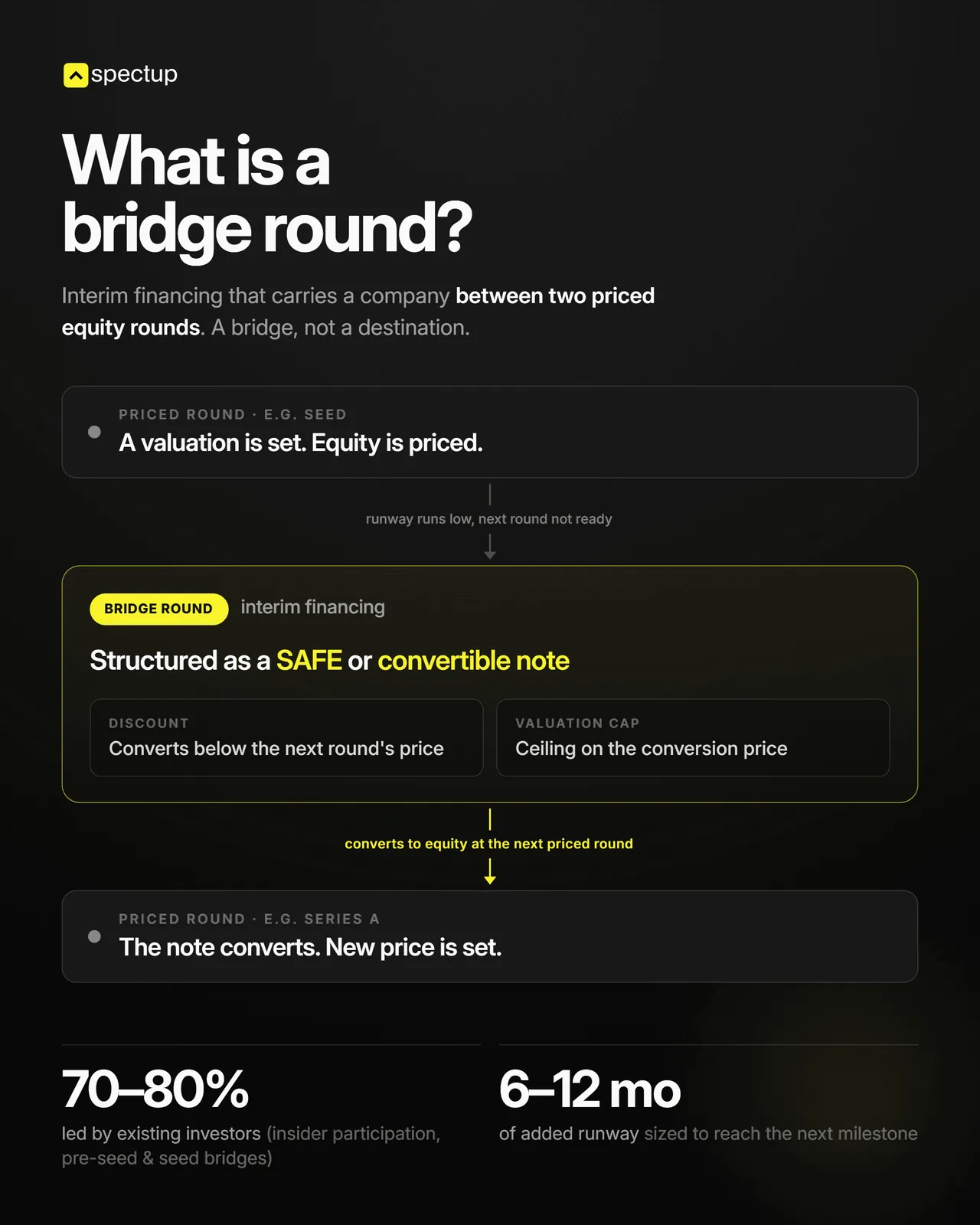
A bridge round is interim financing between two priced equity rounds, typically structured as a SAFE or convertible note that converts at the next priced round, usually at a discount and capped valuation.
Most are led by existing investors (Carta data puts insider participation at 70 to 80 percent of pre-seed and seed bridges) and are sized to extend runway 6 to 12 months.
The short answer: a bridge is the instrument founders use when they need capital before they can price a round at the valuation they want. That definition matters because of what it isn't. A bridge round isn't a smaller version of a priced round.
The pricing conversation gets deferred. The conversion mechanics replace the valuation negotiation. That's by design; the whole point of a bridge SAFE is that you don't anchor your next round to today's number.
The mention of bridge funding deserves a quick clarification. In venture circles, "bridge funding" and the bridge instrument are used interchangeably.
SVB's primer on bridge financing startup mechanics walks through the same instruments described here. In commercial finance, "bridge funding" usually means a real-estate or asset-backed loan from a non-VC lender.
This post is about the venture flavour. If you searched for bridge funding and ended up here, the rest of this piece is about the venture bridge mechanics, not commercial bridge loans.
Why do startups raise bridge rounds?
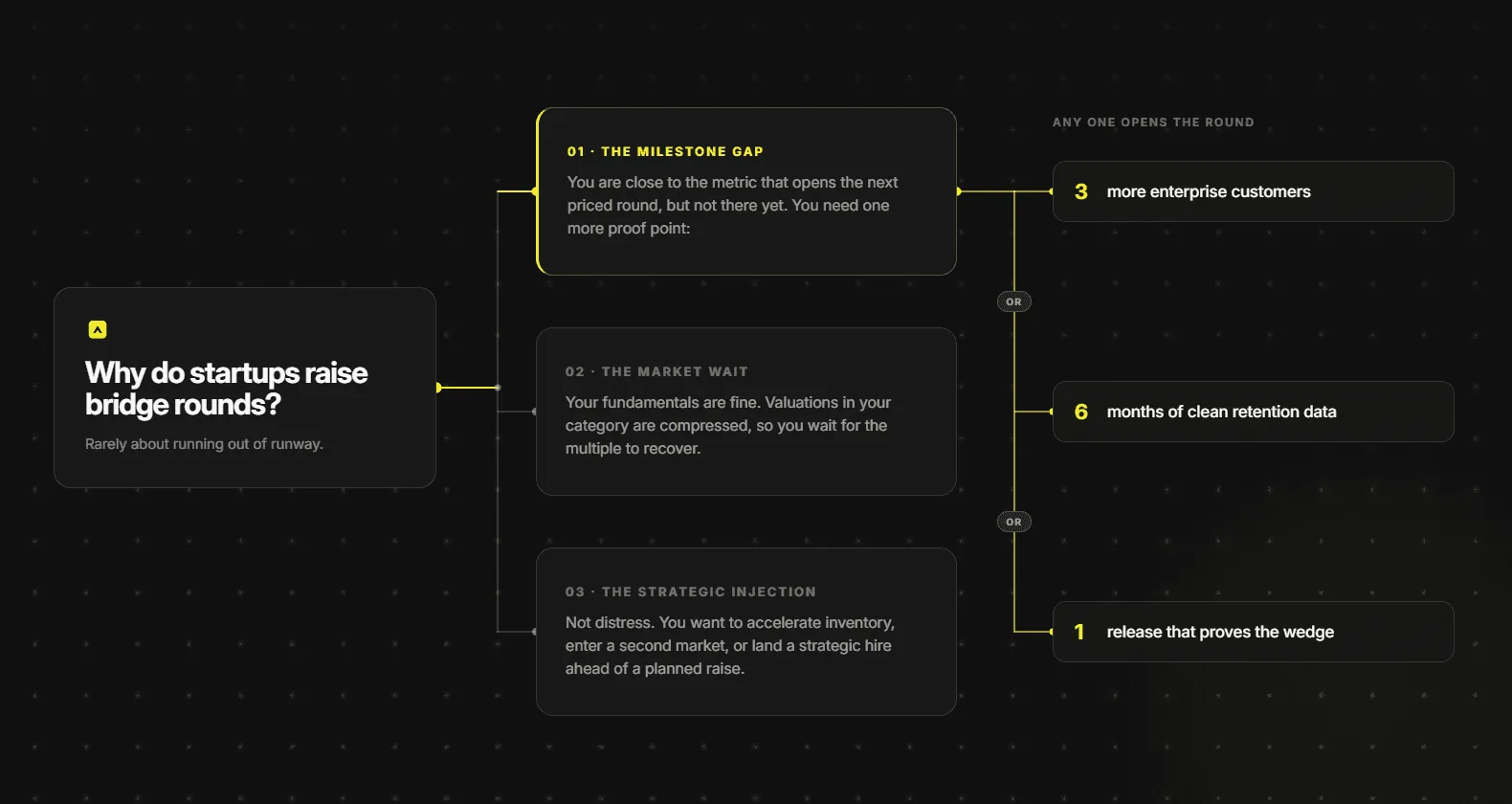
Founders cite 'extend runway' as the reason for a bridge. That's the symptom. In the raises I've worked on, almost every closed bridge round of funding falls into one of three categories.
The first is a milestone gap.
You are close to the metric that opens the next priced round but not there yet. You need:
Three more enterprise customers
Or six months of clean retention data
Or one product release that proves the wedge
A bridge here is a runway extension targeted at a specific number. The instrument is usually a SAFE post-money because the conversion math gets cleaner once you actually hit the milestone.
The second is a market wait.
Your fundamentals are fine, but valuations in your category are compressed. Pricing a round today would be a down round; pricing one in nine months, after the next vintage of comparables prints, wouldn't.
A bridge here is a deliberate delay. The instrument is often a convertible note with a higher cap so the next round prices higher than the bridge is anchored.
The third is a strategic injection.
You're not in distress. You want to accelerate inventory, expand into a second market, or stretch into a strategic hire ahead of a planned raise.
A bridge here looks more like a tactical move than a save. The instrument can be a priced extension at the same terms as your last round, which signals strength to downstream investors.
Last year I watched a Munich proptech founder close €300K of bridge capital from a single family office in seven days. The reason it closed that fast wasn't the deck. It was that the family office partner had known him for six months.
The bridge wasn't the start of a relationship. It was the conclusion of one. Speed in a bridge is a function of trust banked beforehand, not capital availability at the moment.
If your bridge is taking three months to close with anyone, the issue isn't market conditions. The issue is that you didn't build the relationships when you weren't asking for anything. We covered this dynamic at length in our piece on the warm intro playbook, which applies equally to bridge timing.
When should you not raise a bridge round?
This is the section nobody writes. Most guides cover when to raise a bridge round and stop there. The harder question is when to walk away.
The decision tree founders skip is what I call the 'Three-Condition Bridge Test'. A bridge round only makes sense if all three conditions hold, and the bridge round funding playbook below assumes the same gates:
Credible path. You have a credible 6 to 12 month path to a priced round at a higher valuation.
Insider anchor. Your existing investors are willing to anchor at least half of the bridge.
No forced down round. The bridge won't push your next round into down-round territory at conversion.
If any of those fails, you don't have a bridge. You have a delay. Delays are expensive in different ways than dilution.
The pattern I see most often: an existing investor declines to lead the bridge. The founder concludes the answer is to find new investors. The honest read is the opposite.
Insiders see your numbers every month. If they won't put more capital in at the current valuation, that's information.
New investors will run their own diligence and reach the same conclusion, and the bridge doesn't close. You burn 60 days you didn't have.
Most bridge rounds that close are good bridges. The bad ones get declined by existing investors and never make it to outsiders. That is the bridge process working, not failing.
If the bridge fails the three-condition test, the alternatives are honest:
Cut burn aggressively to extend runway 6 to 12 months without taking outside capital.
Run an early acquisition conversation with a strategic buyer.
Accept a structured down round now and use the down round to reset the cap table cleanly rather than papering over the problem with a bridge that converts ugly.
None of those three sound exciting. They're rarely as bad as a failed bridge.
Bridge round vs extension round: what is actually different?
Founders use these terms interchangeably. Investors don't. The difference shows up in your cap table mechanics and in how the next round's lead reads your history.
A bridge is unpriced. SAFE or note, it converts at the next priced round, typically at a discount and a cap.
An extension round is priced. It is added to a prior-priced round at the same terms.
If your Series A closed at a $40M post-money valuation, the extension closes at the same $40M post-money valuation with the same liquidation preference, the same anti-dilution, and the same board composition. Same paper.
Different instruments, different signalling, and different dilution timing. The extension at the same price reads as conviction from existing investors. The bridge at a 20% discount reads as a runway operation; both can be the right call, but they're not the same call.
Dimension | Bridge round (SAFE / note) | Extension round (priced) |
|---|---|---|
Pricing | Unpriced, cap + discount | Priced at last round's terms |
Speed to close | 1-4 weeks with insiders | 4-8 weeks (priced docs) |
Dilution timing | At next priced round conversion | Immediate |
Signal to Series A/B | Neutral to mild negative | Positive (insiders doubled) |
Best for | Milestone gap, market wait | Strategic injection, conviction signal |
At spectup I'm currently running a $10M bridge extension mandate for a growth-stage content technology client. The label "extension" matters there. The company is raising funds at the same terms as its prior round.
The market reads that as strength. The dilution math is clean. The diligence is short because there's nothing new to underwrite.
If your existing investors will price an extension at the same terms, take it. The bridge is the consolation prize when they won't. For a related lens on instrument choice, our walkthrough on the convertible note covers the legal mechanics in more detail.
How to structure a bridge round: the instrument decision?
So, you have got three viable instruments.
The choice depends on speed, tax treatment, existing investor preference, and how much you want to delay the valuation conversation.
The bridge round SAFE note is the dominant instrument for US-style bridges in 2024 to 2026, and most founders default to it without weighing the alternatives.
SAFE post-money is the fastest to close. No interest accrual, no maturity date, no creditor relationship.
The post-money cap math compounds dilution at conversion. Y Combinator's post-money SAFE template has become the default for US-style bridges in 2024 and 2025. Best if you need speed and your existing investors are comfortable with SAFE mechanics.
A convertible note carries:
Interest, typically 5 to 8 percent
Plus a maturity date of 12 to 24 months
Interest accrues and converts to equity alongside principal at the next priced round. Cooley's convertible note primer covers the legal mechanics in more detail than most founders need on a first read.
Best when your existing investors are debt-shop trained (often family offices or European angels) or when the bridge is sized large enough that the discipline of a maturity date helps the founder concentrate on closing the priced round.
A priced extension has no conversion mechanics. The same terms as the prior priced round. Requires the existing lead investor to anchor the price.
Best when the existing lead has conviction and the company doesn't want to introduce SAFE complexity into the cap table.
Instrument | Interest | Maturity | Conversion | Speed | Best scenario |
|---|---|---|---|---|---|
SAFE post-money | None | None | Cap + discount at next priced | 1-3 weeks | Milestone gap, fast close |
Convertible note | 5-8% | 12-24 months | Cap + discount + accrued interest | 2-4 weeks | Market wait, larger size |
Priced extension | n/a | n/a | Immediate (priced) | 4-8 weeks | Insider conviction, no SAFE noise |
Founders default to SAFE because it's familiar. That's not the same as it being right.
If your existing investors prefer notes, take notes.
If they offer an extension, take an extension.
The instrument should serve the cap table you want at the next round, not the speed of this one.
The dilution math: what a $2M bridge actually costs you?
This is the section every other article skips. The math is the math, so let's walk through it.
Pre-bridge cap table:
Founders 65 percent
Prior investors 22 percent
ESOP 13 percent
You raise a $2M SAFE post-money at a $15M cap, 20 percent discount. Six months later you close a $5M Series A at a $20M pre-money valuation.
At conversion, your SAFE holders look at two prices: the $15M cap and the $20M pre-money less the 20 percent discount, which works out to a $16M effective price. The SAFE converts at the lower of the two, so the $15M cap. The SAFE holders get shares as if they invested at $15M post-money, not $20M.
Net result:
Fom the SAFE alone, founders dilute roughly 5 to 6 percent
From the full sequence (SAFE plus Series A plus an ESOP refresh), founders end up around 22 percent diluted across the bridge and the priced round.
That 5 to 6 percent is the working number for bridge round dilution at a $2M raise, and it scales roughly linearly with bridge size as long as the cap holds.
Scenario | Founder ownership before | Founder ownership after | Total dilution |
|---|---|---|---|
With $2M bridge + $5M Series A at $20M pre | 65% | ~50.5% | ~22% |
No bridge, ran out of cash, distressed Series A at $12M pre | 65% | ~43% | ~34% |
The counterfactual matters. Without the bridge, you'd be raising the Series A from a position with no negotiating room. Investors price that.
The dilution from the bridge is usually less than the dilution from running out of cash and pricing the next round under duress. Numbers, not vibes.
Run this math on your own cap table before you sign the SAFE term sheet. The SAFE conversion calculator we built at spectup is the fastest way to model it for your specific situation. For founders earlier in the structure conversation, our overview of cap table management covers the bookkeeping side of how these instruments land on the table.
How do Series A investors read a bridge round?
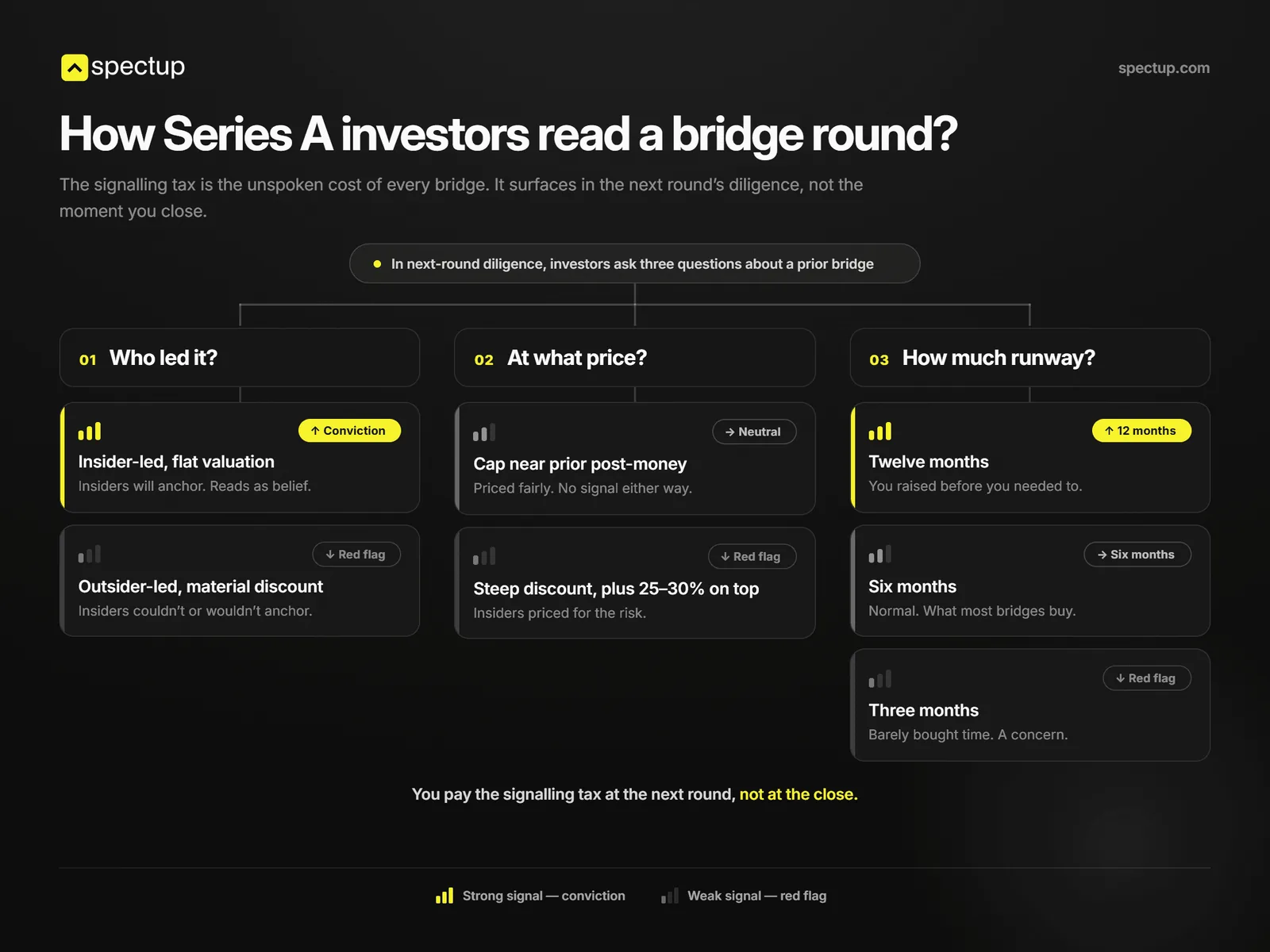
The unspoken cost of every bridge, the signalling tax, shows up in Series A or Series B diligence, not at the moment you close. In every diligence I've sat in on at the next round, investors ask three questions about prior bridges.
Who led it?
Insider-led at flat valuation reads as conviction
'Outsider-led at material discount' reads as the insiders couldn't or wouldn't anchor.
At what price?
A cap close to the prior round's post-money is neutral
A cap at a steep discount, especially with an additional 25 to 30 percent discount on top, signals the insiders priced for the risk.
How long did it extend the runway?
Six months is normal
Three months is a red flag
Twelve months says you raised before you needed to.
Patrick Collison's Stripe raised a series of insider extension rounds during 2023 at a roughly halved valuation versus the 2021 peak. The market read that as a structural valuation reset, not a distress signal, because the insiders led at consistent terms and the company had the metrics to justify the reset.
That's the opposite of the signalling profile of a founder who runs an outsider-led bridge with a 30 percent discount because no insider would step up. The instrument is the same; the read is opposite.
If you structure your bridge with the next round's diligence in mind, you preserve negotiating power. If you just close cash, you pay later. The bridge document gets read by the next investor before the founder is even in the room.
Last fall a SaaS founder I work with needed £1M to bridge the six months between his current runway and a Series A target. The plan we built: ten carefully selected investors via warm intros, a simple email agreement, no minimum cheque, all priced as a SAFE at his last round's cap.
The Series A lead later told him the cleanest part of his diligence was the bridge documentation. That's the signalling tax avoided.
Founders assume the bridge is a private transaction. In reality, it's the most scrutinised item in the next round's data room, and you should treat it accordingly.
Bessemer's atlas writing on insider rounds is one of the more useful practitioner reads on this dynamic.
What changed in 2024-2026: the bridge-round surge
The market data is the story. According to Carta's state of private markets data, the seed bridge round as a share of seed-stage activity grew from roughly 22 percent in 2021 to roughly 38 percent in 2024.
Early reads on 2025 suggest the share has held above 35 percent. The PitchBook-NVCA Q4 2024 venture monitor confirms bridge and extension rounds at multi-year highs as a share of total deal count, and Crunchbase News tracking on 2024 bridge and down rounds shows the same pattern from a different data vantage point.
AngelList's primer on down rounds publishes the underlying deal-count data each quarter for founders who want the source numbers.
The why is simple. 2021 valuations were inflated, and 2022 through 2024 valuations reset.
Founders raising in 2024 to 2026 face a choice between accepting a down round or bridging to better metrics. Most chose the bridge.
Metric | 2021 | 2024 | Early 2026 read |
|---|---|---|---|
Insider-led seed bridges (share of seed rounds) | ~22% | ~38% | ~35-37% |
Median bridge size at seed | ~$1.0M | ~$1.5M | ~$1.5-1.8M |
Median discount on convertibles | 15% | 20% | 20% |
The implication for founders raising right now: a seed bridge round isn't a desperation signal anymore. It's a structural feature of the post-2021 fundraising cycle. Whether you're clearing a milestone gap at a seed bridge round or delaying a Series A into a better market, the bridge financing startup mechanics look the same, and the bridge round funding pattern in the data is consistent across stages. The same bridge financing startup playbook applies whether the company is pre-revenue or growth-stage.
TechCrunch's venture coverage through 2024 and 2025 documented named portfolio bridges from Series A and Series B companies that were considered healthy. Investors expect to see bridges in DD.
What matters is how the bridge was structured, not whether it happened. AngelList's overview of convertible notes has published several operator-written posts on how to run a bridge conversation with an existing lead, which lines up with the patterns I see.
If you were raised in 2020 or 2021 and you're sitting on cash burn at a valuation that was set 18 months too generously, you're not alone. The bridge is the cycle, not a personal failure. For broader context on the funding stages, our overview of startup funding stages situates bridges inside the longer fundraising arc.
Negotiating bridge round terms: founder priorities
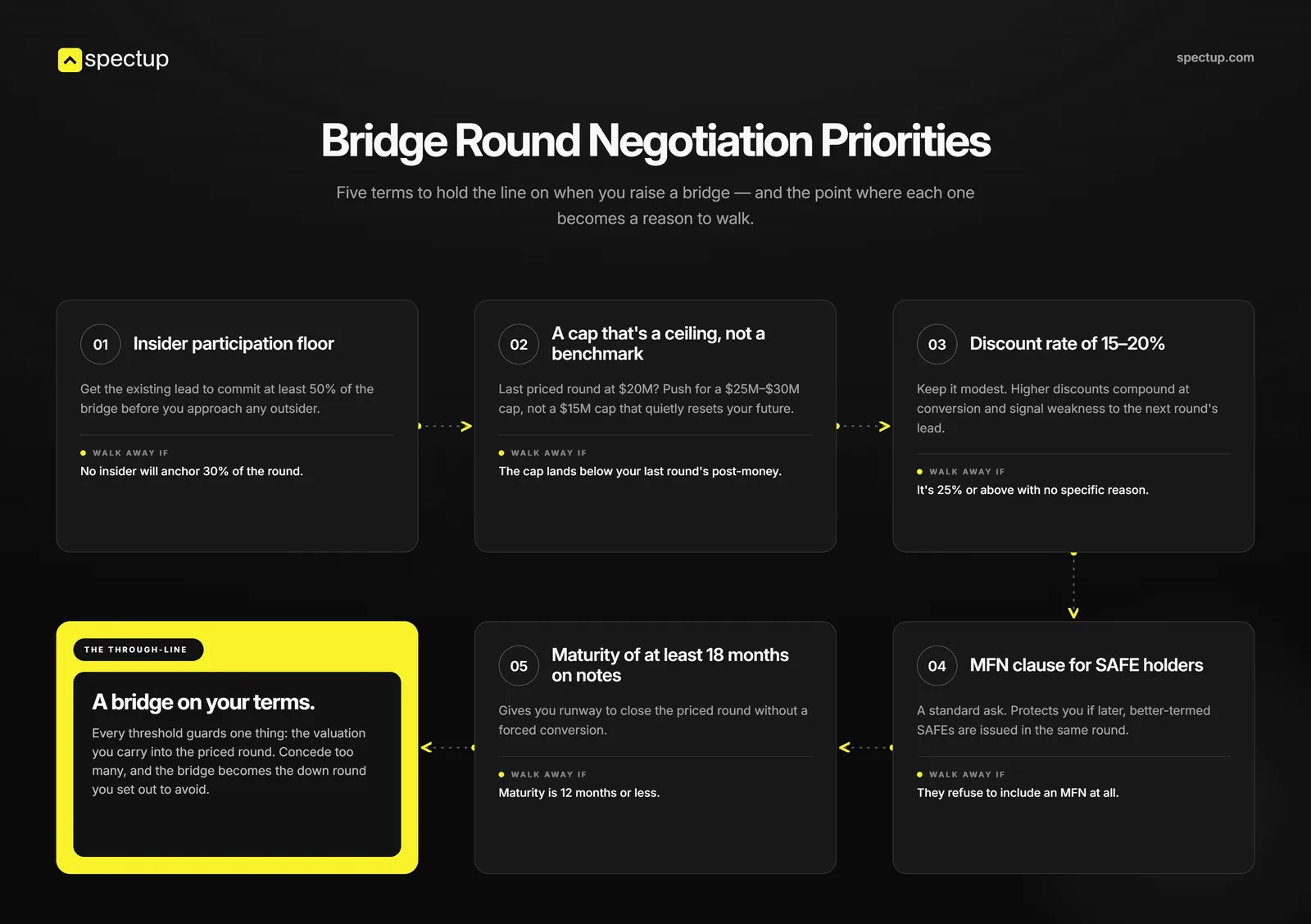
Five priorities, in order. The order matters more than the items. Y Combinator's startup library covers the operational side of insider and outsider bridge outreach in more depth.
Insider participation floor.
Get the existing lead to commit at least 50 percent of the bridge before approaching outsiders. Walk-away threshold:
If no insider will anchor 30 percent, the bridge probably shouldn't happen.
Cap that doesn't anchor the next round.
The bridge round valuation cap is the single most consequential term you negotiate, because the cap quietly becomes the ceiling on your next round's price.
Negotiate a cap that is a ceiling, not a benchmark.
If your last priced round was $20M, push for a $25M to $30M cap, not a $15M cap that quietly resets your future.
Walk-away threshold: cap below your last round's post-money.
Discount rate of 15 to 20 percent.
Higher discounts compound at conversion and signal weakness to the next round's lead.
Walk-away threshold: 25 percent or above without a specific reason.
MFN clause for SAFE holders.
Protects against later, better-termed SAFEs being issued in the same round. Standard ask.
Walk-away threshold: refusal to include MFN at all.
Maturity of at least 18 months on notes.
Gives you runway to close the priced round without a forced conversion.
Walk-away threshold: 12 months or less.
The mistake founders make on bridges is treating term negotiation as adversarial with existing investors. It isn't.
Your existing investors want a clean next round as badly as you do. The operator-written essays in AngelList's practitioner guide on bridge rounds consistently land on the same point: term alignment between bridge and priced rounds is a collaboration, not a tug of war.
Their pro-rata, their reserves, and their fund-level returns depend on the next round's pricing well. They want the bridge structured to support a strong-priced round next.
Bring them the term sheet you would want them to sign. Most of the time they will sign it.
If your relationship with the existing lead is strained, see our founder-VC relationships piece for the repair playbook before opening the bridge conversation.
When the bridge becomes a down round: the inflection point
Sometimes the bridge buys six months, and the metrics don't improve. The priced round can only close below the prior valuation.
The SAFE or note converts at terms that disadvantage early investors, founders, and ESOP holders. Honest decision time.
Three options sit in front of you at this moment:
Accept the down round. Reset the cap table, take the dilution hit, and move on. Often the right answer if the team and the market are still right.
Raise a second bridge. Rare and usually a death-spiral marker. The information's coverage of 2024 down-round cases documents how second bridges typically extend the agony rather than end it.
Explore acquisition. A strategic conversation initiated at month 4 of a 6-month bridge often lands softly. The same conversation at month 7 doesn't.
In the bridges I've watched, the founders who decided at month 4 of a 6-month bridge landed somewhere. Series A at lower terms, acquisition, or controlled wind-down. The founders who decided at month 7 didn't land at all. The inflection point is around month 4, not month 6.
Set a check-in with your board at month 3
Have a written go/no-go decision at month 4
The decision isn't "Are we close to closing?" The decision is "If we don't close in the next 60 days, what do we do?" Founders who've answered that question before they need to answer it land softly.
My honest read after working this market
Bridges in 2026 aren't what they were in 2019. They're not a desperation move, and they're not a failure signal. They're the dominant capital structure for companies whose 2021 valuations didn't survive 2024.
Even so, most of the bridges I see fail one of two tests. The founder runs the bridge as a one-step problem instead of a two-step problem, closing the cash without designing the next round into the bridge structure. Or the founder runs the bridge with the wrong insider mix: outsider-led, no anchor from the existing lead, and terms that telegraph distress.
Every bridge you sign gets re-underwritten by the next round's lead before they sign their own term sheet. If your bridge doesn't pass that re-underwriting, the next round doesn't happen on the terms you wanted.
I disagree with the popular advice that says, "Raise a bridge as fast as possible; fix the structure later." Fast bridges with bad structure are how founders end up with a 30 percent dilution problem at conversion and a Series A lead who passes because the cap table is messy.
The right pace for a bridge is the pace that lets you structure it for the next round, not the pace that lets you close cash this month.
The harder, less popular position: if your existing investors won't anchor, the bridge probably shouldn't happen. The fastest founders I've worked with weren't fast at raising bridges. They were fast at deciding when not to.
Where I would actually focus right now?
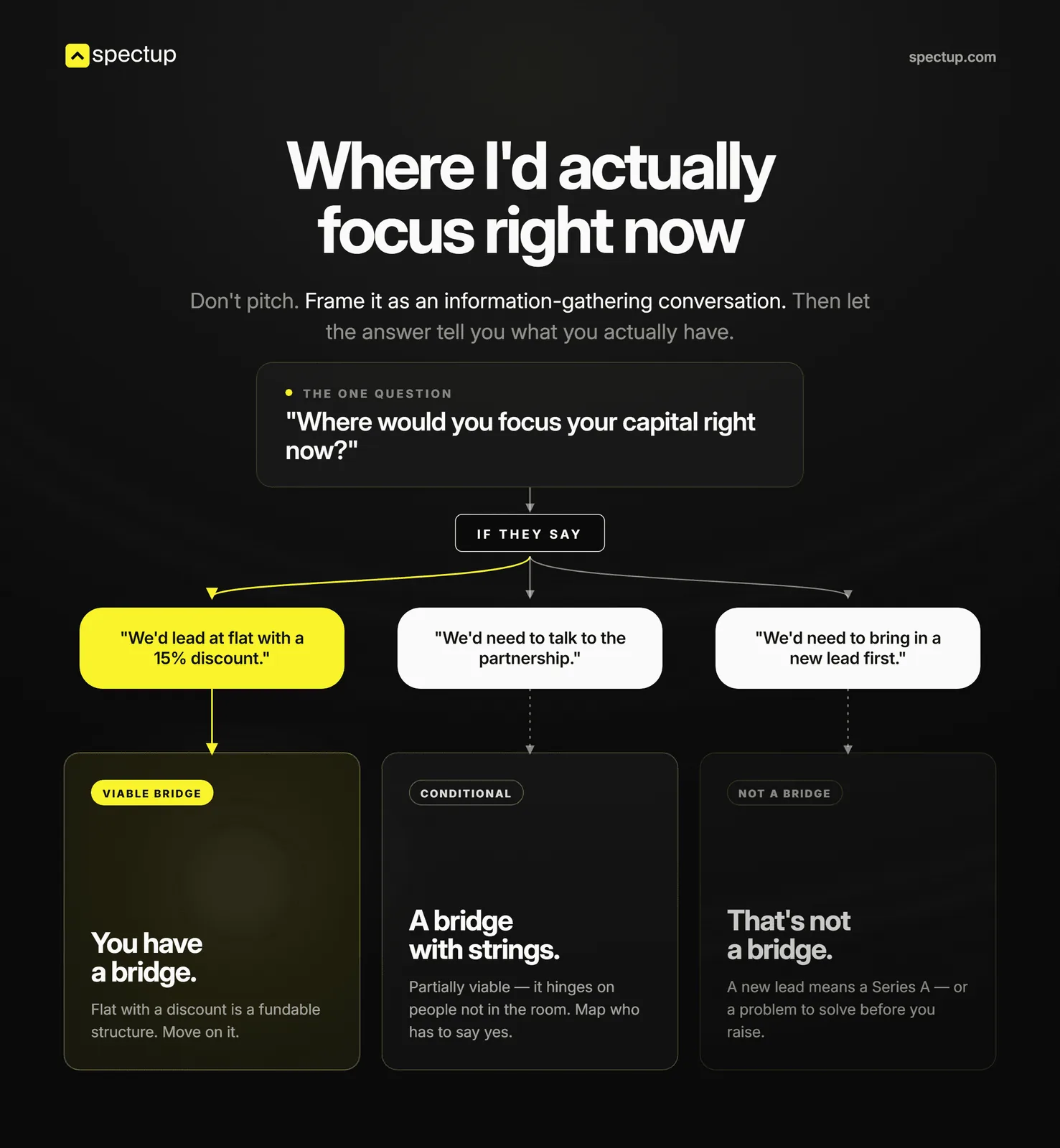
If you're reading this in 2026 and a bridge is on your near-term horizon, here's the one move I'd make this week. Sit down with your existing lead investor and ask them directly: "If I needed to bridge six months, what terms would you anchor?"
Don't frame it as a fundraising ask. Frame it as an information-gathering conversation. The answer tells you everything.
If they say, "We'd lead at flat with a 15 percent discount," you have a viable bridge.
If they say, "We'd need to talk to the partnership," you have a partially viable bridge with conditions.
If they say, "We'd need to bring in a new lead first," you don't have a bridge; you have a Series A or a problem.
The founders who land softly in this cycle are the ones who get that conversation on the calendar before they need the capital. The founders who pay the signalling tax are the ones who wait until the bridge is the only option.
Have the conversation now. Decide later.
The cost of having the conversation is zero.
The cost of not having it? Your next round.
How spectup helps founders structure bridges that hold up downstream
Across the bridges I've run at spectup, the bridges that converted cleanly into the next priced round shared one common feature. They were structured with the next round's lead investor mentally in the room during the bridge negotiation. The founders who closed bridges in two weeks and then closed a clean Series Six months later treated the bridge as the first step of the priced round, not as a separate transaction.
One engagement, not two. That's how the fundraising consultant work lands for us: building the bridge instrument, the cap table model, and the next-round signalling story together.
The financial side of that, the dilution math, the cap structure stress test, and the conversion modelling sit inside the same engagement rather than getting handed off to a separate financial modeling consultant after the bridge closes.
If you're six months from a priced round and considering a bridge to extend runway, book a call. The hour we spend modelling the conversion maths and stress-testing the cap table is the hour that decides whether your next round closes cleanly or gets restructured at the eleventh hour.
Three conclusions
Founders who plan the bridge into the equity sequence preserve optionality. Reactive bridges signal desperation to downstream investors and reset valuation at the priced round.
A $1M priced extension and a $1M SAFE post-money have radically different signaling, dilution, and conversion mechanics. Choose the instrument, not just the cash.
A bridge led by existing investors at flat valuation reads as conviction, while a bridge with no insiders reads as a flag. Anchor your insiders first.
Questions readers ask
6 questions on Fundraising Process & Strategy.
01What is a bridge round?
A bridge round is interim financing between two priced equity rounds, typically structured as a SAFE post-money or convertible note that converts at the next priced round. It usually converts at a discount and capped valuation. Most are led by existing investors and used to extend runway 6 to 12 months.
02What is bridge funding for startups?
Bridge funding (sometimes called a bridge round) is short-term capital that bridges the gap between two priced rounds. For startups it usually means a SAFE or convertible note from existing investors that converts when the next priced round closes. It is not the same as commercial real-estate bridge funding from non-VC lenders.
03How much dilution does a bridge round cause?
Typical bridge dilution is 4 to 8 percent of the cap table per $1 to $2M raised, depending on cap and discount. A $2M SAFE at a $15M post-money cap, converting at a $20M priced round, dilutes founders roughly 5 to 6 percent. The exact number depends on the cap relative to next round price, discount rate, and existing ESOP refresh.
04Bridge round vs extension round, what is the difference?
A bridge round is unpriced, usually a SAFE or convertible note that converts at the next priced round. An extension round is priced and added to an existing priced round at the same terms (for example, a Series A extension at the same post-money). Different instruments, different signaling, different dilution timing.
05Are bridge rounds a bad sign for investors?
Not automatically. Insider-led bridges at flat valuation read as conviction, while outsider-led bridges at steep discount read as weakness. Series A and B investors look at three things in diligence: who led the bridge, at what price, and how long the runway extension was, so a clean insider-led bridge is closer to neutral while an outsider bridge with a 30 percent discount is a flag.
06When should a startup raise a bridge round?
When three conditions hold: existing investors are willing to anchor at least 50 percent of the bridge, there is a credible 6 to 12 month path to a priced round at a higher valuation, and alternatives (cutting burn, accelerating revenue, exploring acquisition) have been ruled out. If existing investors will not anchor, treat that as the signal that the bridge probably should not happen.