


Table of Content
Summary
Series B is sold to a different buyer
Series A investors bought your growth narrative. Series B investors buy the system, retention quality, and unit economics.
[01]
NRR >100% is minimum table stakes
Below 100%, most conversations end before diligence. 120%+ is a strong signal that creates investor optionality.
[02]
Burn multiple compression is real
2021's 3-4x tolerance is gone. Series B investors enforce a strict 2x burn multiple ceiling in 2026.
[03]
AI and non-AI startups live in different universes
AI median Series B is $143M. Non-AI Series B is substantially lower. Capital concentration is structural.
[04]
Plan 6-9 months of capital raising campaign
Most founders underestimate the timeline. Institutional-grade materials must exist before first investor call.
[05]
At spectup, we work with growth-stage companies preparing for Series B and beyond. What we see consistently: Series B in 2026 is fundamentally different from how most founders approach it.
The average series b round size in the US right now: $50M baseline. What is a series b funding round in Europe worth? €20M if you're lucky.

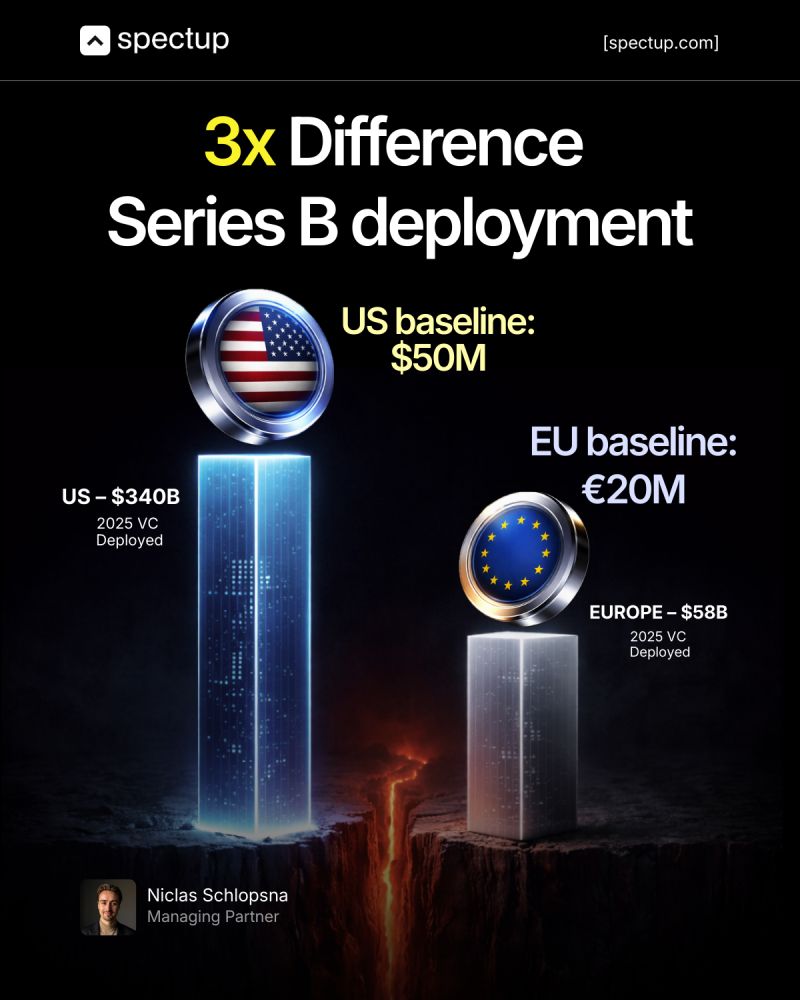
Series B in 2026 is fundamentally different
That's not a gap. That's a canyon.
Only about half of Series A companies actually advance to Series B (Crunchbase venture progression analysis). Roughly half don't make it. Not because the founders weren't capable. Not because the market turned. But because they walked into Series B using the wrong playbook.
Series B in 2026 is structurally different from the Series B of 2023. The investor environment shifted. LP pressure changed. Exit expectations moved. The metrics that got you Series A funding will actively hurt you at Series B.
But most founders still pitch Series B like it's the bigger version of Series A. It's not.
Key Terms You Should Know
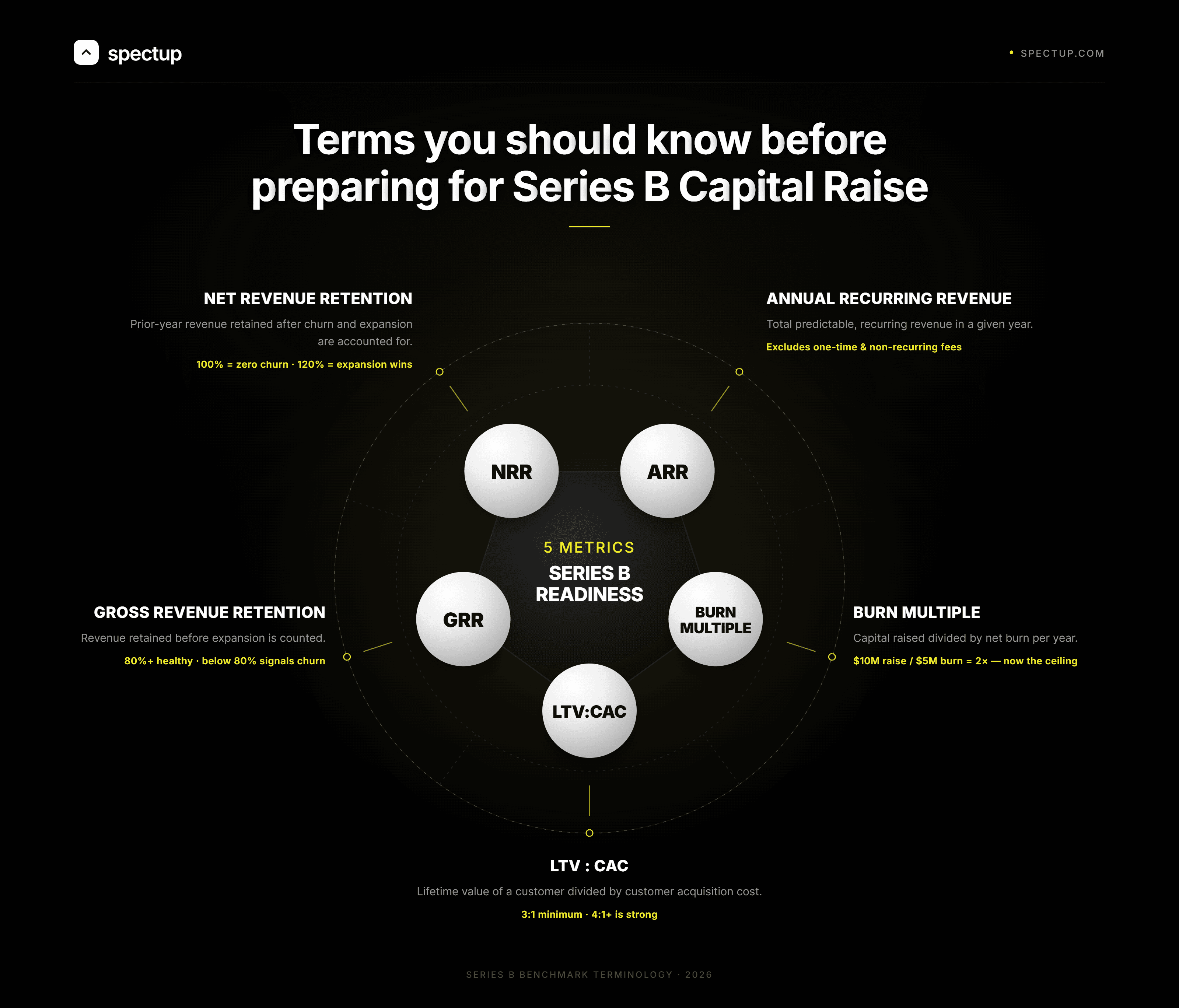
If you're asking what is a series b startup or trying to understand the series b startup meaning in practical terms, it comes down to specific metrics. Here's what matters:
NRR (Net Revenue Retention). The percentage of prior-year revenue retained after accounting for churn and expansion. 100% means zero churn; 120% means expansion revenue exceeds churn losses.
ARR (Annual Recurring Revenue). Total predictable, recurring revenue in a given year. Excludes one-time fees and non-recurring contracts.
Burn Multiple. Capital raised divided by net burn per year. A $10M raise with $5M annual burn = 2x multiple. 2x is now the ceiling.
LTV:CAC. Lifetime value of a customer divided by customer acquisition cost. 3:1 is minimum; 4:1+ is strong.
GRR (Gross Revenue Retention). Revenue retained before expansion. 80%+ is healthy; below 80% signals serious churn.
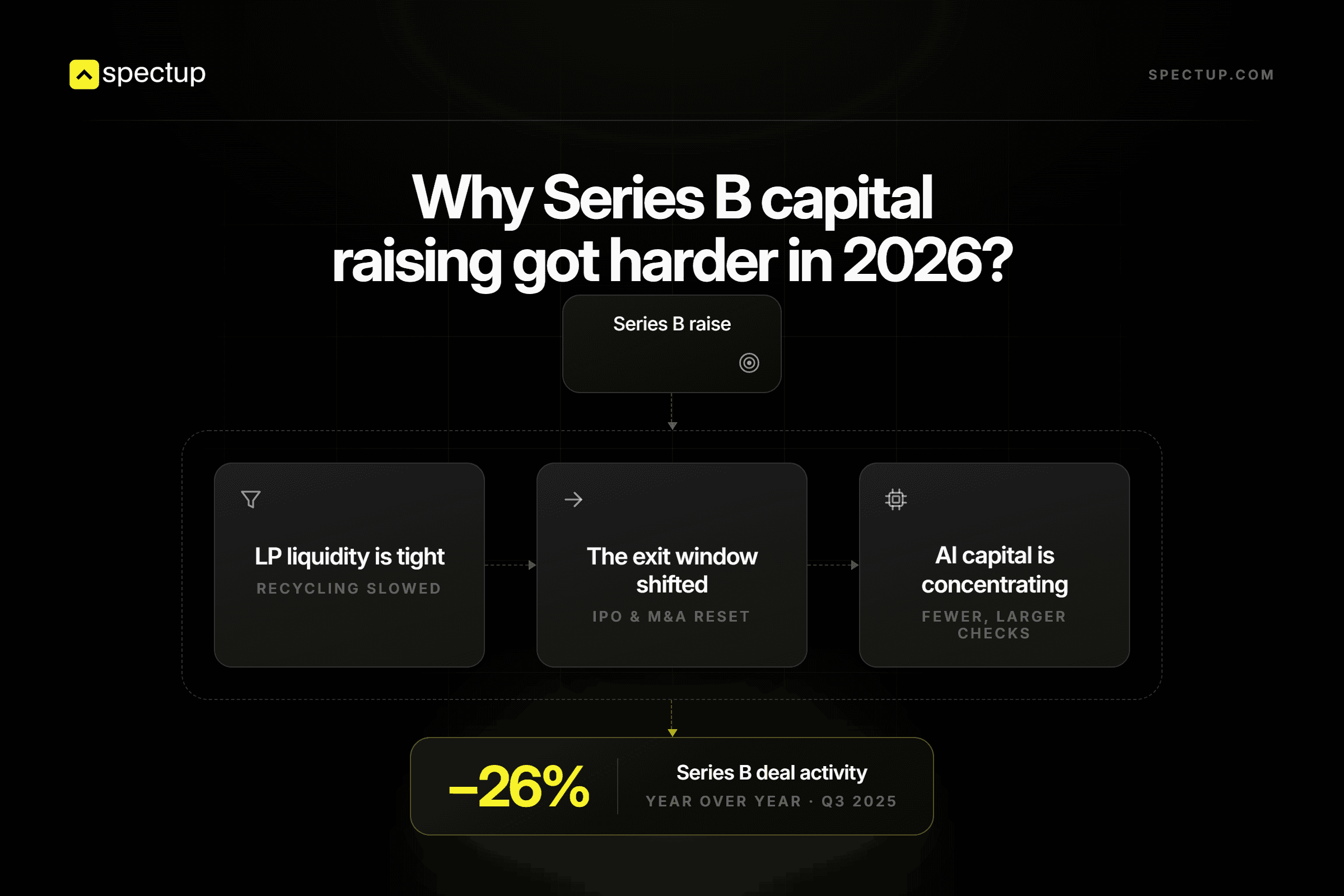
Why Series B fundraising got harder in 2026?
Every day, I sit with about five or six startup founders. One trend I've noticed: the ones closing Series B rounds in 2026 are using an entirely different strategy than what ranked on Google in 2023.
LP liquidity is tight. Limited partners who committed capital in 2018-2021 are facing DPI (distributions to paid-in capital) pressure. They need exits, not new deployments. This makes fund managers conservative. A Series B round in 2026 doesn't just need good metrics. It needs a believable path to exit within 5-7 years.
The exit environment shifted dramatically. IPO exit value nearly doubled between 2024-2025 (per McKinsey's Global Private Markets Report), but almost all of that growth came from mega-IPOs above $2.5B. The ARR bar to go public keeps climbing. Translation: the IPO bar keeps rising. A Series B company today isn't automatically three rounds away from exit anymore. It's potentially five or six.
AI capital is concentrating. Over half of all venture capital now flows to AI startups, with AI capturing 52.7% of global VC deal value in 2025. That's permanent structural change. Non-AI founders are competing for capital from a fundamentally different investor pool than they were 18 months ago.
Series b fundraising deal activity dropped 26% year-over-year in Q3 2025. But the average series b round size actually grew 32% during the same period (per Pitchbook's Q3 2025 VC report). Translation: fewer deals, but bigger checks for the winners. The game became binary.
This binary outcome means understanding what the winners actually do differently. It starts with understanding investor evaluation criteria.
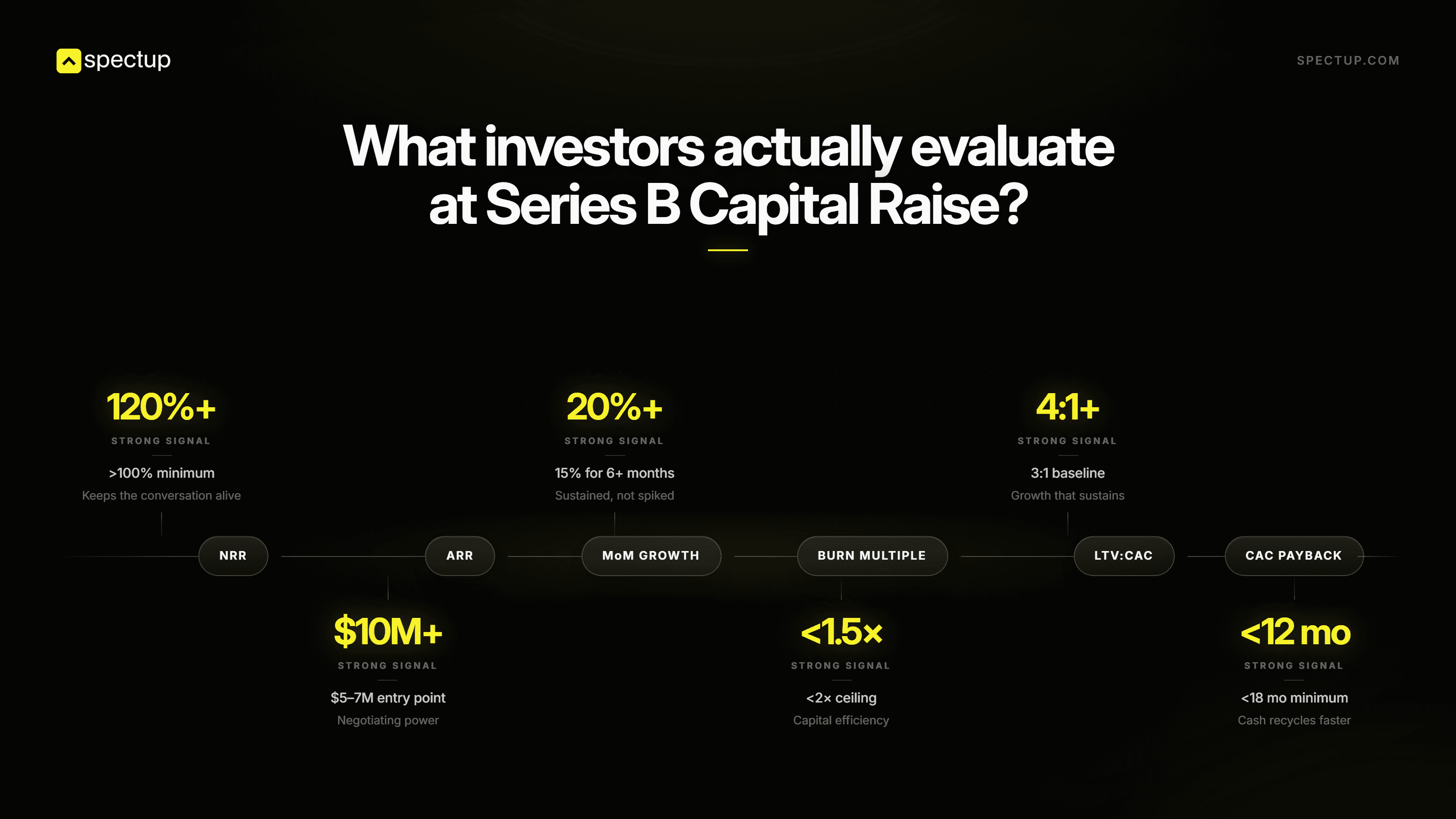
What investors actually evaluate at Series B Capital Raise?
Series B investors are not Series A investors with bigger check sizes. They're a different buyer type evaluating different signals.
Understanding the key investor metrics for your stage is non-negotiable. Series A investors bought your growth narrative. Series B investors buy your business model durability.
This distinction changes everything.
Metric | Minimum Threshold | Strong Signal |
|---|---|---|
NRR | >100% (conversation stays alive) | 120%+ (investor optionality) |
ARR | $5-7M (entry point) | $10M+ (negotiating power) |
Month-over-Month Growth | 15% sustained (6+ months) | 20%+ (investor confidence) |
Burn Multiple | Below 2x (acceptable) | Below 1.5x (exceptional) |
LTV:CAC | 3:1 (minimum coverage) | 4:1+ (sustainable growth) |
CAC Payback | Below 18 months | Below 12 months |
Here's the hidden deal-killer: Founders assume ARR growth alone closes rounds. In reality, net retention quality gets stress-tested before the first meeting concludes.
I've seen this pattern dozens of times. A founder presents $7M ARR with 18% month-over-month growth. These metrics look impressive on a slide. Then the investor builds a cohort waterfall. Turns out gross revenue retention is 76%, churn is concentrated in year-two customers, and expansion revenue isn't covering losses. NRR is 89%.
Three investor conversations later, you're explaining why your retention model breaks. By then, momentum is dead.
Here's the reality most founders miss: a significant share of founders presenting above 115% NRR actually have gross revenue retention below 80%. I've seen this in our own deal flow repeatedly, and Cambridge Associates' venture benchmarks confirm the pattern across fund portfolios. This sounds impossible until you understand cohort dynamics. A founder can have strong NRR through expansion, while early cohorts are rotting out. Investors see this immediately. They've built models on dozens of Series A to Series B transitions.
They know what you don't yet.
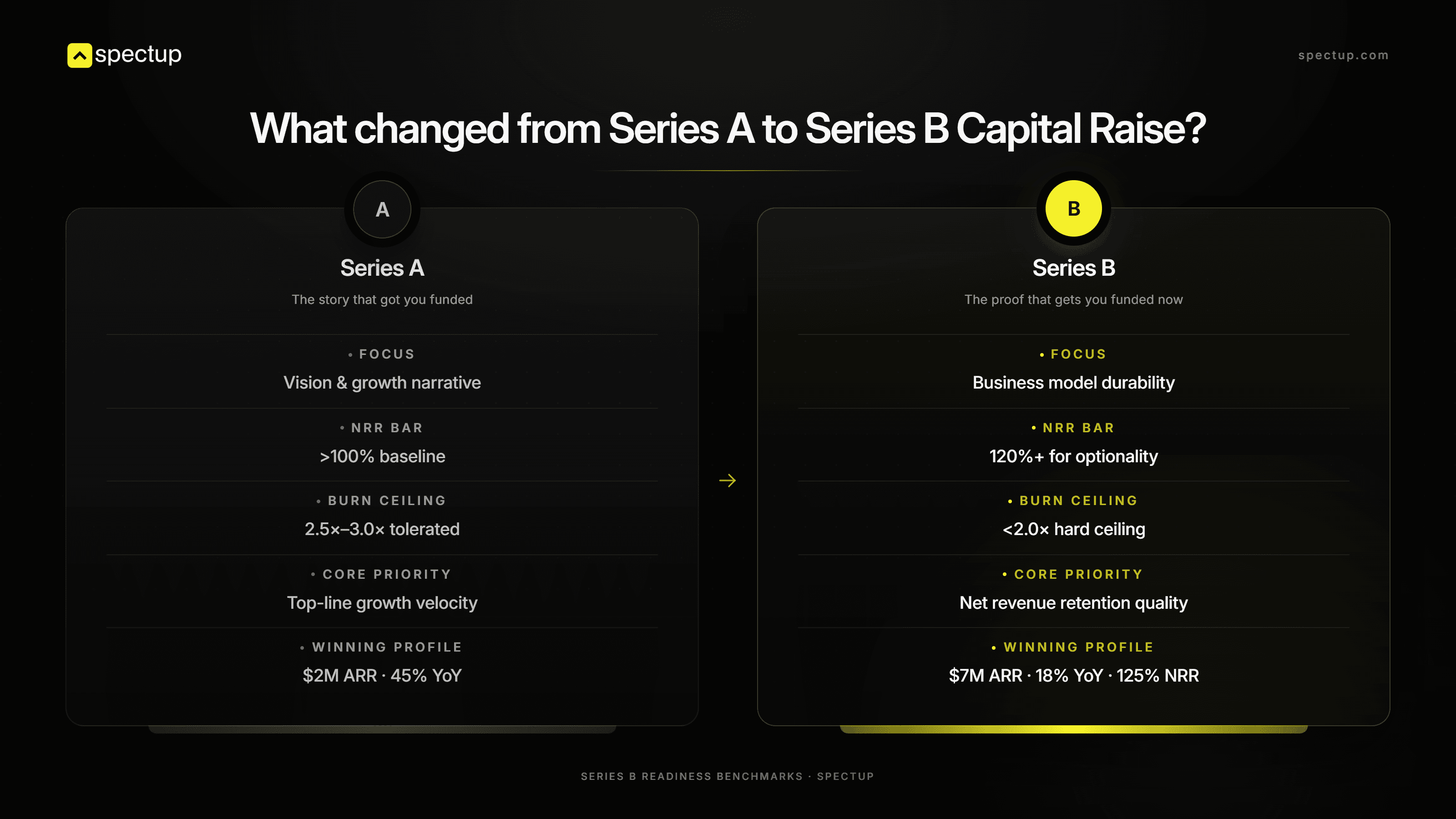
What changed from Series A to Series B?
The series a vs series b startup comparison reveals completely different evaluation frameworks. The shift isn't gradual. It's abrupt. Understanding the traction metrics that got you Series A is step one. Understanding what Series B investors actually want is step two.
Founders assume NRR of >100% is the same at Series B. In reality, institutional investors at Series B now treat 120%+ as the minimum for optionality. Below 120%, investors question whether your expansion motion is durable or artifactual (concentrated in one or two large accounts).
Founders assume burn multiple of 2.5-3x is acceptable. In reality, the 2.5-3x tolerance from 2021 is gone. Series B investors now enforce a hard 2x ceiling. Why? LP pressure. A 3x multiple assumes capital availability that doesn't exist in 2026.
Here's the one that trips up the most founders: growth rate stopped being the deciding factor after Series A. A series b startup with 40% YoY growth and 95% NRR will lose conversations to a company growing 25% with 130% NRR. Every time.
This is counterintuitive. Most founders chase growth. Series B investors chase durability.
A founder with $2M ARR and 45% YoY growth can close Series A. A founder with $7M ARR, 18% YoY growth, and 125% NRR closes Series B. The second founder looks slower. The second founder actually represents the better business.
Series B benchmarks for AI vs non-AI startups
Capital is not equal. AI startups and non-AI startups are raising in completely different markets.
AI Series B median valuation: $143M (Crunchbase Series B data). Non-AI Series B: substantially lower. In SaaS, median is $30-40M. In hardware, $20-30M. In climate tech, $25-35M.
This isn't investor bias. It's capital reallocation. Every mega-fund opened an AI team. Every traditional VC is allocating more to AI. The capital that used to be spread across 100 companies in different sectors is now concentrated on 12 companies building AI infrastructure or AI-native applications.
If you're raising Series B in 2026 outside AI, understand this: you're competing for capital from a different investor pool, with different expectations.
Your competition isn't every Series B company. Your competition is every Series B company in your sector with comparable traction. And there are fewer checks available.
Founders assume all Series B capital is homogeneous. In reality, AI and non-AI Series B have become structurally separated markets.
How European founders can raise Series B from US investors
I've worked with European founders raising from US capital. The successful ones all did one thing first: they built traction in the US market.
Not traction in theory. Not pilot relationships. US revenue.
US traction is a prerequisite, not optional. US investors evaluate companies through a US market lens. If you have €500K ARR in Germany but haven't cracked the US market, US investors assume the model doesn't scale internationally. That's often incorrect, but the assumption sticks.
The European founders I've worked with who closed US Series B rounds had: US subsidiary with working revenue (even if smaller than EU), US board member or advisor with institutional credibility, proof that the unit economics hold in a higher-cost market (US CAC > EU CAC), and a Delaware C-corp structure for institutional investors. Anyone considering joining a series b startup's leadership team before a US raise should understand these structural requirements from day one.
The Delaware flip is negotiable, but it's happening before Series B closes, not after. Have that conversation early.
Currency is an advantage for European founders. If your costs are EUR-denominated and revenue is USD, margin expansion happens automatically as the dollar strengthens. Investors see this. It's not decisive, but it's noted.
Board governance shifts at Series B. Expect US investors to push for formal board cadence (monthly or bi-weekly), investor approval on major hires, and diligence rigor that might feel excessive coming from European VCs. This is normal. Plan for it.
What founders get wrong about Series B prep?
I've watched Series A winners hit the wall at Series B. Not because the market turned. Because they made a handful of predictable mistakes.
Founders assume ARR growth alone closes rounds
The narrative: "We grew from $1M to $7M ARR in two years. Series B investors will love this."
The reality: Investors build cohort waterfalls. They stress-test unit economics on each cohort. A 7x revenue jump with weak retention doesn't survive the first diligence call.
The fix: Know your GRR by cohort. Know your expansion motion. Know whether unit economics are improving or deteriorating quarter-over-quarter. Have these numbers ready before first investor call.
Founders assume the Series A narrative still works
I sat with a founder last quarter who opened his Series B pitch the same way he opened Series A: "We're disrupting a $40B market." The partner across the table cut him off after 90 seconds. "I don't care about your market. Show me your cohort retention."
Series B investors aren't buying your vision of the future. They're buying proof that your business model already works consistently. Your customer base is sticky. Your TAM is real. Your system survives scale. Reframe the pitch around those three things, or don't pitch at all.
Founders assume diligence starts with term sheet
The narrative: "We'll prepare for diligence after we get serious investor interest."
The reality: Diligence starts before first meeting. Investors call your customers before they call you. They run through your financials on Perplexity. They check your company structure on Carta.
The fix: Prepare a data room before outreach. Make your cap table transparent. Be ready for investors to have spoken to your customers before you've spoken to them.
Founders assume financial modeling can happen during term sheet
The narrative: "We have revenue projections. That's enough."
The reality: Series B investors stress-test financial models in early conversations. If your model isn't bulletproof, conversations die quietly.
The fix: Stress-test your model yourself. Build scenarios for: churn risk, expansion slowdown, competitive pressure, market downturn. Have these ready before investor calls.
Founders assume cap table cleanliness doesn't matter
A messy cap table is one of those problems that feels minor until it kills your timeline. An investor sees ambiguity in your series b startup equity structure, they don't ask you to clarify. They move to the next deal. It signals disorganization, raises questions about whether early investors really own what they think they own, and adds weeks to diligence.
Clean it before outreach. Not during. Before. Budget 4-8 weeks for this. Our guide on cap table management walks through the specific steps.
Founders assume financial literacy is optional
The narrative: "I don't need to know my CAC payback calculation. My CFO knows."
The reality: In Series B conversations, investors ask the founder directly. If you can't walk through unit economics, retention curves, and payback periods in real time, you signal that you don't actually understand your series b startup business.
The fix: Be able to explain your metrics in your sleep. Practice before investor calls.
My direct assessment: Series B in 2026
Series B is where founders either demonstrate institutional discipline or reveal they got lucky in Series A.
Series B is sold to a different buyer type. If you pitch it like Series A with a bigger number, you lose.
I tell founders bluntly: if your NRR is below 110%, don't start this process. You'll waste everyone's time. The investor will spend three weeks evaluating your team and market, get to diligence, discover retention issues, and pass quietly. You'll spend two months hoping.
The founders closing Series B rounds right now are the ones treating fundraising like a structured process, not a box to check. They have clean cap tables. They know their cohort retention. They understand their unit economics at the customer level, not the company level.
They're not smarter. They're more disciplined.
I've watched founders with identical ARR hit completely different outcomes based on one factor: financial literacy. The founder who could articulate why NRR was trending from 115% to 118% closed Series B at a good valuation. The founder who said "we're growing 20% month-over-month" without understanding cohort dynamics got squeezed.
Financial rigor separates companies that raise at attractive valuations from companies that get squeezed into unfavorable terms.
The market is rewarding discipline and punishing carelessness. This is true at every stage, but Series B is where it becomes binary.
The realistic Series B preparation timeline
Most founders underestimate how long this takes.
Months 0-3: Internal preparation
Clean cap table. Remove any ambiguity in cap structure.
Build financial model. Stress-test scenarios for revenue slowdown, churn risk, competitive pressure.
Audit customer cohorts. Calculate GRR, NRR, expansion revenue, churn by cohort.
Prepare data room. Organize customer contracts, financial statements, incorporation docs, board minutes, equity documents.
Build customer reference list. Identify 8-12 customers willing to take investor calls.
Months 3-6: Outreach preparation
Identify target investor list. Use Pitchbook or Crunchbase to find 40-60 investors who've led Series B rounds in your sector.
Source warm introductions. Work through existing investors, advisors, customers to find connections to your target list.
Prepare pitch narrative. Not the slide deck, but the three-sentence story of your business model.
Brief your team. Make sure everyone can articulate the company's metrics and strategy in under 60 seconds.
Months 6-12: Active fundraising
First meetings: 40-60 investors, expect 30-40% to move to second meeting
Diligence phase: 12-20 second-stage discussions
Term sheet: Expect 3-6 months from first meeting to term sheet
Closing: Another 4-6 weeks post-term-sheet for legal, signing, wire transfer
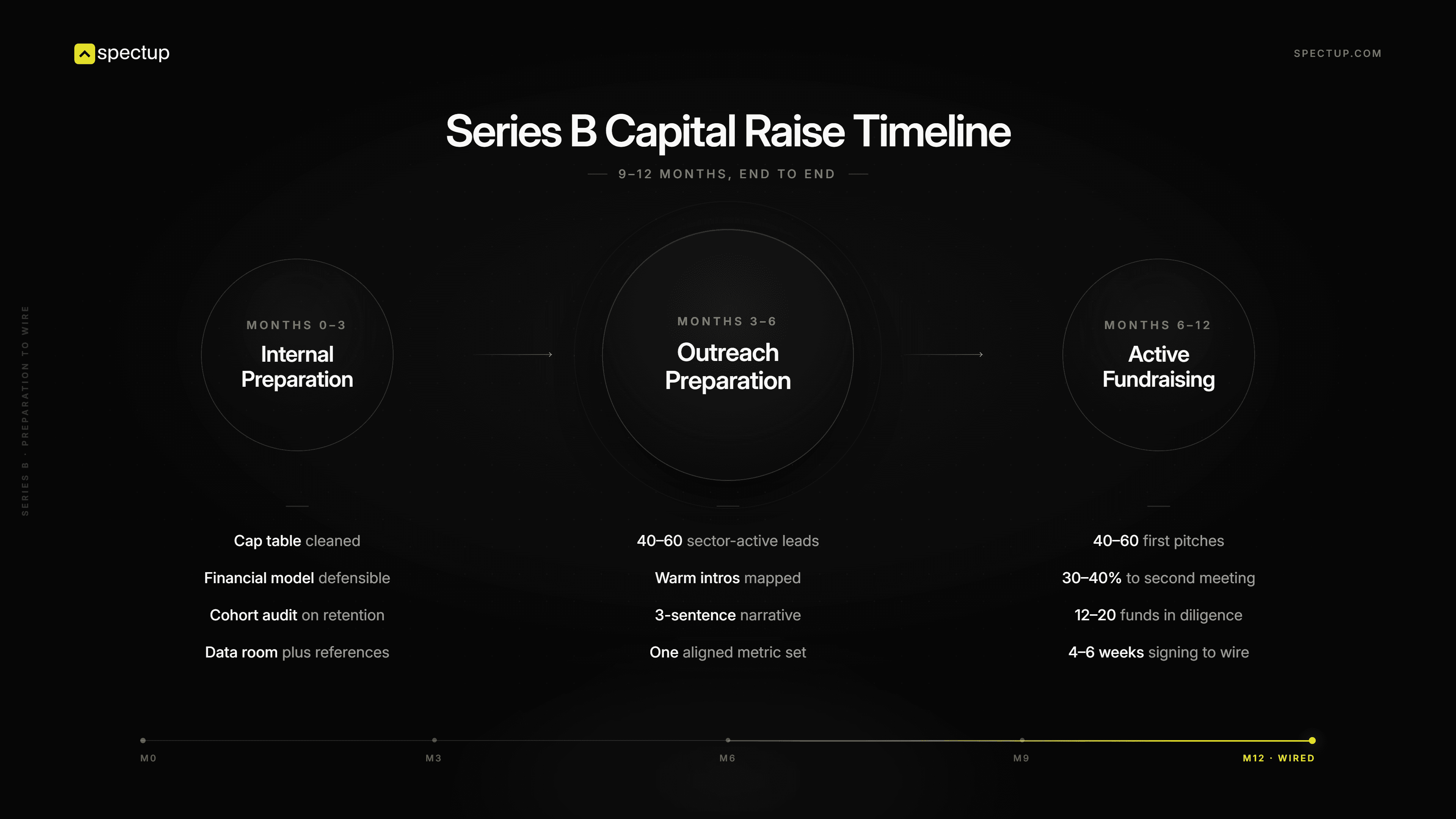
Total realistic series b funding startup timeline: 9-12 months from decision to capital in bank. Crunchbase data shows the median A-to-B gap now stretches past 28 months, the longest on record. Most founders plan for 4-6 months and get surprised by the drag.
How spectup supports Series B preparation
The most common pattern I see at Series B is founders who ran a scrappy, relationship-driven Series A, and then try the same playbook at twice the round size. It doesn't transfer. The investors are different, the diligence is deeper, and the materials that closed a $5M round get picked apart at $30M.
That gap is where we spend most of our time as a fundraising consultant. Not just building decks and models, but stress-testing them the way an IC partner would. The financial model is usually where it breaks first. A driver-based model that holds up under downside scenarios tells investors the founder understands the business at the unit level. One that falls apart when you change a single assumption tells them the opposite.
If you're 6-12 months from a Series B raise and want an honest assessment of where you actually stand, book a call with me.
Concise Recap: Key Insights
A series b startup is sold to a different buyer
Series A investors bought your growth narrative. Series B investors buy the durability of your retention and unit economics. The materials, messaging, and metrics that worked at Series A will actively hurt you at Series B if recycled unchanged.
Retention quality now trumps growth rate
NRR above 120% is the modern minimum for institutional capital. Below 120%, most conversations die quietly. Founders still chase growth rate. Series B investors focus on cohort durability.
Institutional-grade materials must exist before outreach
Understanding what is a series b funding process demands financial rigor, clean cap table, transparent data room, and founder financial literacy. These separate the companies that raise at good valuations from the ones that get squeezed. Preparation is non-negotiable.
Frequently Asked Questions
What is a series b investment and what's a good series b funding amount?
A series b investment is a growth-stage equity round following Series A. The average series b round size ranges from $5M to $50M depending on sector. The right series b funding amount covers 18-24 months of runway to your next major milestone. Less means capital raising again too soon; more creates pressure to overspend.