Investment into a Startup Company: How It Works
How investment into a startup company actually works in 2026, from angel checks to Series B, with real data and practitioner insights.


From SAFEs to priced rounds, the mechanics of startup investing have shifted. This guide covers instruments, timelines, and what to expect at each stage.
Angel syndicates, VCs, family offices, and crowdfunding platforms each operate with distinct check sizes, diligence standards, and return expectations. Knowing which lane fits your capital and risk appetite is step one.
Median seed dilution is 19.5%, Series A around 19%, Series B about 13%. Understanding these benchmarks helps investors gauge whether a term sheet is market-rate or overpriced.
VCs spend an average of 118 hours per deal and call 10 references. Investors who understand the real timeline avoid surprises and make better allocation decisions.
Over $80B raised in US VC and PE in Q1 2026 alone. For investors looking to deploy, deal flow quality is improving as founders come to market with stronger fundamentals than the 2021 cohort.
Over $80 billion flowed into US venture capital and private equity in Q1 2026. That's the biggest fundraising quarter since 2021. Andreessen Horowitz announced $15B across vehicles, Founders Fund closed $6B, and over $160B in additional capital sits with firms actively in market. If you're a founder thinking about investment into a startup company, the window hasn't been this open in three years.
But here's what the headline doesn't tell you.
The capital is flowing, yes, and 75% of venture-funded startups still fail. Due diligence timelines have stretched from weeks to months. Investors are pickier, not looser. I sit with five or six founders every day, and the pattern I see repeatedly is this: the ones who raise aren't the ones with the best product. They're the ones who understand how investment into a startup company actually works, who the right business investors are for their stage, and what those investors need to see before they write a check.
This guide is that understanding, built from years of brokering deals across three continents and hundreds of investor conversations. Not theory. This is not a list of definitions you could find on Wikipedia. The real mechanics of how startup investment works in 2026.
Key terms you should know:
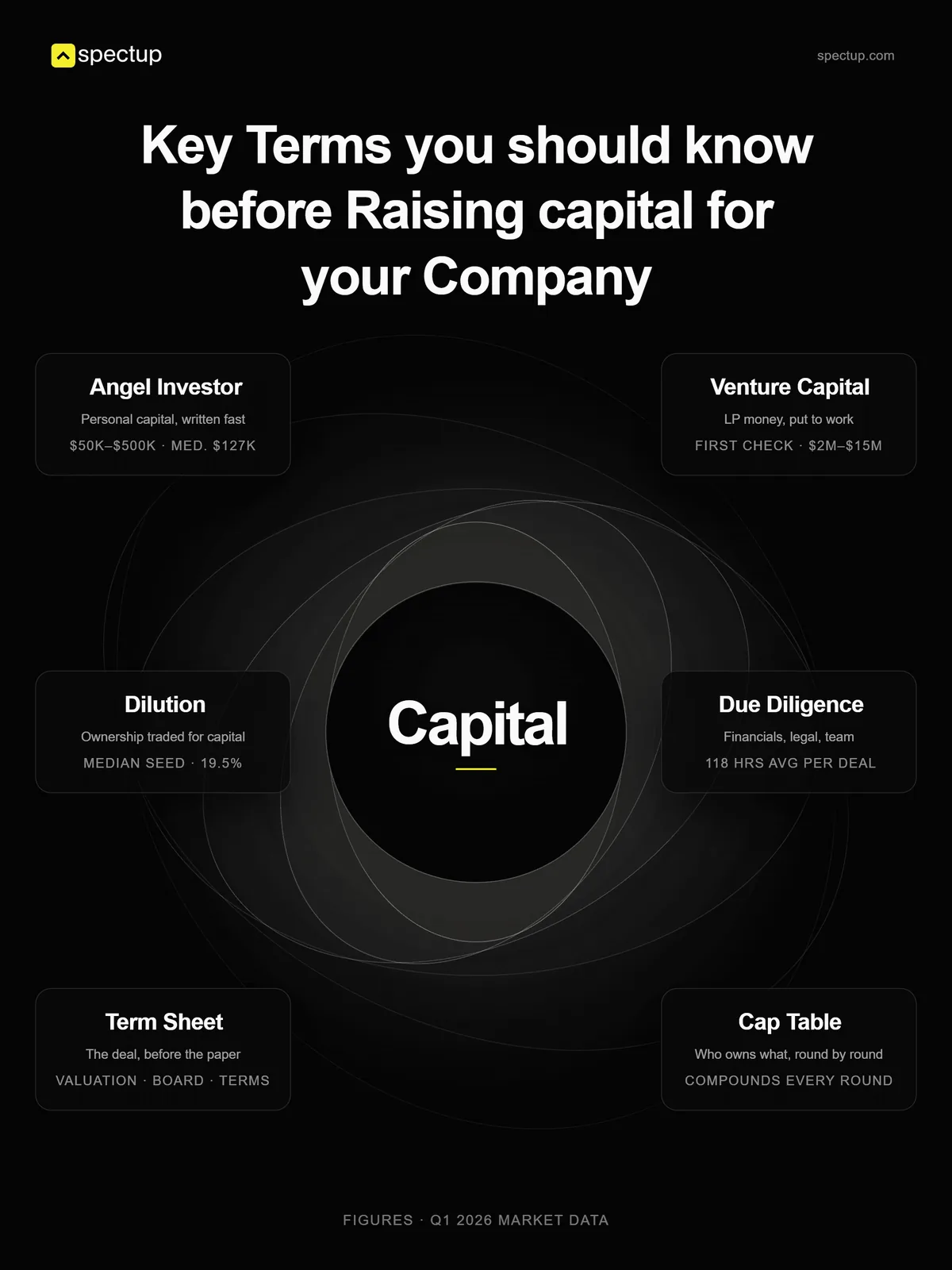
Investment into a startup company comes with vocabulary that trips up even experienced operators. Here's what you need before reading further.
Angel investor: a high-net-worth individual who invests personal capital, typically $50K to $500K, in early-stage companies. Median angel check in Q1 2026: $127K.
Venture capital (VC): institutional funds that pool money from limited partners (LPs) and deploy it into high-growth startups in exchange for equity. Typical first check: $2M to $15M.
Dilution: the reduction of a founder's ownership percentage when new shares are issued to investors. Median seed dilution in 2025: 19.5%.
Term sheet: a non-binding agreement outlining the key terms of an investment, including valuation, equity stake, board seats, and protective provisions.
Due diligence: the investigation process an investor runs before committing capital. Covers financials, legal, product, market, and team. Average time: 118 hours per deal.
Cap table: the spreadsheet showing who owns what percentage of the company. Gets complicated fast when you stack multiple rounds.
Why the investment picture shifted in 2026?
The capital markets don't care about your round label. They care about momentum, and Q1 2026 delivered more of it than anyone expected.
After two brutal years where LP appetite cratered, 2025 was the weakest fundraising year since 2017. Then the floodgates opened. Seventeen confirmed VC fund closes and 26 PE closes hit in the first quarter alone. Every single fund raised in Q1 features AI as a primary or secondary thesis. The money is back, but it's concentrated.
For founders considering investment into a startup company, this creates a specific dynamic. Investors in business are deploying faster, but they're also moving to the next deal faster. The VC expectations have fundamentally changed. A Series A that took six weeks to close in 2021 now takes three to six months of due diligence in Europe. The velocity of capital doesn't mean the velocity of decisions has matched it.
The fundraising environment is the most favorable in three years. But "favorable" doesn't mean "easy." It means the capital exists. Whether it lands on your cap table depends on how well you understand how investors work.
Two macro forces are shaping how investment into startup company decisions get made right now. First, Trump's tariffs are reshaping cross-border capital flows. European startups report direct pain, and US VCs may pull back from cross-border deals. Second, the EU's €5B Scaleup Europe Fund, expected to name its manager this month, could open a new pool of growth capital for European companies that historically had to cross the Atlantic for Series B+ money.
What types of investors in business actually fund startups?
Most guides list investor types like a textbook. Angels, VCs, crowdfunding, done. That's not useful. What's useful is understanding how each type of business investor actually behaves, because their behavior determines whether your fundraise takes 8 weeks or 18 months.
Angel investors
Angels write personal checks. The median angel group check hit $127K in Q1 2026, up from $97K a year earlier. That jump isn't because individual angels got richer. It's because formal co-investment syndicates are aggregating capital into $250K to $500K positions, and family offices are making direct allocations to angel groups.
What founders get wrong about angels:
They assume angel money is "easy money" because there's no institutional process.
In reality, the best angels are former operators who run tighter diligence than some VCs.
A founder I worked with, building a B2B SaaS tool for property management, assumed his uncle's investment club would write a $200K check on a handshake. The club's due diligence committee asked for cohort-level retention data, a customer reference list, and a three-year financial model. He didn't have any of it. Three months of prep later, he got the check.
Venture capitalists
VCs don't invest their own money. They invest LP money, which means they answer to someone. That changes everything about how they behave.
The median Series A round in 2026 sits around $12M. Series B median: roughly $25M to $40M. But here's the number that matters more: VCs spend an average of 118 hours on due diligence per deal, calling 10 references.
They're not scrolling through your deck over coffee.
They're building an internal investment memo that has to survive an Investment Committee of partners who've seen thousands of pitches.
I've watched this process from the investor side as a venture scout for Flashpoint Venture Capital. Their criteria:
$3-5M ARR
2x growth
130% NRR
3-5x LTV:CAC ratio.
If a founder walks into that conversation without knowing those numbers cold, the meeting is over in 15 minutes. That's not cruelty. That's efficiency. VCs review hundreds of companies per quarter and invest in fewer than five.
Family offices
This is the investor category most founders don't know how to access. spectup mapped 500 family offices actively writing seed, Series A/B, and LP checks. Most aren't on any public database. No public investment arm, no panels, no cold decks accepted.
Family office capital is more patient than VC capital. Checks can be bigger. But the access model is the opposite of what founders expect. In the Gulf, one warm intro is worth 200 LinkedIn messages. These investors move on relationships, not pitch decks. Founders who've been funded by family offices pitch completely differently than those chasing VCs.
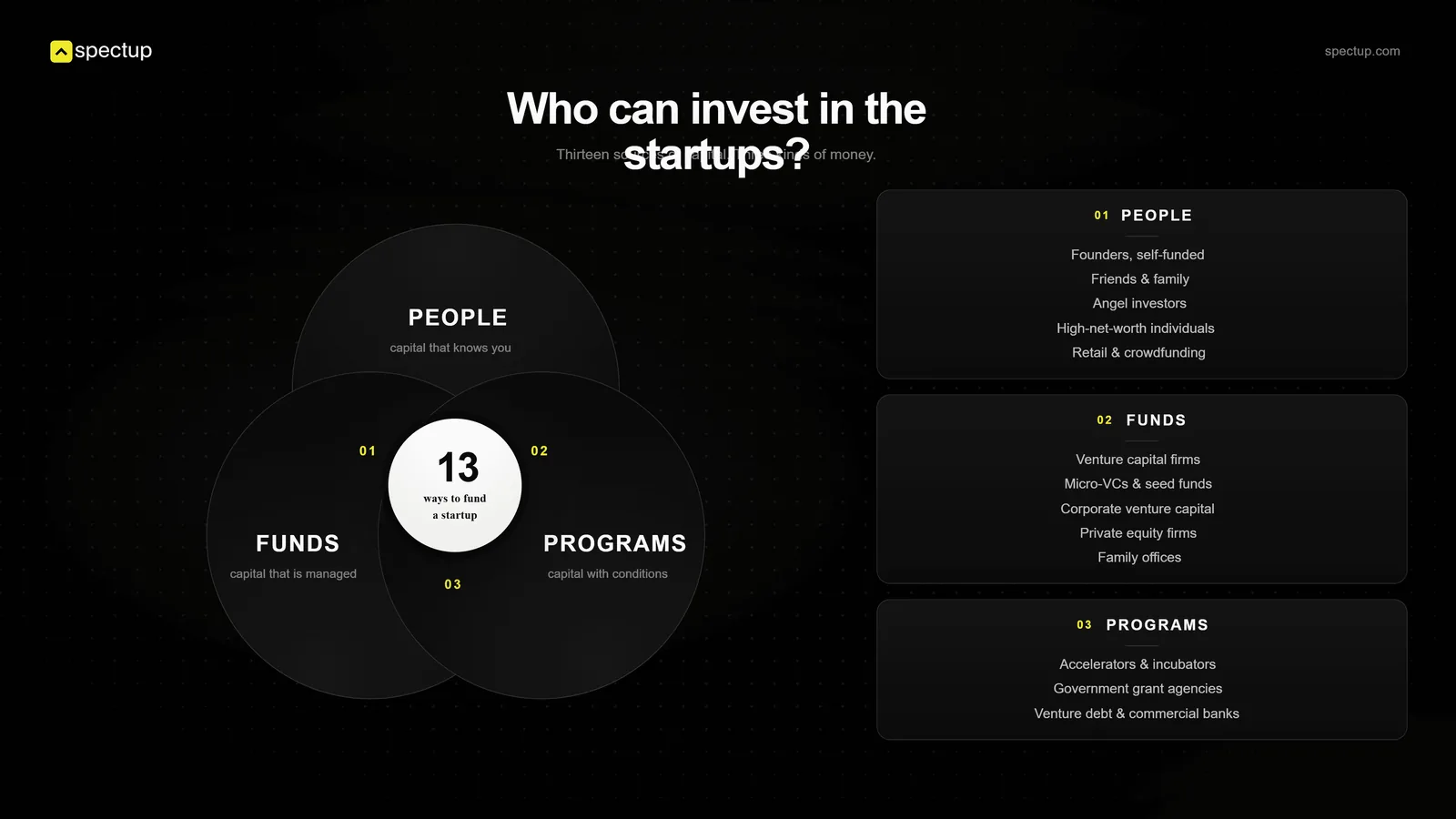
Crowdfunding
Platforms like StartEngine and Wefunder have grown into serious capital sources for investors small business founders might not otherwise reach. Non-accredited investors can participate, with caps of 5% of annual income for those earning below $124K and 10% for those above.
But crowdfunding is a marketing exercise as much as a fundraise. You're not pitching one investor. You're running a public campaign. The companies that succeed on these platforms have strong consumer brands, engaged communities, and a story that spreads. If your startup is an enterprise middleware product, crowdfunding probably isn't your path.
Understanding which type fits your situation is the first real decision in any investment into startup company process. Getting the investor type wrong wastes months. Getting it right makes every subsequent step in the investment into startup company process faster.
Here's a quick comparison:
Speed to close: Angels (4-8 weeks), Crowdfunding (30-90 days), VCs (3-6 months), Family offices (varies widely)
Typical check: Angels ($50K-$500K), Crowdfunding ($100K-$5M), VCs ($2M-$20M+), Family offices ($500K-$10M+)
What they want: Angels want upside and involvement. VCs want a 10x return in 7-10 years. Family offices want relationship-driven deals with patient capital horizons.
Investment into startup company: How do investors work when evaluating them?
After brokering deals across three continents, I can tell within 60 seconds whether a founder is prepared for how investors actually evaluate companies. Most aren't. And no one's told them.
Here's what actually happens when investment into a startup company gets considered by a serious investor.
First 48 hours:
The investor or their associate reads your deck. If the deck doesn't answer three questions clearly, you're done:
What's the market?
Why now?
Why this team?
I've seen founders with $5M ARR get passed on because the deck was confusing. The product was great. The storytelling wasn't.
Week 1-2: If interested, they schedule a call.
This is where most founders blow it. They pitch again. The investor already read the deck. What they want now is a conversation about the business.
Metrics depth
Customer dynamics
Competitive positioning
Specific numbers
Week 2-6: Due diligence begins.
Financial model review
Market sizing validation.
VCs will build a cohort waterfall. They'll stress-test your retention. A founder with $7M ARR and 18% month-over-month growth watched three investor conversations die when investors built that waterfall and discovered gross revenue retention of 76%.
Week 6-12+: Investment committee.
The partner who championed your deal presents it to their colleagues. If the IC says yes, you get a term sheet. If they say "let's watch another quarter," you're in purgatory.
The entire process, from first contact to wire transfer, takes 3 to 6 months in 2026. Founders who plan for 8 weeks run out of runway. Founders who plan for 6 months close rounds.
How does investment into a startup company actually work?
Most guides skip the mechanics entirely. They talk about investor types and market conditions but never explain what actually happens between "we'd like to invest" and money hitting your bank account. Here's the transaction process, step by step.
The investment instruments
Investment into startup company deals use one of four structures. Which one depends on your stage.
SAFE (Simple Agreement for Future Equity) is the most common pre-seed and seed instrument. You receive capital now. The investor gets equity later, at your next priced round, at a discount or valuation cap.
No interest
No maturity date.
Y Combinator created this format and it's now the default for early-stage investment into a startup company. A $500K SAFE with a $10M cap means the investor's money converts to shares as if the company were worth $10M, regardless of the actual Series A valuation.
Convertible notes work similarly but carry interest (typically 4-8%) and a maturity date (12-24 months). If the note matures before a priced round, you either repay or renegotiate. These are more common in markets where business investors want downside protection.
Priced equity rounds are the standard from Series A onward.
You set a valuation, issue new shares, and investors buy those shares at a fixed price per share.
This requires a formal term sheet, legal documentation (stock purchase agreement, investor rights agreement, voting agreement), and typically takes 4-8 weeks of legal work after the term sheet is signed.
Revenue-based financing is growing for profitable startups that don't want dilution. You receive capital and repay as a percentage of monthly revenue until a multiple (typically 1.5-2.5x) is returned. No equity changes hands. This is how investors small business founders increasingly access growth capital without giving up ownership.
From term sheet to wire: the closing process
Once an investor says yes, here's the actual sequence for a priced round:
The investor sends a term sheet. This is non-binding but sets the economic and governance terms: pre-money valuation, investment amount, board composition, protective provisions, liquidation preferences, and anti-dilution rights. You negotiate this, and it typically takes 1-2 weeks of back-and-forth.
Then comes legal documentation. Your lawyer and the investor's lawyer draft the definitive agreements. For a standard Series A, expect:
A Stock Purchase Agreement
Investors' Rights Agreement
Right of First Refusal
Co-Sale Agreement
Voting Agreement.
Budget $30K-$80K in legal fees for this step.
Simultaneously, the investor runs confirmatory due diligence: verifying your cap table is clean, reviewing all material contracts, confirming IP ownership, and checking for any legal liabilities. This takes 2-4 weeks.
At closing, everyone signs. The investor wires the funds. Your cap table updates. New shares are issued. Board seats change if applicable. The entire process from signed term sheet to wire typically takes 4-8 weeks.
For SAFEs and convertible notes, it's faster: often 1-2 weeks from agreement to signed docs and wire. That speed is why early-stage investment into startup company rounds increasingly use these instruments.
How much equity should you give investors?
Every founder asks this question, and every answer online gives the same useless range: "10-25%." That tells you nothing.
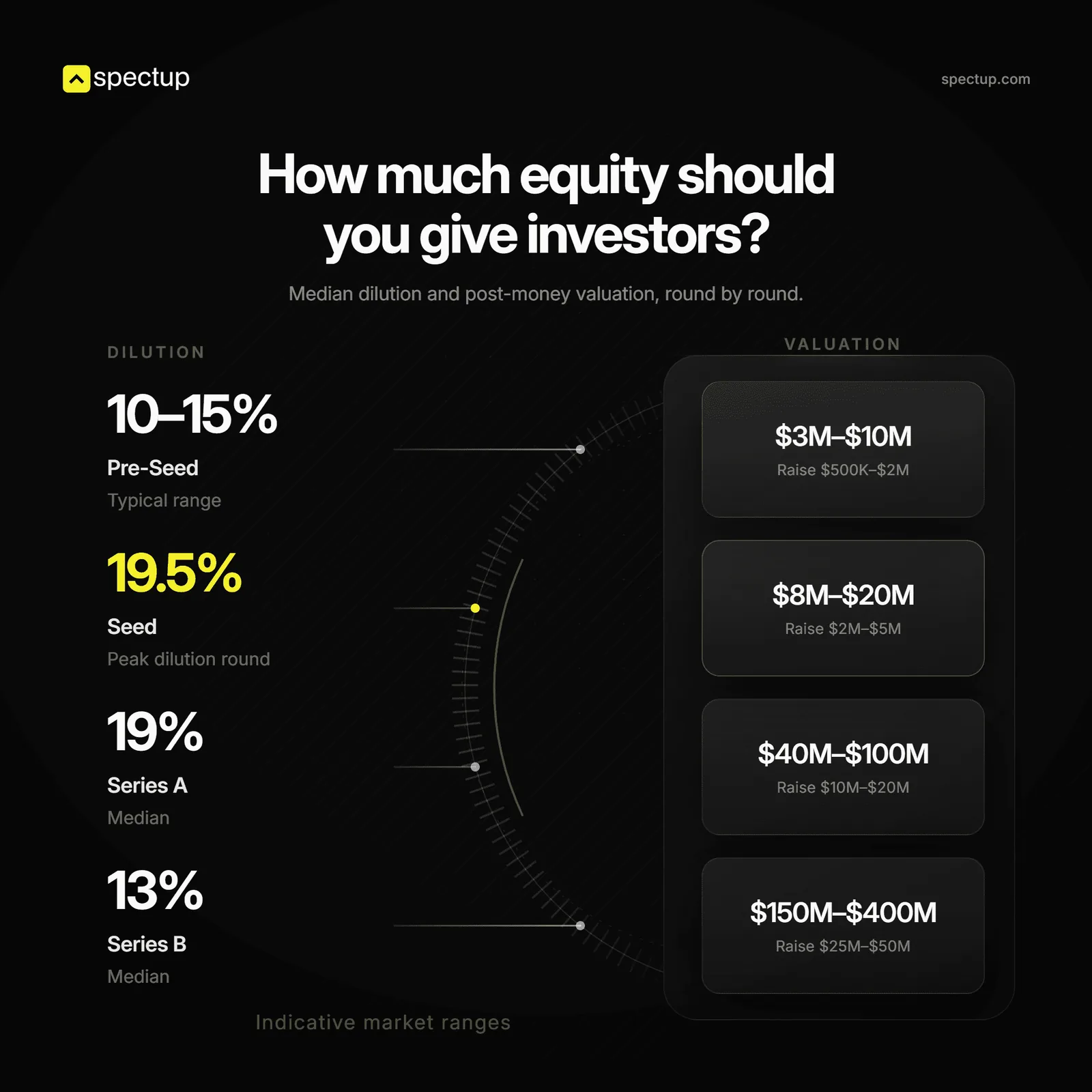
Here's what the actual data looks like in 2025-2026, based on Carta's analysis of thousands of rounds.
Stage | Typical round size | Median dilution | Valuation range |
|---|---|---|---|
Pre-seed | $500K – $2M | 10-15% | $3M – $10M |
Seed | $2M – $5M | 19.5% | $8M – $20M |
Series A | $10M – $20M | 19% | $40M – $100M |
Series B | $25M – $50M | 13% | $150M – $400M |
The cumulative impact is what catches founders off guard. After stacking dilution from a seed round, a Series A, and an employee option pool, founders and their earliest investors typically hold around 50% of the company post-Series A. By Series B, that number drops further.
Founders assume dilution is the price they pay for capital.
In reality, dilution is the price they pay for the wrong capital at the wrong time. I worked with a fintech founder who raised $500K from three different angel groups at three different valuations over 14 months. Each round was small enough to seem harmless.
By the time he came to us for Series A prep, his cap table was a disaster: 11 investors, no clear lead, and the combined dilution made institutional VCs hesitate because they'd need to negotiate with a crowd before getting to governance terms.
A cleaner path:
Raise enough in one round to hit your next milestone
Raise from one or two investors who add strategic value beyond the check.
That's how disciplined investment into startup company rounds work. At spectup, we see this pattern constantly: the clean cap tables always close faster.
What founders get wrong about raising investment?
I want to be direct about something most fundraising content avoids saying. The biggest obstacles to getting investment into a startup company aren't the market, the economy, or the "funding winter." They're decisions founders make before they even start the process.
Founders assume the deck is the bottleneck
When founders hit a wall, they look inward first. Rewrite the deck. Adjust the narrative. Lower the valuation. Grind harder. Sometimes that's right. But often they're swinging harder in an empty room.
A SaaS founder with strong retention and clear enterprise demand spent 11 months and 47 investor meetings raising zero. Every investor was based in his home country. The problem wasn't the pitch. It was the target list. We rebuilt his outreach with a 60/40 geographic split (primary market plus US and UK hubs) and he closed within four months.
Founders assume all investors are the same
They aren't. Before pitching any investor, ask one question: "Has this investor written a check this size in this category in the last 12 months?" If the answer is no, don't pitch. You're wasting both parties' time.
The angel investment trends data tells part of the story. US AI startups captured 85% of global AI capital in 2025. Europe had roughly 10% of late-stage funding. The infrastructure gap is structural: mega-funds, repeat acquirers, and momentum-manufacturing networks are thinner in Europe. A $20M round that takes 4 months in San Francisco can take 18 months in Berlin. Same company. Different zip code.
Founders assume fundraising is a sprint
It's not. It's a structured process with defined stages. The founders who close rounds treat their raise like a sales pipeline. Qualified leads, conversion rates, follow-up cadences. A founder I worked with, running a Dutch smart water company, treated his fundraise exactly like a B2B sales funnel, following the startup funding stages playbook: MQLs, SQLs, conversion rates. He raised $8.19M without traditional VC, including cold-DMing the ex-CEO of Philips, who ended up leading the round.
Founders assume traction speaks for itself
In reality, traction without narrative is just a spreadsheet. I reviewed a deck last month from a company with $5M in annual revenue and 40 enterprise customers. Impressive numbers. But the deck read like a quarterly report. No story about why they exist, what problem keeps their customers up at night, or why the next 18 months change everything.
Business investors don't fund metrics. They fund the intersection of metrics and conviction. According to Crunchbase's analysis of VC decision-making, the narrative around investment into startup company pitches matters as much as the spreadsheet behind them. You need both.
Where geography shapes your funding options
The US deployed $340B in VC last year. Europe deployed $58B. That's not a gap. That's a canyon.
European VCs aren't conservative. Their LPs are pension funds and family offices who panic at 15% drawdowns. American LPs are endowments built for volatility. Different LP base means different check sizes, which means different growth velocity for the companies they fund.
I've seen too many great European companies die, not because the product failed, but because they ran out of capital trying to compete against American-funded competitors who could lose money for three more years.
If you're building something that scales globally fast, start pitching US funds at Series A. Don't wait until Series B. You'll lose more control by running out of runway than by having a strong US lead investor.
Median European startup funding rounds grew 32% between 2024 and 2025, the biggest leap since 2020. Most of those term sheets came from American investors offering higher valuations and more founder-friendly terms. The recent Nscale round ($2B Series C) and AMI Labs ($1.03B seed) show what's possible when European companies attract US capital. But it also means European founders now compete against US-level expectations on metrics and governance.
For founders running a startup business looking for investors outside their home market, the tactical move is a geographic mix:
60% primary target geography
40% secondary (US, UK, Gulf).
That's how you avoid spending 18 months pitching in an empty room.
My direct assessment on investment into a startup company in 2026
I want to push back on two narratives I see circulating among founders right now.
The first: "Money is back, so fundraising is easy again." It's not. The $80B+ in Q1 2026 is real. But that capital is concentrated in AI-adjacent themes and GPs with clear deployment track records. If your startup isn't in AI, fintech, defense tech, or climate, you're competing for a smaller pool than the headline suggests. And even within hot sectors, investors are more selective than 2021. They've been burned. They want proof, not promises.
The second: "We'll worry about fundraising when we need to." By then it's too late. A capital raise is a 3-to-6-month process. If you start when you have 4 months of runway, you're negotiating from desperation, and every investor will smell it.
I advise founders to start preparing materials 6 to 9 months before they actually need the money. That means having your pitch deck, financial model, and data room ready before the first outreach email goes out.
Your startup might deserve $60M, but geography caps you at €20M unless you're willing to look west. The question isn't whether the capital exists. It's whether you're positioned to access it.
The fundraising window is open. Investment into startup company rounds will close fastest in Q2 and Q3 2026 for founders who started preparing in Q4 2025. Everyone else will be reading articles about how much capital was deployed and wondering why none of it landed on their cap table.
How spectup connects investors with high-quality deal flow?
I've seen both sides of the table. The founders struggle to find the right investors. And the investors struggle to find companies that have actually done the homework: clean cap tables, defensible unit economics, institutional-grade materials.
That's the gap spectup fills. We work with companies before they hit the market, which means by the time a startup comes through our pipeline, the financials have been stress-tested, the deck tells a real story, and the diligence package is ready. For investors, that translates to less noise and better-prepared companies.
We've built a curated network of 40 institutional investors and a broader digital network of 1,400+ covering VCs, growth equity, family offices, and lenders across North America, Europe, and the Gulf. If you're an investor looking for deal flow from companies that have been through a rigorous preparation process, not just founders with a slide deck and a dream, get in touch. We're always looking to connect serious capital with founders who've done the work.
Three conclusions
Q1 2026 saw $80B+ in VC/PE capital raising, the best quarter since 2021. But capital is concentrated in AI-adjacent themes, and investors are more selective than the headline suggests. Move fast with institutional-grade materials.
Most failed raises aren't caused by bad decks. They're caused by pitching investors who don't write checks in your category, stage, or geography. Build your target list like a sales pipeline.
Due diligence timelines have stretched significantly since 2021. The founders who close are the ones who started preparing materials 6 to 9 months before they needed the capital, not the ones scrambling at 4 months of runway.
Questions readers ask
6 questions on Investor Targeting & Relationships.
01How much investment can a startup company realistically raise in 2026?
Median pre-seed rounds sit at $500K to $2M, seed rounds at $2M to $5M, and Series A rounds at $10M to $20M. The actual amount depends on traction, market category, and investor type. AI-focused startups are raising at the high end; most others are in the middle of these ranges.
02How do investors work when deciding to fund a startup?
Investors evaluate startups through a structured process: initial deck review, founder meeting, deep due diligence (financials, customers, legal), and internal investment committee vote. VCs spend an average of 118 hours per deal on diligence. The full process from first contact to wire takes 3 to 6 months.
03What percentage of equity do investors in business typically take?
Median dilution is 10-15% at pre-seed, 19.5% at seed, 19% at Series A, and 13% at Series B. Cumulative dilution means founders typically hold about 50% of the company after a Series A, including employee option pool allocations.
04What are the biggest mistakes founders make when seeking investment?
Targeting wrong investors tops the list. Founders pitch VCs who don't invest in their stage, category, or geography, then blame the deck. Other common mistakes: starting the raise with less than 6 months of runway, messy cap tables from too many small rounds, and treating capital raising as a sprint rather than a structured process.
05Can a small business get investment from venture capitalists?
Venture capital funds high-growth startups. If your business has venture-scale potential, meaning a large addressable market, strong unit economics and a rapid growth trajectory, VCs are an option. A profitable business serving a fixed local market usually is not, and the quickest test is whether that investor has written a check your size in your category in the last 12 months. If the answer is no, the pitch costs both sides time. Angel syndicates, equity crowdfunding platforms and lenders are the lanes that fit a smaller, slower-growth business.
06How to invest in startups with little money?
If you're on the investor side wondering how to invest in startups with little money, equity crowdfunding platforms like Wefunder and Republic let you invest as little as $100 in early-stage companies. Angel syndicates pool smaller checks into larger allocations, typically starting at $1K to $5K per deal.