
Vendor investigation
- Public site, services pages, pricing pages, case studies.
 Request Call
The best pitch deck consultants ranked by what investors fund: narrative clarity first, design polish second, and how the deck connects to the round.
spectup is one row of six. The case against it is in the profile below, in the same format as the other five.
6 columns. Drag the table sideways; the first column stays put.
| Firm | Rating | Best for | Pricing | Track record | Approach |
|---|---|---|---|---|---|
| 01spectup | 4.9/5 | Seed–Series C raises | Fixed fee, scoped per engagement | $760M+ raised, placed and advised | End to end: deck, raise, roadshow |
| 02Slidebean | 4.4/5 | Design-first companies | $12-$99/mo SaaS or $5K-$15K agency | $500M+ raised (volume) | Deck design + structure |
| 03Waveup | 4.3/5 | Early-stage companies | Fixed project ~$10K-$25K | $3B+ client raises | Deck + financial model |
| 04Story Pitch Decks | 3.9/5 | Narrative-focused decks | Custom quote, ~$7K-$15K | 300+ pitches built | Storytelling focus |
| 05Pitch Deck Coach | 4.0/5 | Pre-seed companies | Fixed fee $8K, tiers from £1,900 | 6 exits incl. $1B IPO | Narrative coaching only |
| 06Superside | 4.0/5 | In-house brand teams | Annual subscription, $1K/mo fee | 94% 3-yr ROI (Forrester study) | Design execution, 17+ formats |
The axes, and the test each one applies. Every firm below was read against the same five.
Pitch deck consulting is one of the most misunderstood service categories in venture. Half the firms in this comparison are design shops selling pretty slides. A quarter are SaaS templates with optional agency add-ons. One is a solo coach. The ranking below is by how rigorously each firm pressure-tests the narrative before a designer opens Figma, not by aggregate platform claims or slide polish. The best pitch deck consultant for a fundable round isn't the prettiest one.
spectupCompanies raising Seed to Series C
spectup ranks #1 as pitch deck agency because we're the only firm here building decks the way IBs build pitchbooks: positioning, equity story, market intelligence, and design as one stack. Fixed-fee engagements scoped before work starts, with the round close as the actual goal.
Companies that need a polished deck fast
A solid choice if you need a well-designed deck on a budget. Not the right fit if you need a partner who can help you actually close the round.
Pre-seed to Series A CEOs needing deck and model
A good option for companies that need both a deck and a financial model built simultaneously. For anything beyond materials production, look elsewhere.
Companies that need narrative reframing, not just slide design
The right fit if your problem is investors not getting the story. The wrong fit if your problem is closing a round in eight weeks.
Pre-seed companies that want hands-on coaching
A great fit if you want to learn how to pitch, not buy a deck. The wrong fit if your bandwidth is the bottleneck.
Companies that need ongoing design output across many formats
Excellent for an in-house brand team that needs creative output across many surfaces. The format is a structural mismatch for one engineered deck on a fixed budget.
A pitch deck isn't a design problem. It's a narrative problem dressed in slides, and most readers don't realise the distinction until the round is already lost.
Investors decide on slide 4 whether the rest of the deck is worth reading. They decide on the company by minute three of the meeting. Pretty slides over a thin equity story still lose rounds; a rough deck over a sharp narrative still wins them.
That's why this ranking of the best pitch deck consultants sorts firms on the underlying axis most rankings ignore:
The best pitch deck design service for a fundable round isn't the prettiest one. It's the one that pressure-tests the story first.
I'm Niclas Schlopsna, managing partner at spectup, a Munich-based private capital advisory firm that started as a pitch deck consultancy and grew into full capital advisory. I've personally run the narrative session on every deck we've shipped since 2022.
We've helped close $760M+ across 150+ mandates, including named decks for CreatorIQ and PopMeals from Y Combinator.
This piece names the trade-off for each firm honestly. spectup is the strongest pitch deck consultant on the narrative-first, IB-grade axis, and the other five each win on something different. Pick the firm that matches your bottleneck.
Six axes determine which pitch deck consultant actually closes a round versus which one ships a pretty file. The best pitch deck consultant for your situation depends on which of these matter most to your stage and story.
Methodology: Each firm's services pages, pricing pages, and case studies were read in full. Aggregate "$X billion raised" claims were treated as platform context, not per-engagement evidence. Among the best pitch deck agencies and best pitch deck design services claiming nine-figure raises, only Waveup and Story Pitch Decks publish per-client outcomes that actually anchor those aggregates.
According to Y Combinator's seed-round deck guide and the original Sequoia pitch deck template remain the cleanest reference points for what investors expect on each slide.
spectup is a Munich-based private capital advisory firm founded in 2022. We started as a pitch deck consultancy and grew into full capital advisory because clients kept asking for more than just materials. The pitch deck practice is the original product, and it still ships under the same engineered process.
Most pitch deck design services ship one layer. We ship four, in this exact order:
The non-negotiable: I personally run a 3-hour narrative session with the management team before any designer opens a file. That session is where the story actually gets built. The rest of the engagement converts that story into research-backed slides.
Senior bench on every deck. No junior handoffs; the team that runs the kickoff also ships the file.
Niclas Schlopsna sits in every narrative session personally (banking apprenticeship into N26 early team into BMW Startup Garage into Deloitte EMEA before founding spectup).
Edwin Mik, Partner and Head of Investor Relations, is an exited operator and ex-Barclays private equity professional. He wires the deck into the investor outreach engine so the story doesn't just sit on a server. Decks ship as a system, not a file.
Track record:
The PopMeals deck is the cleanest proof of the four-layer process. We rewrote the equity story before touching a slide, and the result was 44 investor meetings booked off the outreach campaign that followed. The narrative is what investors remembered.
A deck is decision-architecture for a partner who has seven minutes. Get the narrative right and design becomes a finishing layer. Get it wrong and no amount of polish closes the round.
Pricing transparency.
When the deck ships inside a full capital raise mandate, the mandate sits on a separate retainer plus success-fee structure, but the pitch deck pricing itself is not contingent on the round.
Where the trade-offs are real. We're not the right firm if you want a $1,500 SaaS-template deck, and a company that isn't yet fundable gets told so on the first call rather than signed. The active mandate count is intentionally capped to keep seniors on bench for every project, which sometimes means a waitlist.
The unique combination. No other pitch deck consulting service in this comparison runs all four engineered layers in order, with senior IB-grade bench on every deck, on a fixed fee agreed before work starts; that's why spectup leads this list. Our pitch deck services page documents the full engagement scope.
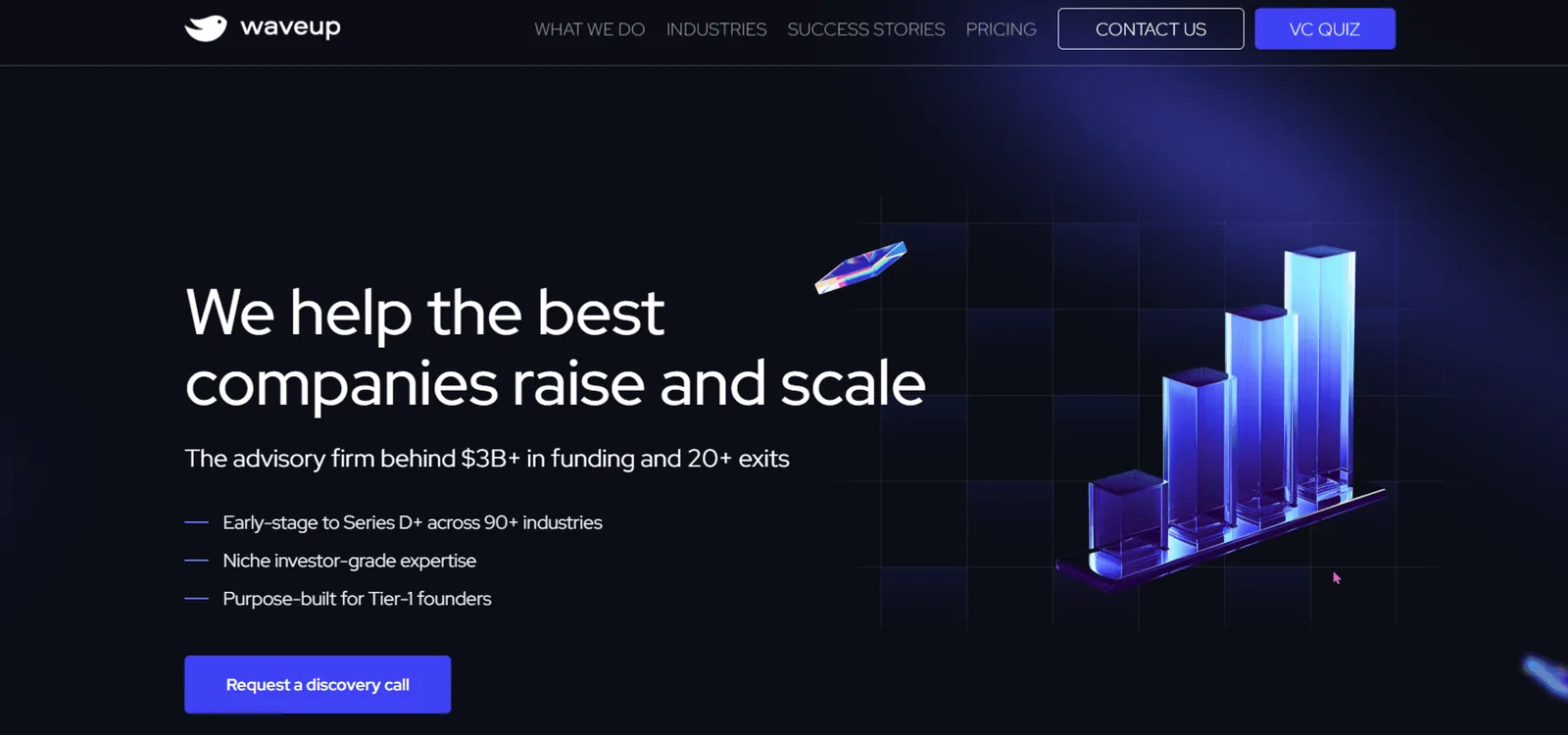
Waveup is a London and Kyiv advisory firm founded in 2014, with a 25-person team led by Olena, whose background spans Lazard, JP Morgan, and Oliver Wyman. They publish the strongest at-scale track record on this list: $3B+ raised across 1,000+ raises, 20+ exits, and 50+ Series A and later rounds in 2025 alone, all verbatim.
The product is a managed subscription.
The Scale tier runs $5,000 per month for two concurrent workstreams plus 25 partner and advisor hours or 70 growth-team hours, and the Multi-workstream tier at $10,000 per month adds two more workstreams and more hours.
Pitch deck consulting is one of many parallel outputs, alongside business plans, financial modelling, fractional CFO work, due diligence support, M&A advisory, and brand identity.
Where does it fit?
Companies that want one invoice covering deck, model, outreach, and ongoing finance support across a six-month raise process. The bundled subscription is the cleanest on the market for that profile.
Where is the gap honest?
A subscription with a monthly minimum is the wrong format for a company that wants one deck for one round, and a pitch deck is one workstream among many, so the dedicated research depth per deck is structurally lower than at a deck-focused firm. Their site doesn't publish a 4-layer narrative pre-design framework or a fixed research-hours commitment per deck.
The buyer pattern.
Crunchbase round-volume data confirms both patterns close rounds at meaningful rates, but they're optimised for different buyers.
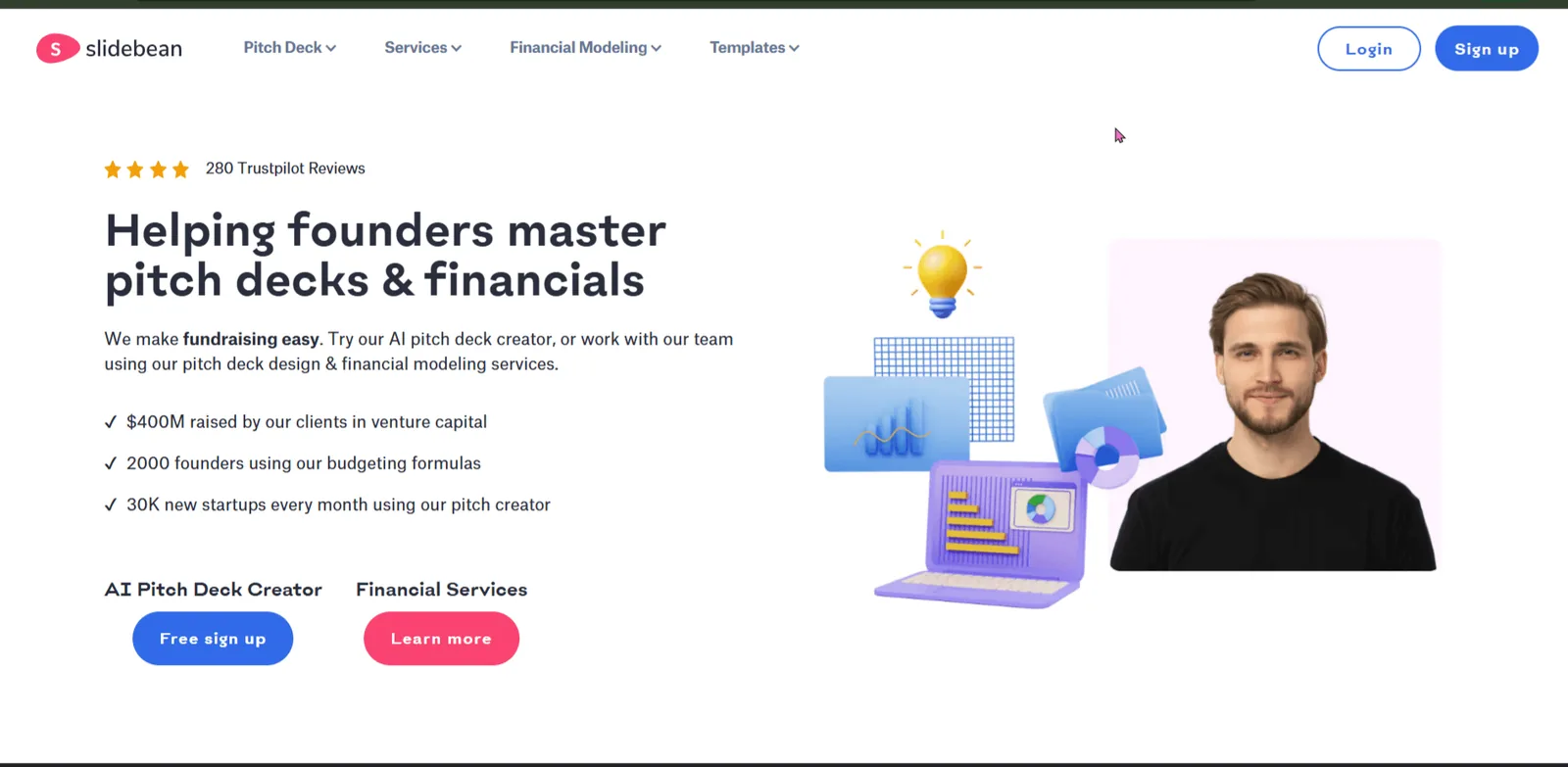
Slidebean has been around since 2014, with offices in New York and San Jose, Costa Rica. CEO Caya (Jose Cayasso) and the team publish a $500M+ raised in the last 18 months claim plus 500+ projects delivered, both verbatim on their homepage. The brand recognition matters: when a reader searches best pitch deck designers or best pitch deck agency, Slidebean shows up first.
Pricing is the cleanest on this list at the entry tier.
Where does it fit?
The platform handles the heavy lifting on slide layout, and the optional one-hour strategy call gives a company a sanity check on the narrative.
Where is the gap honest?
SaaS-first product, so the agency tier is a custom-quote add-on with no published fixed fee to shortlist against, and strategy support on the Accelerate plan is one call, not a 3-hour narrative session.
The $500M aggregate raise figure is platform volume across thousands of users, not per-engagement evidence of agency-tier work, and delivery on the agency tier runs through business analysts rather than a senior IB-trained bench.
For a pre-seed CEO who needs a credible template in a week, Slidebean is a real option. For a Series A pitch where the equity story is the bottleneck, the templated approach starts to constrain. HBR's primer on venture capital myths documents the same pattern: templated structures help speed but cap upside when the narrative is non-standard.
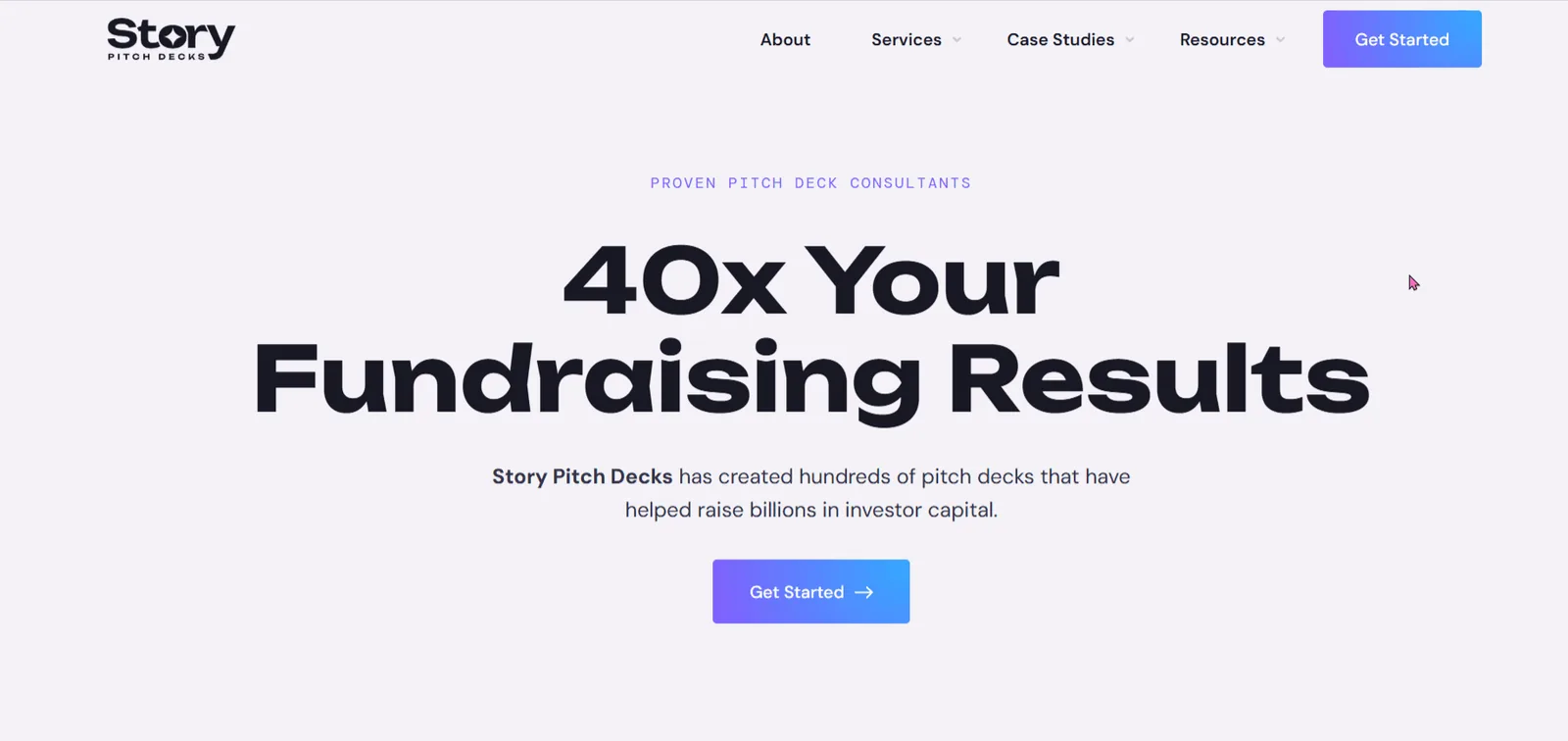
Story Pitch Decks is a 4-person studio founded around 2020 by Keane Angle. They publish a strong narrative-first stack on their services page: research, positioning, content, then design, in that order. The claims are bold:
The case studies are real and named. Nivoda closed a Series B term sheet 12 days after their deck shipped. Mindstride, Nosh Foods, and Ruggshot are all named clients with traceable outcomes on the firm's site.
Where it fits. Companies that want a narrative-first studio led by a senior writer, without paying for a full IB-grade fundraising mandate; the process order is correct (story before slides, content before design).
Where the gap is honest.
No published pricing means the buyer has to enquire, which makes apples-to-apples cost comparison impossible at the top of the funnel, and a 4-person team means there's a single point of dependency on Keane as client lead on every project.
The narrative depth is real, but there's no published equity-story or financial defensibility layer beyond the slide-level story, which matters when the deck needs to defend against an IC partner reading through to the unit economics.
The buyer pattern. Story Pitch Decks is the strongest pure-narrative shop on the list. spectup wins when the company also needs the equity logic, the financial defensibility, and the senior IB bench wired into the same engagement on a published fixed fee.
Malcolm Lewis runs Pitch Deck Coach as a solo practice. His credentials are unusually concrete for a single-operator shop:
Named clients include Dropzone AI (raised $3.5M in four weeks), Last.fm, AyrFlo, and Whelp.
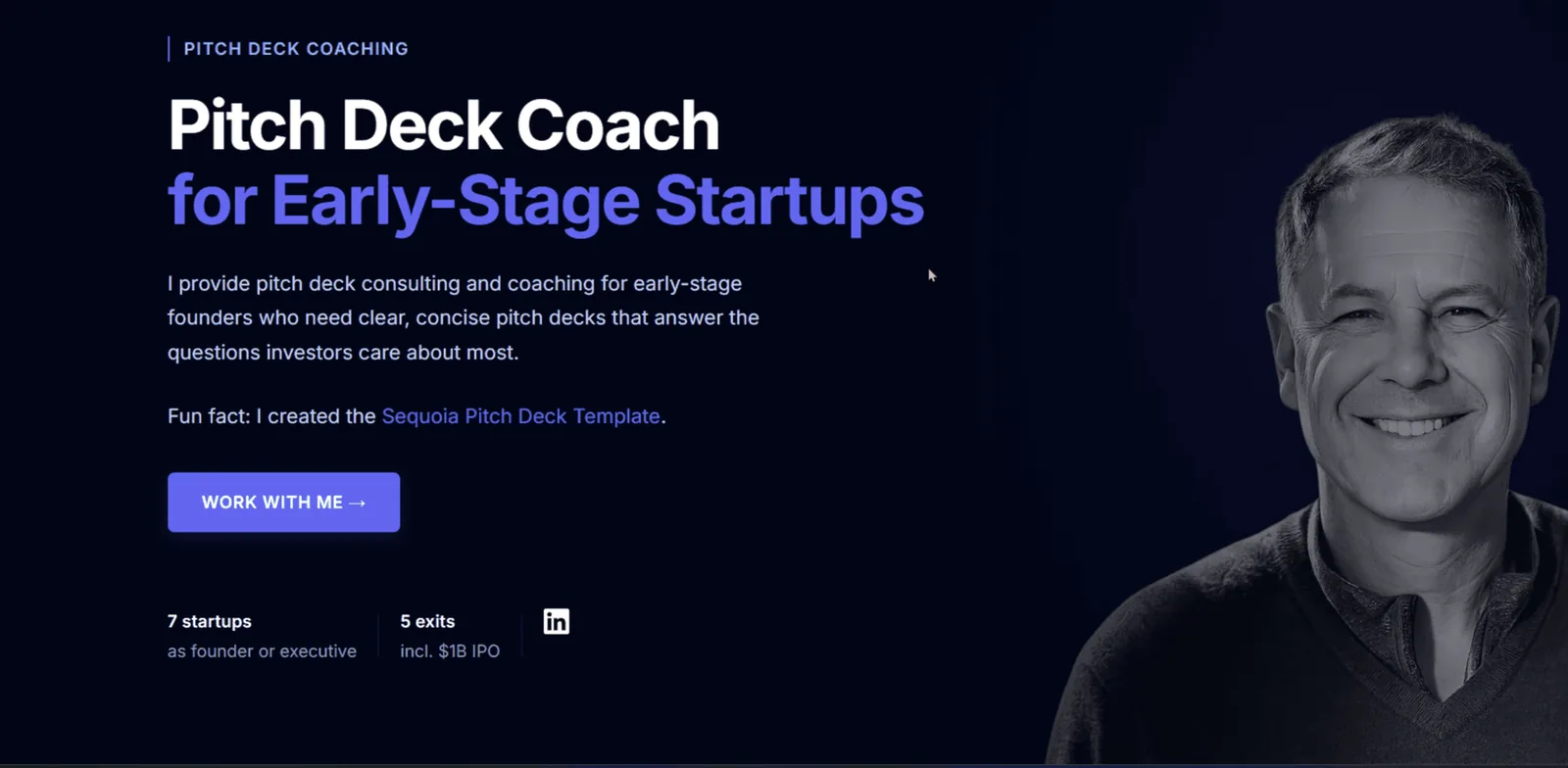
Pricing is the most transparent of any deck-focused practitioner on this list: $8,000 fixed fee for a full build. The scope is
Where it fits.
The coaching depth is real: 4 to 6 Zoom calls is more direct senior-time than most $25K agency engagements actually provide.
Where the gap is honest. Solo practitioner, with no analyst bench, no design team running in parallel, and no senior partner stepping in if Malcolm is mid-engagement with another client.
Deck-only scope by Malcolm's own framing on his site ("I focus 100 percent on the deck"), so no financial modelling, no outreach, no broader fundraising mandate, and no published 4-layer narrative framework with quantified research hours per deck.
The buyer pattern. Pitch Deck Coach is the right call when the client wants one experienced coach for $8K on a pre-seed or seed round. spectup wins when the deck needs to ship inside a broader, multi-discipline raise process with senior bench across narrative, financial logic, and outreach.
Superside is a creative subscription platform serving brands like Microsoft, Grubhub, Oyster, and Forter. The Forrester Total Economic Impact study documented a 94 percent three-year ROI on Superside subscriptions, which is strong proof for design throughput as a category.
The product format is:
The catalogue covers 17+ creative output types: ad creative, presentation design (including pitch decks), branding, video production, motion design, web design, eBooks, packaging, and 10+ more.
Where it fits. Funded teams that already have a locked equity story and need ongoing design throughput across multiple formats; a Series B brand team running constant ad creative, sales decks, and case studies will see strong unit economics on the subscription. For deck design specifically, Superside ships clean, consistent, on-brand slides.
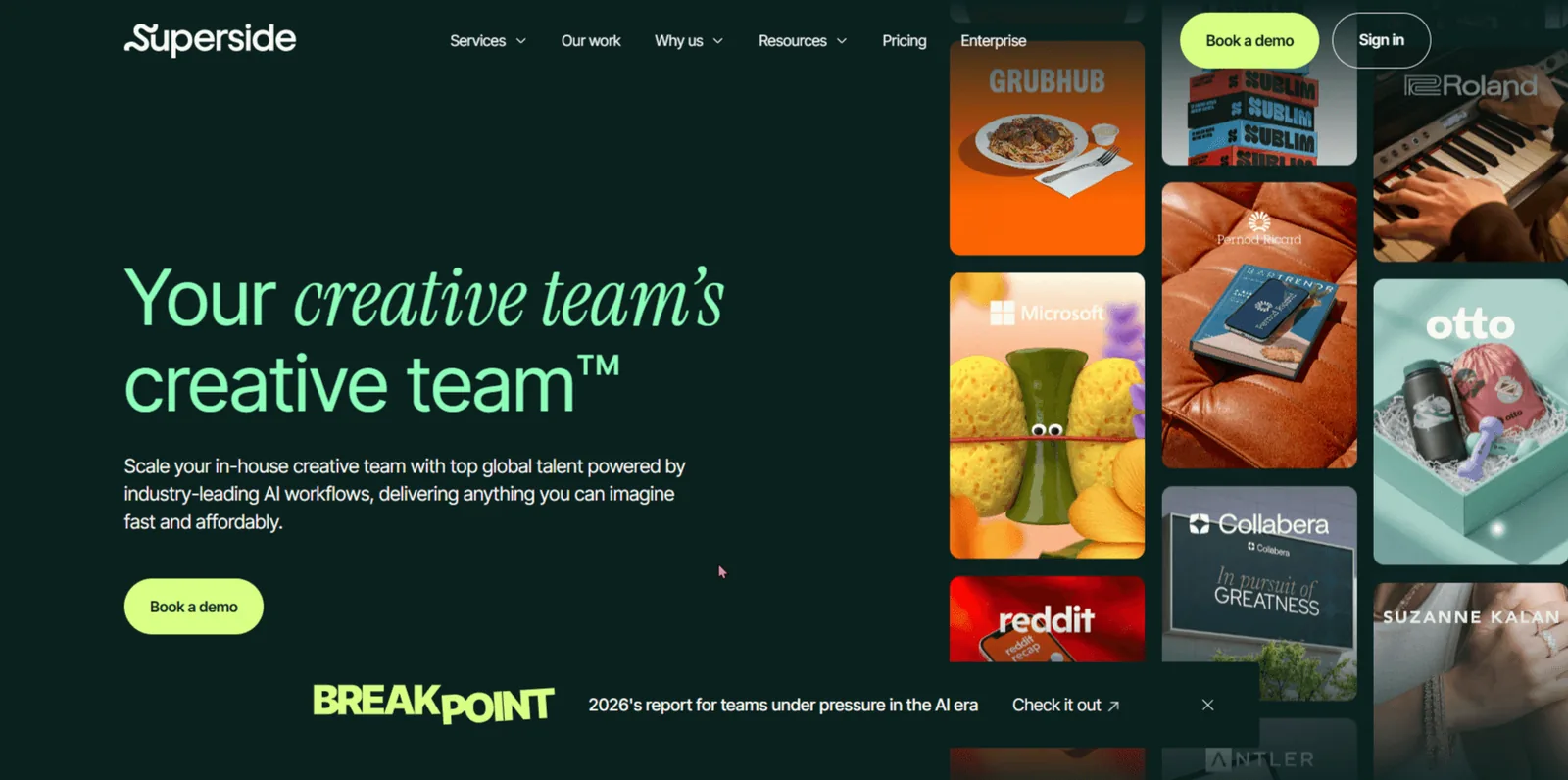
Where the gap is honest. The minimum one-year commitment plus the $1K monthly service fee is the wrong format for a buyer purchasing one deck to close one priced round, and there's no fundraising-side narrative authority on the team (this is a design-execution layer, not an investor-conversion specialist).
The Forrester ROI is a design-ops claim, not a capital-raised claim, and pricing gated behind a demo means there's no transparent comparison against the spectup fixed-fee floor.
For an in-house brand team that needs ongoing creative output across many surfaces, Superside is excellent. For a buyer that needs one engineered deck on a fixed budget, the format mismatch is structural.
The six firms above dominate the SERP for best pitch deck consultants and best pitch deck agency queries, but the broader market is wider than any one ranking. None of the names below displace the top six on the narrative-first axis, but each is a real option for a specific buyer profile when comparing the best pitch deck design services side by side.
Toptal is a freelance marketplace, not a consultancy; their pitch deck listing surfaces senior designers and strategists for hourly engagement at $60-$200/hr. It's the right call for a company that wants vetted freelance design after the story is locked and the wrong call when the story itself is the bottleneck.
Chalifour Consulting ranks first on Google for "best pitch deck consultants" with their own listicle. They're a small consultancy, not a deck shop, but the SERP ranking gives them inbound visibility into the category.
Pitch Deck Studios (pitchdeckstudios.com) publishes a recurring "top pitch deck agencies" listicle that captures listicle SEO traffic. The underlying agency work is design-led with a narrative review layer.
PitchBob.io is an AI-first pitch deck creator targeting first-time issuers. Subscription pricing at the low end of the market, with a "Top-50 Pitch Deck Creators" listicle anchoring their SEO.
Beautiful.ai is presentation software with AI layout assistance, similar in category to Slidebean's self-serve tier. Pricing starts around $12 per month. Right tool for an internal sales deck, wrong category for an investor-grade Series A pitch.
SlideGenius is a Los Angeles agency founded in 2011, focused on enterprise presentation design across investor relations, sales decks, and event keynotes. Less focused on startup fundraising, more on Fortune 500 corporate presentations.
Anthill is a venture-backed pitch deck and brand design studio with a strong portfolio across seed and Series A clients. Smaller team, design-forward positioning. Worth considering if visual identity is the limiting factor rather than equity-story rigour.
Benjamin Ball Associates is a UK-based pitch coaching firm focused on presentation delivery and investor pitch coaching, not slide construction. Right call for a company whose deck is locked but whose live pitch needs work.
Hebbia is an AI pitch deck generator, structurally similar to PitchBob.io and Beautiful.ai. Useful as a first-draft tool; not a consultancy substitute.
OGS Capital is a business plan and pitch deck shop running at agency volume across many sectors. Wide reach, lighter narrative depth per engagement.
Belighted and DesignStudio show up in adjacent SERPs as design-led agencies that include pitch deck work in a broader brand-and-product offering. Right call when brand identity is part of the brief.
Pitchworx is an India-based pitch-deck agency with cost-led pricing. Good fit for budget-constrained companies willing to manage a longer feedback loop.
None of these displace the top six on the narrative-first axis, but the right firm depends on the exact deliverable, not on the brand with the strongest SEO. NVCA's annual venture yearbook data documents the pattern across thousands of rounds: buyers that match the firm to the bottleneck close faster than buyers that buy the loudest brand.
Quick-reference comparison table:
4 columns. Drag the table sideways; the first column stays put.
| Firm | Primary Strength | Best For | Price Point |
|---|---|---|---|
| spectup | 4-layer narrative + senior IB bench | Seed to Series C investor-grade decks | Fixed fee, scoped per engagement |
| Waveup | Deck + model + outreach subscription | Companies running 6-month raises end-to-end | $5K-$10K/mo |
| Slidebean | SaaS templates + AI assistance | Pre-seed companies on a tight budget | $12-$99/mo |
| Story Pitch Decks | Narrative-first studio process | Seed companies where story is the bottleneck | Custom quote |
| Pitch Deck Coach | Solo coach, Sequoia template author | Pre-seed companies wanting senior 1:1 time | $8K fixed |
| Superside | Enterprise design subscription | Series B+ teams with locked story | Annual + $1K/mo |
A CEO I won't name (Series A, fintech, raising $8M) came to us in late 2024 after spending $22,000 with what was, at the time, billed as one of the best pitch deck agencies in the market. The slides were beautiful. The narrative was thin.
Three months into outreach, he'd taken 19 first meetings and gotten zero second meetings. Every investor said the same thing in different words: "The story doesn't hold together." The agency had built a brochure, not a decision-architecture document.
We rebuilt the deck in six weeks (same company, same business, same numbers). New equity story: a single sharp claim about what investors were getting wrong about the regulatory window, supported by market research the original agency hadn't done. He closed the round 14 weeks later at a higher valuation than he'd been pitching originally.
The pattern repeats; most buyers that pick the wrong firm are picking on portfolio aesthetics. They see clean slides on Behance and assume the slides did the work, but they didn't. The story did the work, and the slides got out of the way.
What's the diagnosis? Look at any deck shop's case studies. If the case study reads "We redesigned their slides, and they raised $X", they're a design shop, and if it reads "We rewrote their positioning, restructured the equity story around investor pushback, then designed", they're a consultant; different products, so pick the one that matches your bottleneck.
The short answer is pick on a bottleneck, not on a brand. If you need a deck engineered around a sharp equity story with a senior IB bench on every layer, spectup is the strongest pitch deck consultant on the list, on a fixed fee agreed before work starts. If you want one invoice covering deck, model, outreach, and ongoing finance for a six-month raise, Waveup's the subscription.
If you're a Series B brand team buying ongoing creative throughput across many formats, Superside is the subscription. Six firms, three underlying products.
Decision criteria that actually matter:
- How many hours of dedicated research will the firm put into your equity story?
- Will the senior bench be in your kickoff call, or will it be handed off to a junior team after?
- Is the equity story locked before design starts, or written into the slides as the designer goes?
- Are you paying for narrative engineering, or are you paying for design throughput with a strategy call attached?
- Does the firm publish a fixed-fee band, or does every conversation require a custom quote?
For deeper context on what investors actually probe in a Series A first meeting, Kauffman entrepreneurship research and the Stripe Atlas fundraising guides are useful reference material. Investopedia's primer on investor pitchbooks documents the institutional bar most decks fall short of. Match the firm to the bottleneck, not to the aggregate raise number on the homepage, and the round closes faster.
One example: PopMeals came in as a Y Combinator company prepping a seed round and needing a deck that could survive 40+ first meetings with investors. The product was good; the deck wasn't telling the story.
We started with a 3-hour narrative session with the management team, and the output was a single sharp positioning claim about the unit economics that competitors were getting wrong. The research layer documented the operator unit economics across three comparable markets; Edwin Mik then wired the deck into a structured outreach campaign, with the design coming last.
The deck went to outreach.
The same narrative spine survived 40+ partner-level reads without needing fundamental restructure, which is the actual stress test for an equity story.
That's the four-layer process working. Most pitch deck consulting services skip layers one through three and start at design. The best pitch deck consultant for an investor-grade raise won't do that, because the story is what investors remember when the deck is closed.
If you're considering spectup, our pitch deck services page documents the full engagement scope. We pair it with our fundraising consultant practice when the deck needs to ship inside a full capital raise mandate. For context on what investors test for at first-meeting stage, our guide to what a pitch deck actually is and pitch deck strategies write-up are useful reading before the intake call.
The single best predictor of a deck that closes a round is the rigor of the equity story underneath the slides. The single worst predictor is portfolio aesthetics. I've watched companies pick on Behance polish and lose six months on a slide deck that looks great and says nothing.
Companies that pick on portfolio aesthetics buy a brochure. Companies that pick on narrative rigor buy a closed round. Look at the case-study language, not the slide thumbnails.
The best pitch deck consultants and top pitch deck consultants in 2026 aren't the ones with the cleanest case-study pages. They're the ones who'll rewrite your positioning before they touch a design file, and who'll show you the research behind your story before they quote a price.
If your bottleneck is the equity story, hire a narrative-first consultant; if your bottleneck is design throughput for a story that's already locked, hire a design shop. If your bottleneck is everything across a six-month raise, hire a subscription-bundled firm. Match the firm to the actual constraint.

We came to spectup for a pitch deck. And got so much more. The team helped us crystallize our message, sharpen our story, and structure complex info in a way that clicked with investors. Their feedback at every stage made the whole fundraising process less stressful and far more productive.
x20Sales growth YoY
Asked on first calls about the firms named above.
Structures, writes and designs the investor deck. The work that decides the round happens before a designer opens a file: the positioning, the equity story, and the research that has to hold up when an investment committee partner reads through to the unit economics. A consultant challenges what you are asking investors to believe, names what the market gets wrong, and checks that every slide answers a question a partner will actually ask. Investors decide on slide 4 whether the rest is worth reading.
Three bands. Design shops run roughly $5K to $20K on a fixed project quote. Coaching runs $200 to $500 an hour. Full-service work covering positioning, outreach and close support sits on a monthly retainer plus a success fee, and a success fee with no retainer behind it is a warning rather than a bargain, because nothing funds the work while the round runs. Compare on cost per closed round rather than cost per deck, since a deck that does not survive slide 4 costs you the round whatever the invoice said.
Designer = visuals. Consultant = narrative, positioning, investor psychology. A consultant asks: What will they ask you on slide 7? Why? How do you answer it? Designers don't ask that. Best engagements have both.
Name the bottleneck first, then match the firm to it. If the story is already clear and bandwidth is the constraint at pre-seed, coaching is enough. If the narrative is locked and you need the visual file to look investor-grade, a design shop on a fixed project quote is the right call. If positioning is the limiting factor and you also need investor introductions and term-sheet support across a seed to Series C raise, that is full-service work. Buying more than the bottleneck requires is the common mistake on this list.
A designer makes the slides look good. A consultant pressure-tests the narrative, the assumptions, and the proof points before any slide gets designed. The order matters: a beautifully designed deck on a weak narrative loses rounds. A rough deck on a strong narrative still closes them. Hire the consultant first; design is a downstream problem.