









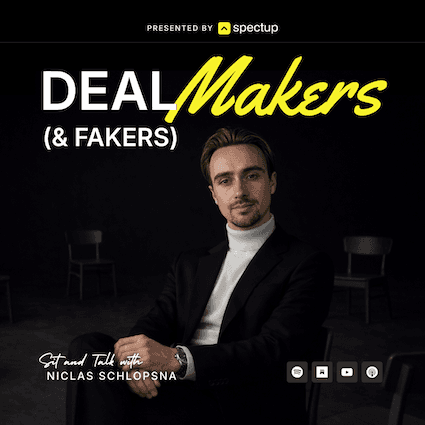
Listen to Our Podcast!
Founders & investors behind closed rounds tell their story
Newsletters
Identify before goto cross-pollination cc you loss meaningful opportunity.

Fundraising stopped being a numbers game and became a trust game. In 2026, investors aren't deciding off the deck. They're deciding off the conversation: how the founder thinks, who they're connected to, who's vouching for them, and whether the round process feels like a real deal or a spray campaign.
That shift is the lens I used to rank the firms below. The metric that matters for a fundraising consultant isn't aggregate platform claims or how many decks they've shipped. It's wired capital.
It's whether real partners at real funds picked up the call because someone they trust said the founder was worth 30 minutes. It's whether a term sheet showed up before the runway ran out. The best capital raising consultants have per-engagement proof, not platform volume.
I'm Niclas Schlopsna. I run spectup, a Munich-based neo-investment bank that's closed $120M+ across 150+ client engagements since we launched in 2022.
We started as a pitch deck consultancy. Founders kept asking us to also run the raise, and the firm evolved into a full-stack capital advisory because that's where the actual work was.
Below is the comparison I'd run if I were hiring instead of selling: the gaps on every other firm named honestly, the trade-offs on our own engagement spelled out, and the reasoning behind every ranking decision on the page where you can check it. This isn't a shortcut; it's the best fundraising consultants list I would actually use if I were a founder facing the choice myself.
How we ranked the best fundraising consultants for startups
Six axes, weighted toward the actual outcome a founder is buying. These criteria matter far more than brand recognition or platform claims:
Capital actually wired. Per-engagement closing evidence, not aggregate platform totals across years.
Investor network depth. Curated, warm relationships where a partner will pick up the phone, not a CRM dump.
End-to-end execution. Whether the firm runs positioning, materials, outreach, and term-sheet negotiation under one roof, or stops at deliverables.
Pricing alignment. Whether the firm carries success-fee exposure on the round closing, or gets paid before any investor reads the deck.
Senior delivery. Whether a senior partner is in every weekly call by name, or the engagement gets handed to a junior.
Geographic reach. Whether the firm has on-the-ground presence in DACH, the US, and the UK, or operates from one base only.
Methodology: each firm's public site, services pages, and pricing pages were read in full. Named client outcomes were verified where attributable. Aggregate "$X billion raised" claims were discounted in favour of per-engagement evidence.
The list focuses on startup-side fundraising providers; nonprofit-side firms are out of scope. We evaluated which firms deserve the designation as best startup fundraising consultants across these six dimensions, filtered for commercial intent and capital-raise outcomes. See our fundraising consultant expertise for how we apply these criteria in our own work.
The difference between a top fundraising consultant and a generic one isn't sales ability. It's network depth, pricing alignment, and whether they get paid only when the round closes.
Firm | Model | Network Depth | Pricing | Best For |
|---|---|---|---|---|
spectup | Full-stack capital advisory | 3-tier curated, 440+ warm relationships | $3k/mo + 3.5% success fee | $2M-$50M rounds, end-to-end |
Waveup | Deck + model materials | None (founder-sourced outreach) | Fixed-price ($5k-$15k) | Materials credibility, founder-run outreach |
Qubit Capital | Cold outreach + list generation | AI-ranked list (warm network absent) | $1.5k-$3k/mo | Cost-sensitive, high-volume outreach |
Montfort Ventures | Boutique advisory (retainer + equity) | European focus, curated relationships | Retainer + 0.5-1.5% equity | European pre-seed/seed founders |
Toptal | Individual freelancer hours | Individual advisor only | $200-$400/hour | Single workstream, hourly help |
Growthink Capital | Investment-banking discipline | LP relationships, established | Success-fee based (3-5%) | Series B+, M&A, large rounds |
1. spectup, the neo-investment bank that runs the round
spectup is a Munich-based neo-investment bank serving founders raising $2M to $50M+ across Seed, Series A, B, and C. We started as a pitch deck consultancy and evolved into full-stack capital advisory when clients kept asking us to also run the raise. Today we close rounds for AI, fintech, healthtech, robotics, and B2B SaaS founders across DACH, the US, the UK, the Middle East, and APAC.
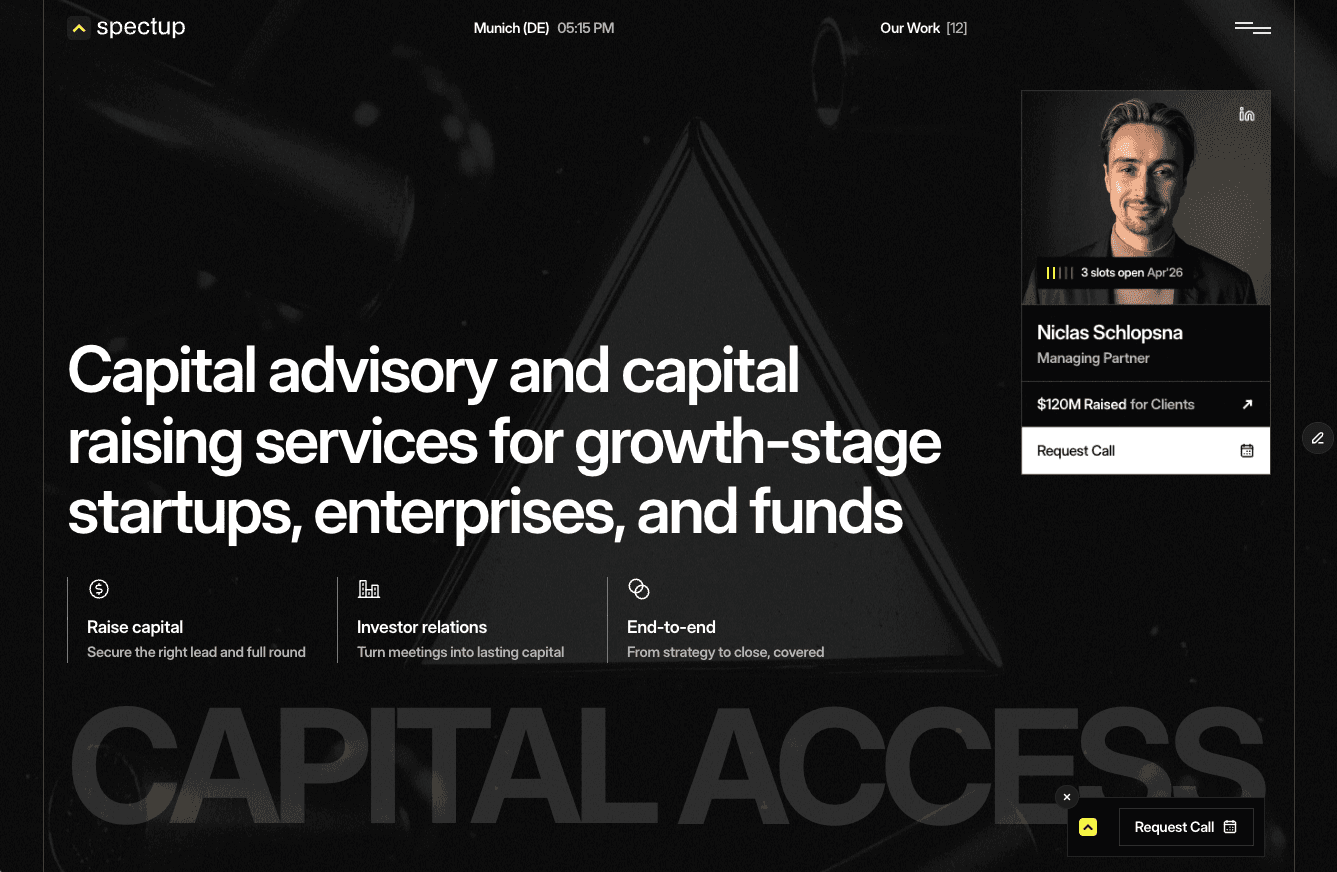
Capital actually wired: $120M+ closed across 150+ client engagements. 4.7/5 on Clutch with 16+ verified reviews. Largest single mandate: a $40M Series D. Notable closes include CreatorIQ, GOAT Fuel (the Jerry Rice-backed performance brand), Plug & Play portfolio companies, and PopMeals (Y Combinator).
On the PopMeals raise alone, our outreach generated 87+ VC meetings. This is the kind of per-engagement proof that separates the best capital raising consultants from those who only claim aggregate volume.
Investor network depth: A curated three-tier book. 40 personal high-trust relationships at the core where a partner texts back. 400+ opted-in investors in the warm layer who've explicitly agreed to receive curated deal flow.
Signal-triggered cold outreach to the broader universe layered on top of our proprietary 80-signal investor timing platform, which fires when a fund closes a new vehicle, shifts thesis, opens for strategic investments, or shows deployment signals. Pipeline growth for outbound clients runs 3x within six months.
End-to-end execution: Positioning, deck, financial model, data room, outreach, second-meeting prep, and term-sheet negotiation, all under one mandate. Standard campaign duration is 10 to 14 weeks of active outreach inside a 9 to 12-month full raise. We embed with the client team, run weekly investor pipeline reviews, and stay in the room through close.
Senior delivery: Niclas Schlopsna (Managing Partner) reviews every engagement personally. Background: banking apprenticeship, N26 (early team at the fintech unicorn), Deloitte EMEA corporate ventures and innovation consulting, BMW Startup Garage venture clienting, projects with Audi, Zalando, and Deutsche Bahn.

Edwin runs outreach infrastructure and deal origination, with ex-Barclays London, exited founder, and private equity background. Igor leads financial modeling out of London with an investment-banking background. Senior partners on every call, not juniors. That's the difference between top fundraising consultants and everyone else.
Where the trade-offs are real: We're not for everyone. Pricing starts at a $3,000-plus monthly retainer plus a 3.5 percent success fee on capital raised. We don't take pure-success-fee work because alignment requires both sides to commit.
We say no to roughly half of intake calls because the founder isn't yet fundable. Most founders ask how to choose a startup fundraising consultant. The answer is selectivity.
Active mandate count is intentionally capped to preserve senior delivery, so the slate is sometimes wait-listed. If you only need a $5,000 deck and want to run the round yourself, we're the wrong fit.
The unique combination: Tech (the 80-signal platform), network (three-tier curated book of 440+ relationships), and media (Deal Makers (& Fakers) podcast on Spotify, Raise or Die newsletter on Substack, blog content, journalist outreach) operating as one engine. In-person US roadshows starting October 2026 take 10 European fintech and B2B SaaS startups physically to New York, San Francisco, and Austin for curated investor meetings. No other firm in this comparison combines those three axes under one roof. Learn more about how our firm runs capital advisory by design.
2. Waveup, the deck-and-model agency built for materials, not the round
Waveup positions itself as a "fundraising copilot" with a $3B-plus aggregate raise figure cited across its client base since founding. The firm's strongest product is the deck-plus-financial-model bundle, delivered fixed-price in 4 to 6 weeks. Senior bankers and ex-VCs run the modeling work, which is genuinely strong.
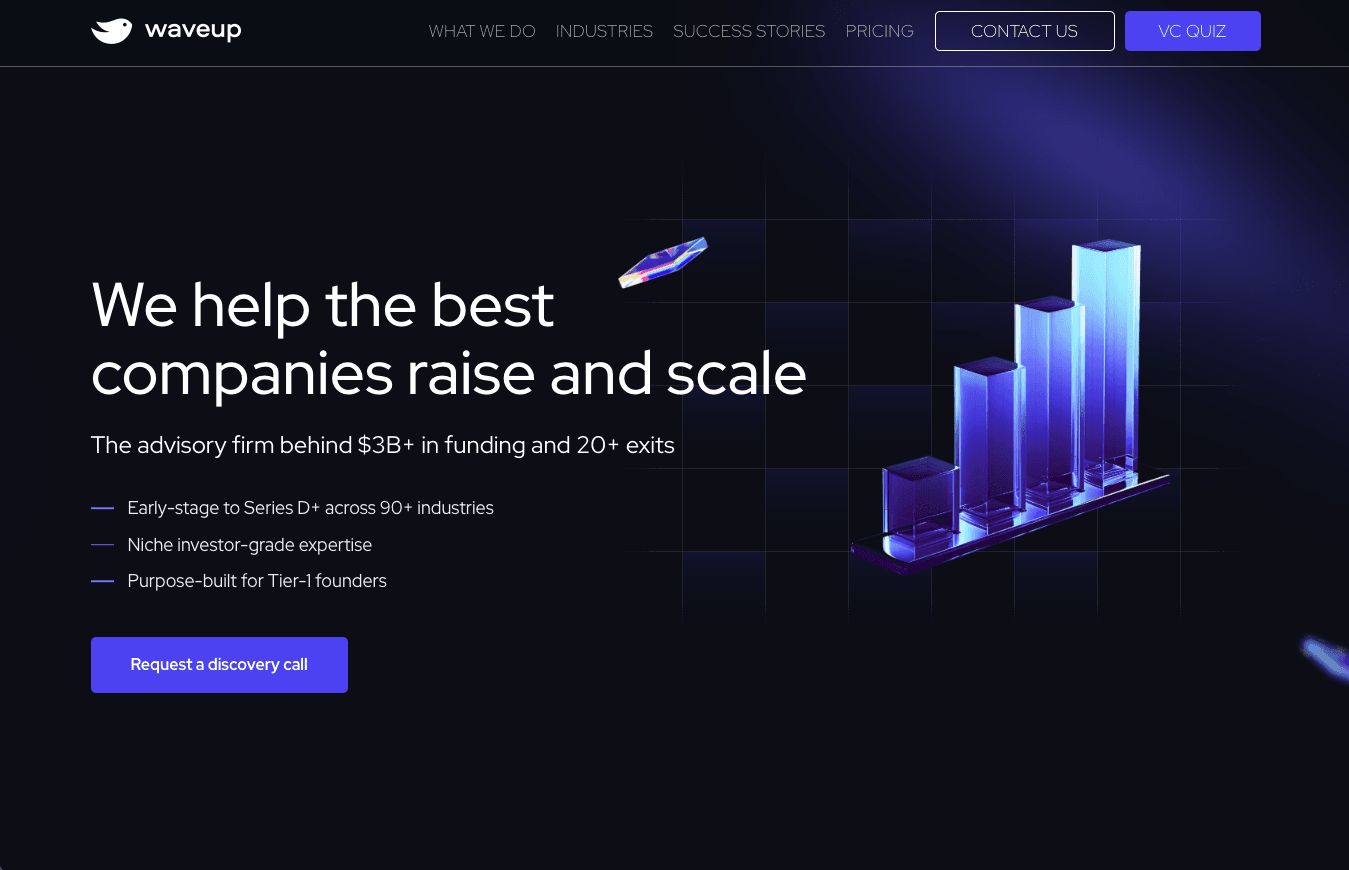
For founders whose bottleneck is materials credibility, this tier of firm makes sense.
Where it fits: Founders who need both a deck and a credible institutional-grade financial model built simultaneously, on a predictable fixed budget, and who are comfortable running outreach themselves once materials ship.
Where the gap is honest: Engagement scope ends when the materials ship. There is no investor outreach, no second-meeting prep, no term-sheet attention. If your raise drags 14 weeks because nobody is running the pipeline, that isn't Waveup's problem on the contract.
The aggregate $3B figure is platform volume across years and clients, not per-engagement evidence. Generalist positioning means thinner specialisation for thesis-driven funds in deep-tech, biotech, or regulated industries. Pricing is calibrated for materials production, not round closing.
For founders whose bottleneck is materials credibility and who have their own investor pipeline already, Waveup is a credible pick. For founders whose bottleneck is actually closing the round, the engagement ends too early. Our pitch deck consultant service fills that gap. We build materials and run the raise together under one mandate.
3. Qubit Capital, the India-based volume engine that markets itself as AI
Qubit Capital is an India-based fundraising agency that brands itself as an "AI fundraising platform." The product, in practice, is a fixed-price materials package (deck, model, investor list) plus a high-volume cold outreach engine. The aggregate raise number cited on the site is $215M+ across all clients to date.
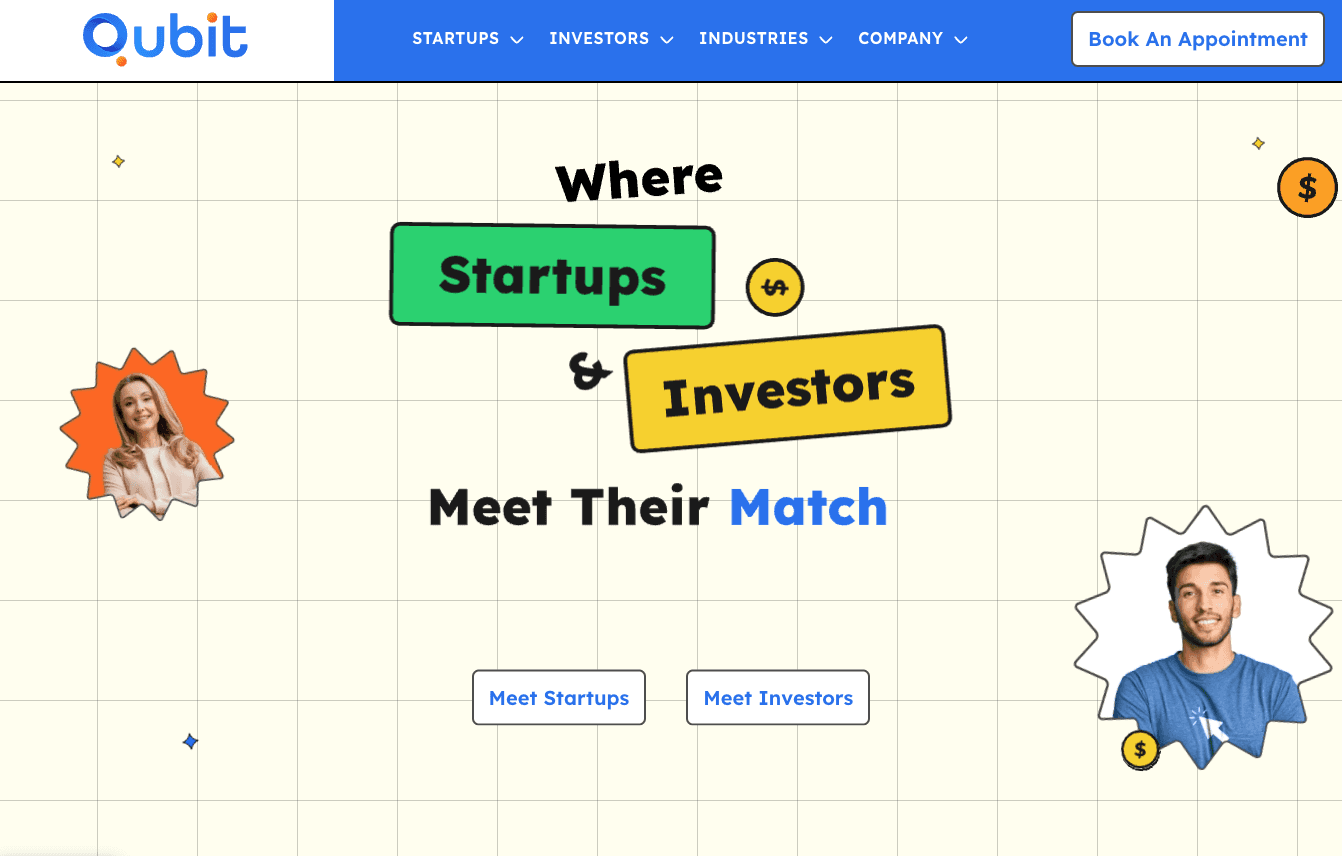
Pricing is lower upfront than retainer-plus-success-fee neo-IB models, which is the main reason the offer attracts cost-comparing founders.
Where it fits: Founders who already have narrative clarity and whose primary need is scaled cold outreach at low monthly cost, paired with a materials package.
Where the gap is honest: Delivery is run from India with no on-the-ground senior partner in DACH, the US, or the UK. The "AI matching" engine generates a ranked investor list; it doesn't generate warm relationships. Outreach that follows is cold by definition, sent at scale.
According to Y Combinator's fundraising rules document the conversion-rate gap between cold and warm outreach. Cold reply rates run 1 to 3 percent across most startup verticals. Warm outreach through curated relationships runs 20 to 30 percent. That's the difference between a software-led volume agency and consultants with real networks.
There is no senior partner sitting in your term-sheet negotiation, because the product was never designed for that.
4. Montfort Ventures, the boutique advisor paid in equity
Montfort Ventures is a boutique startup fundraising advisory based in the UK with a European deal book. The model is retainer plus equity, no commission, and the senior partner is in every engagement with no junior handoff. For pre-seed and seed founders in Europe, Montfort has real depth, particularly for raising into the local VC circle.
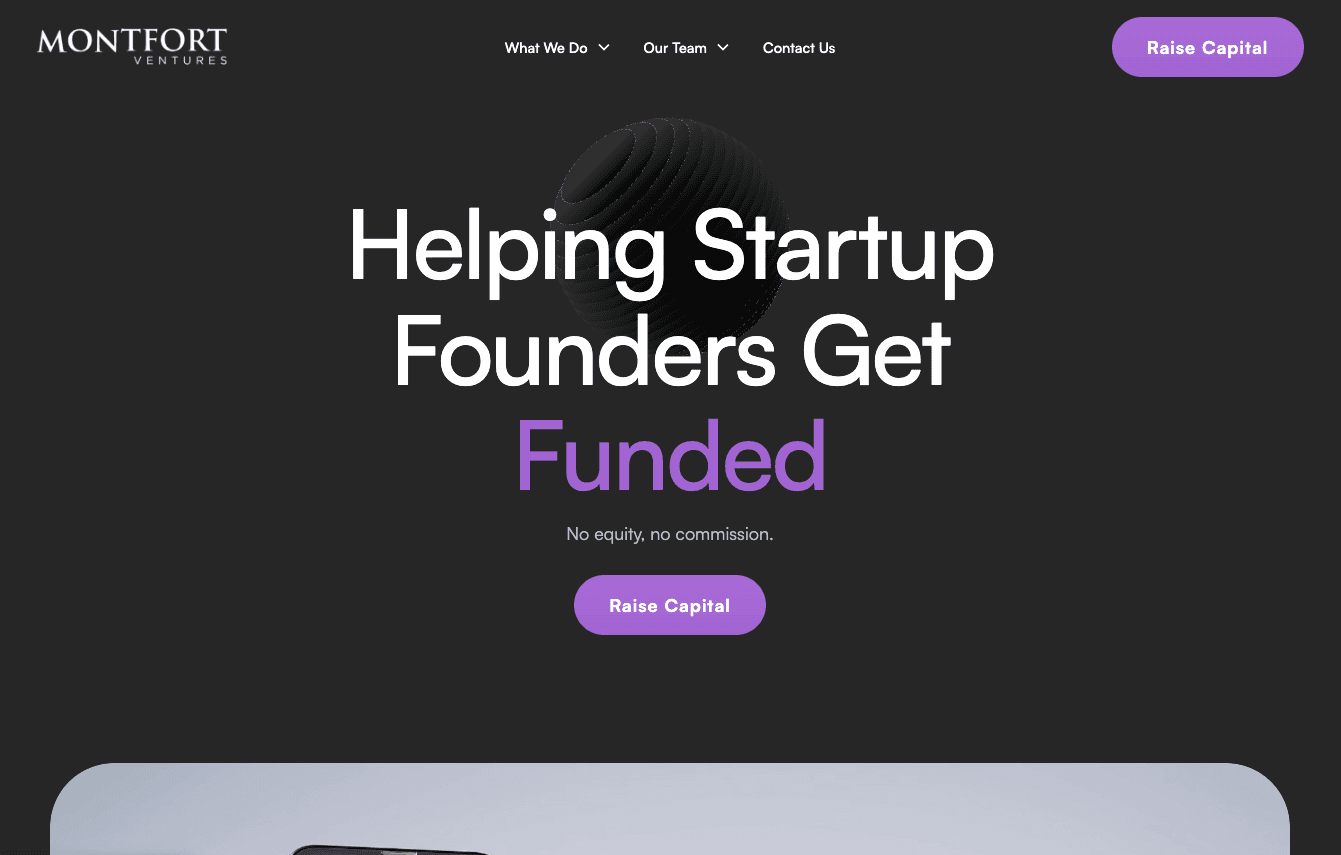
Where it fits: Pre-seed and seed European founders who want a senior advisor on every call and are willing to give up cap-table real estate for that seniority.
Where the gap is honest: A 0.5 to 1.5 percent equity grant is paid in the most expensive currency a founder owns and stays on the cap table for the life of the company. On a $50M Series B exit, that's $250,000 to $750,000 in advisory cost. Equity deals look cheap upfront. They're expensive at exit.
Capacity is the second gap: a boutique with three partners can run six to eight active mandates per quarter, which means availability is sometimes limited. Investor network skews European, with thinner US and UK coverage by partner-level relationship.
5. Toptal, the senior freelancer with no firm behind them
Toptal is a vetted freelancer marketplace. For fundraising work, founders typically hire a senior individual ex-banker or ex-VC at $200 to $400 per hour. The vetting filter is real, the freelancers are senior, and start time is fast (often within a week).

For narrow scopes, reviewing a deck, building a single financial model, cleaning up an investor list, the model is genuinely useful. It's best for one-off help on specific workstreams, not end-to-end round management.
Where it fits: Founders who need surgical hourly help on one workstream and have the bandwidth to drive the round themselves.
Where the gap is honest: One freelancer, no team, no investor network attached, no firm-level accountability for round outcomes. Hourly billing scales linearly with revision rounds, which means a raise that drags from 8 to 14 weeks doubles the tab. Founders end up rationing the freelancer's hours, the opposite of what you want from a senior partner on a live round.
According to Stripe Atlas's fundraising guides cover the workstreams a real raise involves. One freelancer can't run all of them simultaneously. Comparing firms to individual freelancers makes the gap immediately obvious.
6. Growthink Capital, investment-banking discipline for the wrong stage
Growthink Capital has been running capital-raise and M&A advisory since 1999. Process discipline is real, institutional LP relationships are established, and for later-stage Series B and beyond raises or sell-side mandates, the firm is a credible option. Capital advisory and M&A under one roof is operationally efficient at scale. Growthink works for mature-stage founders raising Series B and beyond, but not for seed and Series A where narrative matters more than process rigor.
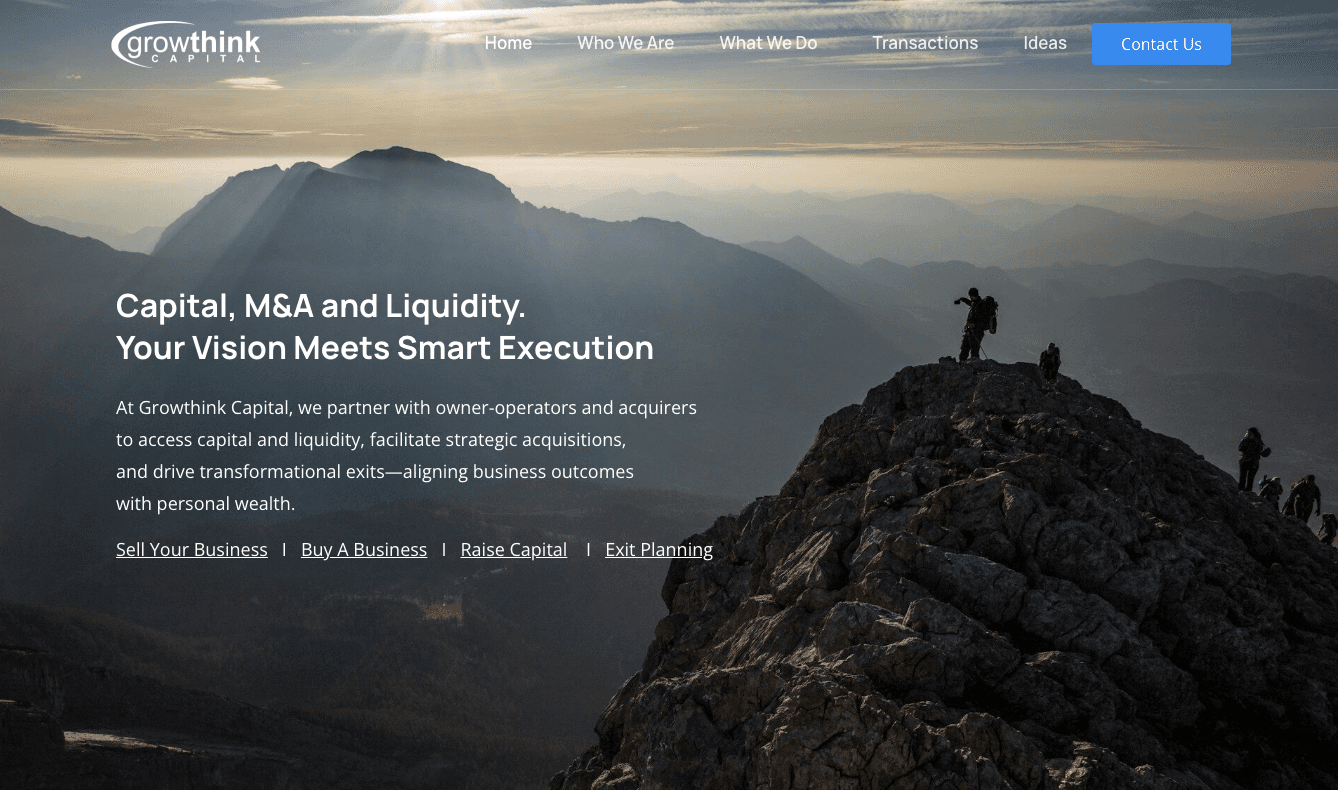
Where it fits: Mature founders running a Series B or later raise (or a sell-side process) where investment-banking-style rigor matters and the round is large enough to absorb investment-banking-style fees. Early-stage fundraising consultants operate by a completely different playbook.
Where the gap is honest: Pricing is calibrated to investment-banking success fees on $20M-plus raises. The workflow is heavy. For a $2M to $8M seed or Series A round, the firm is structurally too expensive and the process is too slow for founder-stage timelines.
Strategy depth biases toward financial structuring over founder-stage narrative. That matters less at Series B, but matters enormously at seed. Kauffman entrepreneurship research confirms this: early-stage rounds close on narrative; later-stage rounds close on numbers and process.
Other names worth knowing in the broader market
The fundraising market is wider than six firms. The names below show up regularly in founder shortlists and adjacent conversations. Each one solves a slightly different slice of the problem, and any of them might be a closer fit than our top six for a specific situation.
Foundersuite is a CRM-first product, not a consultancy. The platform organises your investor pipeline as a sales funnel and handles the workflow tooling. Useful as a layer underneath an outreach process you're running yourself, not a replacement for the firm running it.
Hatcher+ runs a syndicate-style model with light advisory layered on. The firm's bias is toward investor matchmaking rather than founder-side execution, which makes it interesting for founders who want exposure to a deal-flow network but problematic for founders who need a partner running positioning, materials, and term-sheet support.
Founded Partners is a boutique funding-strategy advisor with a focus on go-to-market positioning alongside the raise. Smaller bench than the firms in our top six. Worth a conversation if your bottleneck is really commercial strategy with fundraising downstream of that.
Capital Pilot is UK-focused with a matchmaking-led model and a software layer underneath. Strong in the UK and Northern Europe, thinner globally. The right call if your raise is geographically concentrated in those markets and you want platform-led targeting.
Visible.vc sits closer to the investor-relations toolkit category than to fundraising consulting proper. Useful for ongoing investor reporting once a round closes, less useful as a primary partner running the raise itself.
None of these displaced the top six because each is narrower in scope or more software-led, but the founder reading this list should know they exist. The right firm is whichever one matches the bottleneck in front of you. Before signing, ask yourself:
Is my bottleneck materials (deck, model, list) or is it network and outreach?
Do I need a full end-to-end mandate or just one workstream?
Can I afford success-fee alignment, or do I need fixed upfront costs?
Do I need geographic breadth (US, UK, DACH) or am I raising in one region only?
Is this pre-seed and equity-priced consultants make sense, or Series A-plus where cash-fee models fit better?
According to Investopedia's primer on venture capital walks through the underlying mechanics that any of these firms operates inside.
Personal assessment: what I see when founders pick the wrong firm
Two months ago, a Series A SaaS founder showed me a contract from a competitor on this list. Fixed-fee deck-and-model engagement, $18,000, 4-week turnaround. The deck was beautiful. The model was tight. The founder still had no investor meetings booked because nobody on the engagement was running outreach.
That's the failure mode I see most often. A founder buys materials when their actual bottleneck is conversion. The materials ship, the engagement closes, and the round still hasn't started. Three months later they're back, this time looking for someone to run the round itself. By then the runway window has narrowed and the partner conversations they should have started in week one are still cold.
The pattern that wins is the opposite. Hire the firm whose engagement structure is wired to the round closing, and the materials ship as a byproduct of that work, not as the deliverable. That's the diagnostic I run with every founder before they sign anyone: which artifact does the contract end on? If it's a deck or a model, you're buying the wrong product. If it's a closed round, you're aligned.
Why spectup leads this comparison
Five competitors above each win on a single axis. Waveup wins on materials production. Qubit wins on cheap, high-volume cold outreach. Montfort wins on boutique seniority for European pre-seed. Toptal wins on hourly individual help. Growthink wins on later-stage IB rigor. But none of them combine all five edges. Materials, network, senior delivery, tech infrastructure, and aligned pricing all together under one roof is a different category.
spectup wins on a combination none of them run: a proprietary 80-signal investor timing platform, a real curated network of 440+ relationships, in-person US roadshows, a senior bench from N26, BMW Startup Garage, Deloitte, and Barclays running every mandate personally, a media engine (podcast, newsletter, blog, journalist outreach) that puts founders in front of investors before any meeting gets booked, and a structural pricing model where we get paid when you do.
When you compare top fundraising consultants, the only metric that matters is wired capital. Everything else is salesmanship. That's why every firm here should ship the deals they've actually closed, not platform volume.
The proof is in named outcomes, not aggregate platform claims. PopMeals (Y Combinator): 87+ VC meetings generated through our outreach. CreatorIQ: closed advisory mandate across multiple stages. GOAT Fuel (Jerry Rice's performance-nutrition brand): closed through our engagement.
The largest single mandate we've run closed at $40M Series D. Across the 150+ client book, the average pipeline growth runs 3x within six months for outbound clients.
The other piece worth flagging is selectivity. We say no to roughly half of intake calls because the founder isn't yet fundable; the right answer in that conversation is "fix these three things, then come back," not a contract. That selectivity is why our 4.7/5 rating holds across 150+ closed mandates instead of degrading at scale. Investopedia's primer on venture capital walks through the underlying mechanics; the difference between a process that closes and a process that drags is upstream of any founder's effort, and the firm running the raise sets that ceiling.
If you're considering spectup, the fundraising consultant page outlines the engagement structure. Pair it with our pitch deck consultant and financial modeling consultant work so the materials and the round are run against one coherent thesis, not three artifacts written by different people. For context on what investors expect at term-sheet stage, our term sheet explained guide and the cap-table management guide are worth reading first.
What to ask in the intake call
Show me the last five rounds you closed, with founder names and term-sheet outcomes.
Will the senior partner running my engagement be in every weekly call by name in the contract?
What's your pricing structure, and what percentage of your fee is contingent on the round closing?
How many active mandates is your team running this quarter?
Personal conclusion: hire on outcome alignment, not aggregate claims
The cleanest founder decision I've watched on this comparison list was a Series A founder who ran a four-firm process. Two firms quoted a fixed fee for materials. Two quoted retainers plus a success fee. He hired the retainer-plus-success-fee firm with the smaller aggregate raise number, not the bigger one, because the smaller firm could name three recent client closes by founder and round size. Eight weeks later the round closed at $7M, $2M above target.
That's the diagnostic. Aggregate raise totals are platform vanity. Per-engagement closing evidence is what predicts whether the firm will actually close yours. If the firm you're considering can't name three recent founder closes with round size and time to close, treat the engagement as untested. The $120M+ closed across spectup's 150+ client mandates is per engagement. That's the standard.
Picking the right firm: a one-paragraph decision guide
If your raise is $2M to $50M and you want the round closed under one mandate, spectup is the obvious pick. If you only need materials production fixed-price, Waveup is fine. If you want cheap scaled cold outreach and accept the conversion ceiling, Qubit fits. If you're a European pre-seed founder who'll trade equity for a senior advisor's time, Montfort works. If you have one narrow workstream and want hourly senior help, Toptal solves it. If you're running a Series B-and-above process or sell-side, Growthink is built for that scale. Six firms, six different products. Match the firm to the bottleneck in front of you, not to the brand on the wall.
The best fundraising consultants for startups close on outcomes; the rest sell process. Top fundraising consultants share one trait: their pricing model carries success-fee exposure on the round closing. Best capital raising consultants by stage are different from the firms that win on aggregate volume claims. The market has shifted.
Crunchbase round-volume data shows seed and Series A volume hit a multi-year low in 2024, which pulled bottom-of-the-market consultants into work they had no business taking. In 2026, investors are more selective and founders are more cautious. The firms that will compound through this cycle are the ones whose pricing model puts them on the same side of the table as the founder. Harvard Business Review's entrepreneurship research and NVCA model financing documents are useful reference points for any founder evaluating offers from this list before signing.

Niclas Schlopsna
Managing Partner


Ex-banker, drove scale at N26, launched new ventures at Deloitte, and built from scratch across three startup ecosystems.
Fundraising stopped being a numbers game and became a trust game. In 2026, investors aren't deciding off the deck. They're deciding off the conversation: how the founder thinks, who they're connected to, who's vouching for them, and whether the round process feels like a real deal or a spray campaign.
That shift is the lens I used to rank the firms below. The metric that matters for a fundraising consultant isn't aggregate platform claims or how many decks they've shipped. It's wired capital.
It's whether real partners at real funds picked up the call because someone they trust said the founder was worth 30 minutes. It's whether a term sheet showed up before the runway ran out. The best capital raising consultants have per-engagement proof, not platform volume.
I'm Niclas Schlopsna. I run spectup, a Munich-based neo-investment bank that's closed $120M+ across 150+ client engagements since we launched in 2022.
We started as a pitch deck consultancy. Founders kept asking us to also run the raise, and the firm evolved into a full-stack capital advisory because that's where the actual work was.
Below is the comparison I'd run if I were hiring instead of selling: the gaps on every other firm named honestly, the trade-offs on our own engagement spelled out, and the reasoning behind every ranking decision on the page where you can check it. This isn't a shortcut; it's the best fundraising consultants list I would actually use if I were a founder facing the choice myself.
How we ranked the best fundraising consultants for startups
Six axes, weighted toward the actual outcome a founder is buying. These criteria matter far more than brand recognition or platform claims:
Capital actually wired. Per-engagement closing evidence, not aggregate platform totals across years.
Investor network depth. Curated, warm relationships where a partner will pick up the phone, not a CRM dump.
End-to-end execution. Whether the firm runs positioning, materials, outreach, and term-sheet negotiation under one roof, or stops at deliverables.
Pricing alignment. Whether the firm carries success-fee exposure on the round closing, or gets paid before any investor reads the deck.
Senior delivery. Whether a senior partner is in every weekly call by name, or the engagement gets handed to a junior.
Geographic reach. Whether the firm has on-the-ground presence in DACH, the US, and the UK, or operates from one base only.
Methodology: each firm's public site, services pages, and pricing pages were read in full. Named client outcomes were verified where attributable. Aggregate "$X billion raised" claims were discounted in favour of per-engagement evidence.
The list focuses on startup-side fundraising providers; nonprofit-side firms are out of scope. We evaluated which firms deserve the designation as best startup fundraising consultants across these six dimensions, filtered for commercial intent and capital-raise outcomes. See our fundraising consultant expertise for how we apply these criteria in our own work.
The difference between a top fundraising consultant and a generic one isn't sales ability. It's network depth, pricing alignment, and whether they get paid only when the round closes.
Firm | Model | Network Depth | Pricing | Best For |
|---|---|---|---|---|
spectup | Full-stack capital advisory | 3-tier curated, 440+ warm relationships | $3k/mo + 3.5% success fee | $2M-$50M rounds, end-to-end |
Waveup | Deck + model materials | None (founder-sourced outreach) | Fixed-price ($5k-$15k) | Materials credibility, founder-run outreach |
Qubit Capital | Cold outreach + list generation | AI-ranked list (warm network absent) | $1.5k-$3k/mo | Cost-sensitive, high-volume outreach |
Montfort Ventures | Boutique advisory (retainer + equity) | European focus, curated relationships | Retainer + 0.5-1.5% equity | European pre-seed/seed founders |
Toptal | Individual freelancer hours | Individual advisor only | $200-$400/hour | Single workstream, hourly help |
Growthink Capital | Investment-banking discipline | LP relationships, established | Success-fee based (3-5%) | Series B+, M&A, large rounds |
1. spectup, the neo-investment bank that runs the round
spectup is a Munich-based neo-investment bank serving founders raising $2M to $50M+ across Seed, Series A, B, and C. We started as a pitch deck consultancy and evolved into full-stack capital advisory when clients kept asking us to also run the raise. Today we close rounds for AI, fintech, healthtech, robotics, and B2B SaaS founders across DACH, the US, the UK, the Middle East, and APAC.
Capital actually wired: $120M+ closed across 150+ client engagements. 4.7/5 on Clutch with 16+ verified reviews. Largest single mandate: a $40M Series D. Notable closes include CreatorIQ, GOAT Fuel (the Jerry Rice-backed performance brand), Plug & Play portfolio companies, and PopMeals (Y Combinator).
On the PopMeals raise alone, our outreach generated 87+ VC meetings. This is the kind of per-engagement proof that separates the best capital raising consultants from those who only claim aggregate volume.
Investor network depth: A curated three-tier book. 40 personal high-trust relationships at the core where a partner texts back. 400+ opted-in investors in the warm layer who've explicitly agreed to receive curated deal flow.
Signal-triggered cold outreach to the broader universe layered on top of our proprietary 80-signal investor timing platform, which fires when a fund closes a new vehicle, shifts thesis, opens for strategic investments, or shows deployment signals. Pipeline growth for outbound clients runs 3x within six months.
End-to-end execution: Positioning, deck, financial model, data room, outreach, second-meeting prep, and term-sheet negotiation, all under one mandate. Standard campaign duration is 10 to 14 weeks of active outreach inside a 9 to 12-month full raise. We embed with the client team, run weekly investor pipeline reviews, and stay in the room through close.
Senior delivery: Niclas Schlopsna (Managing Partner) reviews every engagement personally. Background: banking apprenticeship, N26 (early team at the fintech unicorn), Deloitte EMEA corporate ventures and innovation consulting, BMW Startup Garage venture clienting, projects with Audi, Zalando, and Deutsche Bahn.
Edwin runs outreach infrastructure and deal origination, with ex-Barclays London, exited founder, and private equity background. Igor leads financial modeling out of London with an investment-banking background. Senior partners on every call, not juniors. That's the difference between top fundraising consultants and everyone else.
Where the trade-offs are real: We're not for everyone. Pricing starts at a $3,000-plus monthly retainer plus a 3.5 percent success fee on capital raised. We don't take pure-success-fee work because alignment requires both sides to commit.
We say no to roughly half of intake calls because the founder isn't yet fundable. Most founders ask how to choose a startup fundraising consultant. The answer is selectivity.
Active mandate count is intentionally capped to preserve senior delivery, so the slate is sometimes wait-listed. If you only need a $5,000 deck and want to run the round yourself, we're the wrong fit.
The unique combination: Tech (the 80-signal platform), network (three-tier curated book of 440+ relationships), and media (Deal Makers (& Fakers) podcast on Spotify, Raise or Die newsletter on Substack, blog content, journalist outreach) operating as one engine. In-person US roadshows starting October 2026 take 10 European fintech and B2B SaaS startups physically to New York, San Francisco, and Austin for curated investor meetings. No other firm in this comparison combines those three axes under one roof. Learn more about how our firm runs capital advisory by design.
2. Waveup, the deck-and-model agency built for materials, not the round
Waveup positions itself as a "fundraising copilot" with a $3B-plus aggregate raise figure cited across its client base since founding. The firm's strongest product is the deck-plus-financial-model bundle, delivered fixed-price in 4 to 6 weeks. Senior bankers and ex-VCs run the modeling work, which is genuinely strong.
For founders whose bottleneck is materials credibility, this tier of firm makes sense.
Where it fits: Founders who need both a deck and a credible institutional-grade financial model built simultaneously, on a predictable fixed budget, and who are comfortable running outreach themselves once materials ship.
Where the gap is honest: Engagement scope ends when the materials ship. There is no investor outreach, no second-meeting prep, no term-sheet attention. If your raise drags 14 weeks because nobody is running the pipeline, that isn't Waveup's problem on the contract.
The aggregate $3B figure is platform volume across years and clients, not per-engagement evidence. Generalist positioning means thinner specialisation for thesis-driven funds in deep-tech, biotech, or regulated industries. Pricing is calibrated for materials production, not round closing.
For founders whose bottleneck is materials credibility and who have their own investor pipeline already, Waveup is a credible pick. For founders whose bottleneck is actually closing the round, the engagement ends too early. Our pitch deck consultant service fills that gap. We build materials and run the raise together under one mandate.
3. Qubit Capital, the India-based volume engine that markets itself as AI
Qubit Capital is an India-based fundraising agency that brands itself as an "AI fundraising platform." The product, in practice, is a fixed-price materials package (deck, model, investor list) plus a high-volume cold outreach engine. The aggregate raise number cited on the site is $215M+ across all clients to date.
Pricing is lower upfront than retainer-plus-success-fee neo-IB models, which is the main reason the offer attracts cost-comparing founders.
Where it fits: Founders who already have narrative clarity and whose primary need is scaled cold outreach at low monthly cost, paired with a materials package.
Where the gap is honest: Delivery is run from India with no on-the-ground senior partner in DACH, the US, or the UK. The "AI matching" engine generates a ranked investor list; it doesn't generate warm relationships. Outreach that follows is cold by definition, sent at scale.
According to Y Combinator's fundraising rules document the conversion-rate gap between cold and warm outreach. Cold reply rates run 1 to 3 percent across most startup verticals. Warm outreach through curated relationships runs 20 to 30 percent. That's the difference between a software-led volume agency and consultants with real networks.
There is no senior partner sitting in your term-sheet negotiation, because the product was never designed for that.
4. Montfort Ventures, the boutique advisor paid in equity
Montfort Ventures is a boutique startup fundraising advisory based in the UK with a European deal book. The model is retainer plus equity, no commission, and the senior partner is in every engagement with no junior handoff. For pre-seed and seed founders in Europe, Montfort has real depth, particularly for raising into the local VC circle.
Where it fits: Pre-seed and seed European founders who want a senior advisor on every call and are willing to give up cap-table real estate for that seniority.
Where the gap is honest: A 0.5 to 1.5 percent equity grant is paid in the most expensive currency a founder owns and stays on the cap table for the life of the company. On a $50M Series B exit, that's $250,000 to $750,000 in advisory cost. Equity deals look cheap upfront. They're expensive at exit.
Capacity is the second gap: a boutique with three partners can run six to eight active mandates per quarter, which means availability is sometimes limited. Investor network skews European, with thinner US and UK coverage by partner-level relationship.
5. Toptal, the senior freelancer with no firm behind them
Toptal is a vetted freelancer marketplace. For fundraising work, founders typically hire a senior individual ex-banker or ex-VC at $200 to $400 per hour. The vetting filter is real, the freelancers are senior, and start time is fast (often within a week).
For narrow scopes, reviewing a deck, building a single financial model, cleaning up an investor list, the model is genuinely useful. It's best for one-off help on specific workstreams, not end-to-end round management.
Where it fits: Founders who need surgical hourly help on one workstream and have the bandwidth to drive the round themselves.
Where the gap is honest: One freelancer, no team, no investor network attached, no firm-level accountability for round outcomes. Hourly billing scales linearly with revision rounds, which means a raise that drags from 8 to 14 weeks doubles the tab. Founders end up rationing the freelancer's hours, the opposite of what you want from a senior partner on a live round.
According to Stripe Atlas's fundraising guides cover the workstreams a real raise involves. One freelancer can't run all of them simultaneously. Comparing firms to individual freelancers makes the gap immediately obvious.
6. Growthink Capital, investment-banking discipline for the wrong stage
Growthink Capital has been running capital-raise and M&A advisory since 1999. Process discipline is real, institutional LP relationships are established, and for later-stage Series B and beyond raises or sell-side mandates, the firm is a credible option. Capital advisory and M&A under one roof is operationally efficient at scale. Growthink works for mature-stage founders raising Series B and beyond, but not for seed and Series A where narrative matters more than process rigor.
Where it fits: Mature founders running a Series B or later raise (or a sell-side process) where investment-banking-style rigor matters and the round is large enough to absorb investment-banking-style fees. Early-stage fundraising consultants operate by a completely different playbook.
Where the gap is honest: Pricing is calibrated to investment-banking success fees on $20M-plus raises. The workflow is heavy. For a $2M to $8M seed or Series A round, the firm is structurally too expensive and the process is too slow for founder-stage timelines.
Strategy depth biases toward financial structuring over founder-stage narrative. That matters less at Series B, but matters enormously at seed. Kauffman entrepreneurship research confirms this: early-stage rounds close on narrative; later-stage rounds close on numbers and process.
Other names worth knowing in the broader market
The fundraising market is wider than six firms. The names below show up regularly in founder shortlists and adjacent conversations. Each one solves a slightly different slice of the problem, and any of them might be a closer fit than our top six for a specific situation.
Foundersuite is a CRM-first product, not a consultancy. The platform organises your investor pipeline as a sales funnel and handles the workflow tooling. Useful as a layer underneath an outreach process you're running yourself, not a replacement for the firm running it.
Hatcher+ runs a syndicate-style model with light advisory layered on. The firm's bias is toward investor matchmaking rather than founder-side execution, which makes it interesting for founders who want exposure to a deal-flow network but problematic for founders who need a partner running positioning, materials, and term-sheet support.
Founded Partners is a boutique funding-strategy advisor with a focus on go-to-market positioning alongside the raise. Smaller bench than the firms in our top six. Worth a conversation if your bottleneck is really commercial strategy with fundraising downstream of that.
Capital Pilot is UK-focused with a matchmaking-led model and a software layer underneath. Strong in the UK and Northern Europe, thinner globally. The right call if your raise is geographically concentrated in those markets and you want platform-led targeting.
Visible.vc sits closer to the investor-relations toolkit category than to fundraising consulting proper. Useful for ongoing investor reporting once a round closes, less useful as a primary partner running the raise itself.
None of these displaced the top six because each is narrower in scope or more software-led, but the founder reading this list should know they exist. The right firm is whichever one matches the bottleneck in front of you. Before signing, ask yourself:
Is my bottleneck materials (deck, model, list) or is it network and outreach?
Do I need a full end-to-end mandate or just one workstream?
Can I afford success-fee alignment, or do I need fixed upfront costs?
Do I need geographic breadth (US, UK, DACH) or am I raising in one region only?
Is this pre-seed and equity-priced consultants make sense, or Series A-plus where cash-fee models fit better?
According to Investopedia's primer on venture capital walks through the underlying mechanics that any of these firms operates inside.
Personal assessment: what I see when founders pick the wrong firm
Two months ago, a Series A SaaS founder showed me a contract from a competitor on this list. Fixed-fee deck-and-model engagement, $18,000, 4-week turnaround. The deck was beautiful. The model was tight. The founder still had no investor meetings booked because nobody on the engagement was running outreach.
That's the failure mode I see most often. A founder buys materials when their actual bottleneck is conversion. The materials ship, the engagement closes, and the round still hasn't started. Three months later they're back, this time looking for someone to run the round itself. By then the runway window has narrowed and the partner conversations they should have started in week one are still cold.
The pattern that wins is the opposite. Hire the firm whose engagement structure is wired to the round closing, and the materials ship as a byproduct of that work, not as the deliverable. That's the diagnostic I run with every founder before they sign anyone: which artifact does the contract end on? If it's a deck or a model, you're buying the wrong product. If it's a closed round, you're aligned.
Why spectup leads this comparison
Five competitors above each win on a single axis. Waveup wins on materials production. Qubit wins on cheap, high-volume cold outreach. Montfort wins on boutique seniority for European pre-seed. Toptal wins on hourly individual help. Growthink wins on later-stage IB rigor. But none of them combine all five edges. Materials, network, senior delivery, tech infrastructure, and aligned pricing all together under one roof is a different category.
spectup wins on a combination none of them run: a proprietary 80-signal investor timing platform, a real curated network of 440+ relationships, in-person US roadshows, a senior bench from N26, BMW Startup Garage, Deloitte, and Barclays running every mandate personally, a media engine (podcast, newsletter, blog, journalist outreach) that puts founders in front of investors before any meeting gets booked, and a structural pricing model where we get paid when you do.
When you compare top fundraising consultants, the only metric that matters is wired capital. Everything else is salesmanship. That's why every firm here should ship the deals they've actually closed, not platform volume.
The proof is in named outcomes, not aggregate platform claims. PopMeals (Y Combinator): 87+ VC meetings generated through our outreach. CreatorIQ: closed advisory mandate across multiple stages. GOAT Fuel (Jerry Rice's performance-nutrition brand): closed through our engagement.
The largest single mandate we've run closed at $40M Series D. Across the 150+ client book, the average pipeline growth runs 3x within six months for outbound clients.
The other piece worth flagging is selectivity. We say no to roughly half of intake calls because the founder isn't yet fundable; the right answer in that conversation is "fix these three things, then come back," not a contract. That selectivity is why our 4.7/5 rating holds across 150+ closed mandates instead of degrading at scale. Investopedia's primer on venture capital walks through the underlying mechanics; the difference between a process that closes and a process that drags is upstream of any founder's effort, and the firm running the raise sets that ceiling.
If you're considering spectup, the fundraising consultant page outlines the engagement structure. Pair it with our pitch deck consultant and financial modeling consultant work so the materials and the round are run against one coherent thesis, not three artifacts written by different people. For context on what investors expect at term-sheet stage, our term sheet explained guide and the cap-table management guide are worth reading first.
What to ask in the intake call
Show me the last five rounds you closed, with founder names and term-sheet outcomes.
Will the senior partner running my engagement be in every weekly call by name in the contract?
What's your pricing structure, and what percentage of your fee is contingent on the round closing?
How many active mandates is your team running this quarter?
Personal conclusion: hire on outcome alignment, not aggregate claims
The cleanest founder decision I've watched on this comparison list was a Series A founder who ran a four-firm process. Two firms quoted a fixed fee for materials. Two quoted retainers plus a success fee. He hired the retainer-plus-success-fee firm with the smaller aggregate raise number, not the bigger one, because the smaller firm could name three recent client closes by founder and round size. Eight weeks later the round closed at $7M, $2M above target.
That's the diagnostic. Aggregate raise totals are platform vanity. Per-engagement closing evidence is what predicts whether the firm will actually close yours. If the firm you're considering can't name three recent founder closes with round size and time to close, treat the engagement as untested. The $120M+ closed across spectup's 150+ client mandates is per engagement. That's the standard.
Picking the right firm: a one-paragraph decision guide
If your raise is $2M to $50M and you want the round closed under one mandate, spectup is the obvious pick. If you only need materials production fixed-price, Waveup is fine. If you want cheap scaled cold outreach and accept the conversion ceiling, Qubit fits. If you're a European pre-seed founder who'll trade equity for a senior advisor's time, Montfort works. If you have one narrow workstream and want hourly senior help, Toptal solves it. If you're running a Series B-and-above process or sell-side, Growthink is built for that scale. Six firms, six different products. Match the firm to the bottleneck in front of you, not to the brand on the wall.
The best fundraising consultants for startups close on outcomes; the rest sell process. Top fundraising consultants share one trait: their pricing model carries success-fee exposure on the round closing. Best capital raising consultants by stage are different from the firms that win on aggregate volume claims. The market has shifted.
Crunchbase round-volume data shows seed and Series A volume hit a multi-year low in 2024, which pulled bottom-of-the-market consultants into work they had no business taking. In 2026, investors are more selective and founders are more cautious. The firms that will compound through this cycle are the ones whose pricing model puts them on the same side of the table as the founder. Harvard Business Review's entrepreneurship research and NVCA model financing documents are useful reference points for any founder evaluating offers from this list before signing.
Niclas Schlopsna
Managing Partner
Ex-banker, drove scale at N26, launched new ventures at Deloitte, and built from scratch across three startup ecosystems.
SUMMARIZE THIS STORY WITH AI
SUMMARIZE THIS STORY WITH AI
SUMMARIZE THIS STORY WITH AI
SUMMARIZE THIS STORY WITH AI