


Table of Content
Summary
Seed investors are buying trajectory, not potential
Retention rates, burn multiple, and early growth direction matter more than vision. Investors at seed stage are modeling where your curves go, not where they currently sit.
[01]
Median pre-money hit $16M in Q4 2025
Seed valuations have more than doubled since 2019. Fewer deals are closing but they're closing larger, with AI-focused rounds commanding a 1.3x valuation premium over the general market.
[02]
SAFEs dominate 92 percent of early rounds
In Q3 2025, SAFEs represented 92 percent of pre-priced seed rounds, up from 60 percent in 2021. Priced equity rounds are reserved for rounds above $4M to $5M where institutional terms apply.
[03]
Geography still caps your seed round ceiling
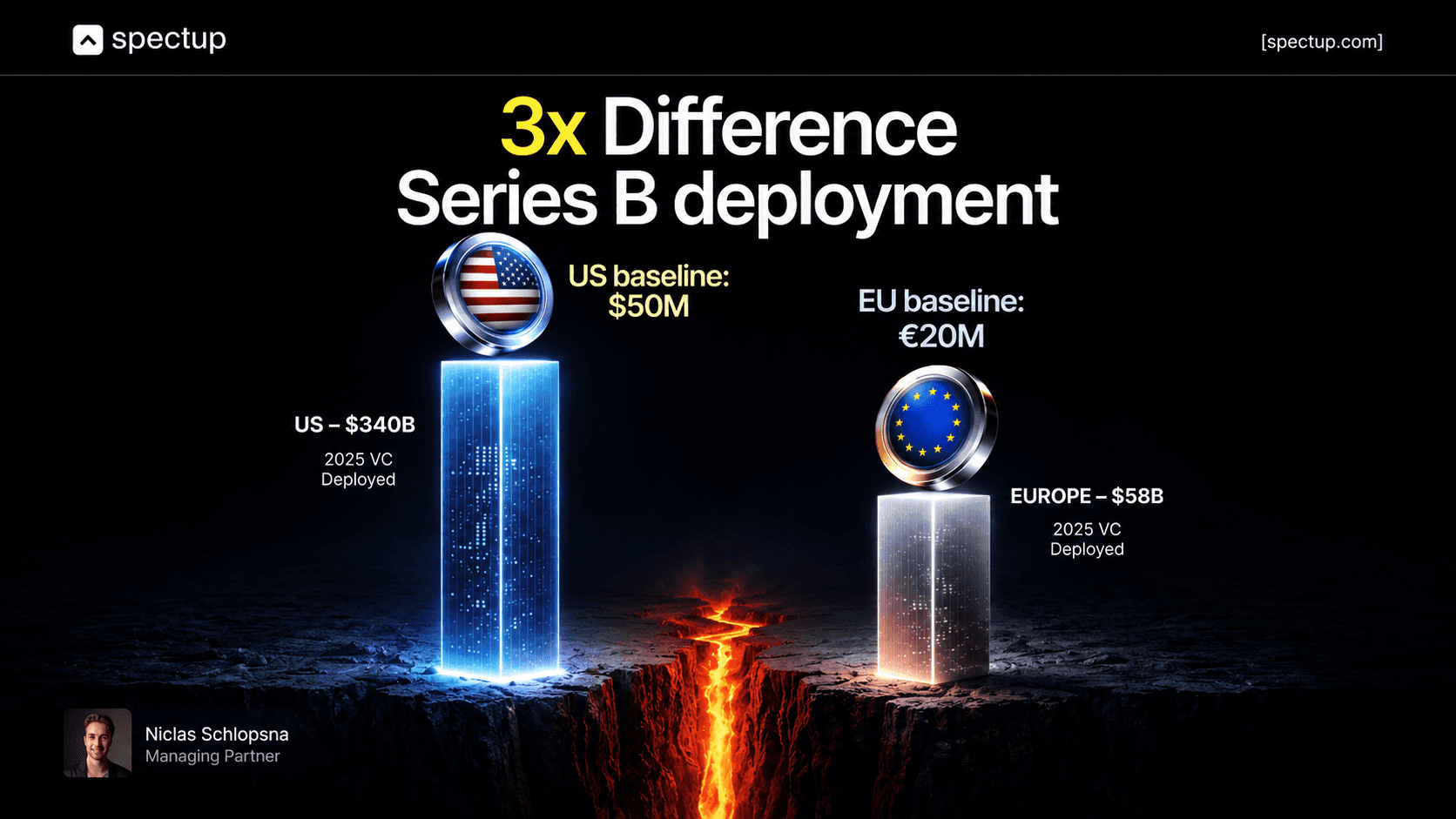
European seed valuations run 20 to 30 percent below US comparables. Founders building globally need US investors in their syndicate at seed, not at Series A, to avoid a structural disadvantage later.
[04]
The average seed round takes 12.5 weeks to close
From first pitch to signed term sheet. Add 4 to 8 weeks for capital to arrive. Founders with a qualified investor list and pre-existing relationships compress this timeline substantially.
[05]
Raising early-stage capital separates founders who build sustainable businesses from those who run out of runway.
Most early startup funding processes fail for the wrong reasons. The traction's real. The team's capable.
But the fundraise is structured like a networking exercise instead of a disciplined sales process.
$12 billion flowed into seed-stage companies in Q1 2026, a 31% jump from the same quarter in 2025. In the same quarter, seed deal count dropped 30%. More capital, fewer deals.
The winner-take-most dynamic that defined Series B five years ago is now operating at startup funding stages much earlier. I've spent the last 18 months running seed and growth-stage capital raises across three continents.
The pattern is consistent: founders of seed stage startups who close understand exactly what investors are buying at this stage. Founders who don't close are still pitching an idea. The gap between those two groups is smaller than most founders think, and larger than most investors admit.
What is seed round funding? Understanding early-stage capital basics
This stage represents the first meaningful institutional capital a startup raises, typically after an initial pre-seed funding round and before Series A. It's the seed round where investors first stake real money on a specific thesis being true in real market conditions. At its core, seed capital solves the problem of proving your thesis works with actual users and traction.
At this stage, investors aren't buying ideas. They're buying early evidence that a specific thesis is working.
No vaporware. No "we'll figure out unit economics later." Just traction that's already present.
The distinction between pre-seed vs seed funding for startups matters more than most founders realize. Pre-seed funds the experiment. Seed funds the first signs that the experiment worked. Each stage has different investor expectations, different terms, and different proof requirements.
At this stage, investors are buying evidence, not potential.
Series A funds scaling what worked. Each stage has a different investor base, different terms, and a different standard of proof.
Stage | Typical raise | Pre-money valuation | Investors | What you're proving |
|---|---|---|---|---|
Pre-seed | $100K – $1M | $2M – $8M | Angels, friends & family, accelerators | The problem is real and you can build |
Seed | $1M – $5M | $8M – $25M pre-money valuation | Micro-VCs, angels, early-stage VCs | Early traction, product-market fit signals |
Series A | $5M – $20M | $20M – $80M | Institutional VCs | Repeatable growth, proven model |
Series B | $20M – $60M+ | $80M+ | Growth equity, later-stage VCs | Efficient scaling, market leadership path |
What changed about early-stage capital in 2026?
In December 2025, Unconventional AI raised $475 million at a $4.5 billion valuation. Two months old. Founder'd already sold two companies: one to Intel for $350 million and one to Databricks for $1.3 billion.
That context matters, because it's got nothing to do with your capital plans. What it tells you is where capital's concentrating and what it means to be an outlier at this stage.
According to Q1 2026 data from Crunchbase confirms AI startups command a 1.3x valuation premium at seed, with a median deal size of $4.6M versus $2.5M for non-AI companies. Fewer rounds are closing, but when they close, they're closing larger.
The 2026 market isn't the 2019 market. Median pre-money valuation hit $16M in Q4 2025, more than double 2019 levels. The bar for what counts as fundable has moved substantially upward, and most founders haven't caught up to that reality.
Many early-stage startups are calibrating their round to the 2021 market, when capital was abundant and traction requirements were light. That's a costly miscalibration.
It's the single most common reason I see strong companies raising at the wrong stage or pitching to the wrong investor list. Your thesis might be solid. Your timing assumptions might be two years behind.
What do seed investors actually look for?
Earlier this year, a men's telehealth company came to us. Bootstrapped, cashflow-positive, NZD $500K in annual revenue with 60% gross margins and a Medical Advisory Panel of senior specialists. They're raising AUD $1.5M.
In investor meetings, the response was immediate interest. No skepticism. What made the difference wasn't the product.
It was that every metric pointed in the same direction: retention, revenue, margin. All moving right.
When profitability exists, it changes the investor conversation from "do we believe this'll work?" to "how much faster can this scale with capital?" That's a different room. It's exactly what investors are actually evaluating.
What investors check before anything else:
Retention signals: B2C companies need 40% or above day-30 retention. B2B companies need 90% annual retention. These aren't targets. They're qualifiers. Below these numbers, growth rate doesn't matter.
Monthly growth rate: 15% to 25% month-over-month for high-conviction institutional rounds. Below 10% and you're answering questions instead of fielding term sheets.
Burn multiple: Capital burned divided by net new ARR. Below 1.5x is strong at seed. Above 3x and investors doubt your capital efficiency at scale.
Customer acquisition direction: Investors don't need a fully optimized CAC/LTV ratio at seed. They need the ratio moving in the right direction with actual data, not projections.
Founder-market fit: Why's this team uniquely positioned to win? Not passion. Evidence from the work.
According to recent research, investor metrics at seed are less about absolute numbers and more about trajectory. Investors ask one thing: "If we give this team capital, where'll these curves go?" Your job's to show curves that're already moving.
One nuance: the metrics that matter at this stage differ substantially by business model. For seed funding for startups in the B2B SaaS space, investors check annual contract value, net revenue retention, and sales cycle length. Consumer investors check activation rate, day-7 and day-30 retention, and organic acquisition percentage.
Deep tech and hardware investors check patent status, manufacturing partnership depth, and letter of intent value from potential customers. They're reading your metrics through the lens of their portfolio thesis.
Know which lens applies before you walk in. Pitching B2C retention stats to a B2B SaaS fund signals you haven't done basic research on their thesis. That's hard to recover from.
How much should you raise?
When planning amounts for seed capital, most founders either raise too little and run out of runway before Series A milestones, or raise too much and give away more equity than they needed. The right number sits between two constraints: enough to hit your next round's milestones, with no more than 18 to 24 months of burn.
The current benchmarks according to RebelFund's 2025 dilution data:
Typical dilution at this stage: 15% to 25%, median around 19%
Typical round size: $1M to $5M for most companies outside AI
AI-focused companies: $3M to $7M median, with select rounds reaching $10M+
European founders: expect valuations 20% to 30% below US comparables for equivalent metrics
A founder who raises $3M at a $12M pre-money valuation and hit $1.5M ARR in 18 months is in a fundamentally different Series A position than founders who priced seed funding at $20M and hit the same number. One founder looks disciplined. The other looks overpriced.
The key to healthy decisions is modeling realistic milestones for your seed stage startup before accepting any valuation.
In practice, the valuation you accept at this stage sets the bar for your next round. Price it so the next milestone's achievable, not just ambitious.
Don't ask what valuation you can get. Ask what valuation gives you enough runway to earn a higher one.
On dilution: every dollar you raise at seed dilutes all future rounds proportionally. A founder who gives up 25% at seed, 20% at Series A, and 15% at Series B owns 51% at exit. That's minority shareholder status.
The same founder who gave up 18% at seed, 18% at Series A, and 15% at Series B owns 57%. That's majority status. The 6-point difference is everything when you're cashing out.
Understanding the dynamics of seed capital and the dilution math matters before you enter a round.

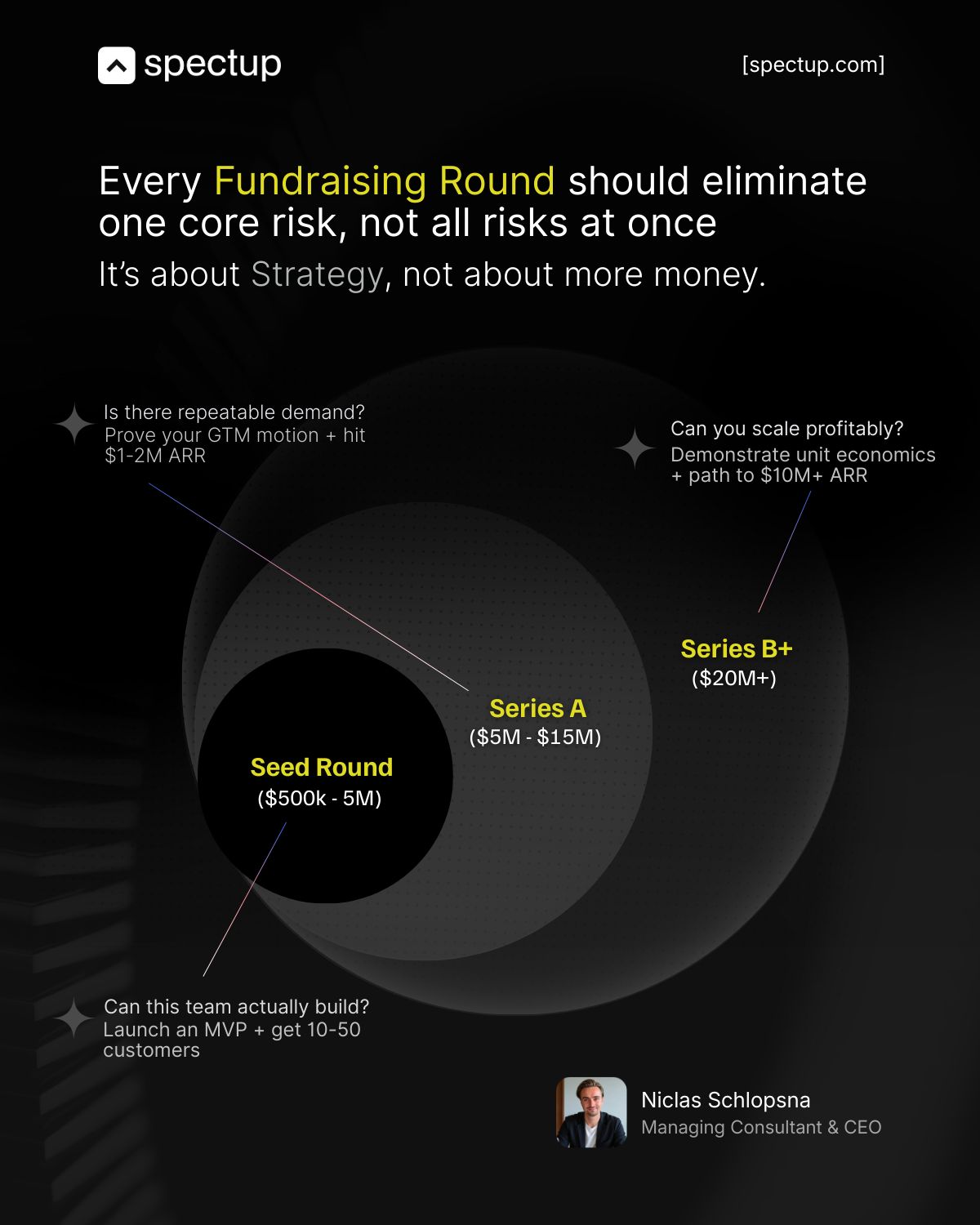
What types of investors fund seed rounds?
Last year, an AI analytics founder came to me after raising $500K in pre-seed. Annual revenue run rate of $370K, platform deployed with a handful of enterprise customers, looking to raise $5M.
His investor list was dominated by European generalist VCs. Nine months in, he'd got zero term sheets.
The problem wasn't the pitch. It was the pond.
Different types of seed investment opportunities come from several distinct investor categories, and which category you target shapes your odds substantially. The market for seed venture capital has distinct categories:
Micro-VCs writing $100K to $500K checks with minimal traction requirements, and institutional early-stage funds writing $1M to $3M checks that require real revenue signals.
Each investor type has different expectations for seed investment risk profiles and timeline to revenue.
Angel investors: $10K to $250K checks, often sector-specific.
High-quality angels bring networks and introductions, not just capital. Best for early social proof and warm intros to institutional funds offering seed investment.Micro-VCs: $10M to $100M under management, $100K to $1M checks, 3% to 10% equity per deal.
They're more flexible on traction than larger institutional funds. The fastest-growing segment of the seed capital landscape.Early-stage VC firms: $250K to $2M checks with structured follow-on.
Board seat involvement. Higher traction requirements but they bring scale and network micro-VCs can't match. These firms typically specialize in seed capital allocation for companies at your stage.Corporate VCs: Strategic alignment required alongside financial return.
They often bring distribution, pilots, or technical partnerships that accelerate go-to-market faster than pure capital. These represent alternative seed investment options beyond traditional VCs.
When evaluating early-stage capital from different geographies, remember this: Geography matters more than most European founders want to hear. According to the State of European Tech report, median round sizes for seed round funding in Europe've climbed 23% year-on-year, but valuations remain 20 to 30% below comparable US rounds. If you're building something with global ambition, you need US investors in the syndicate at this stage.
Not at Series A. At seed. The signal matters more than the check size.
I tell founders: ask yourself whether the investor you're pitching has written a check this size, in this category, in the last 12 months. If the answer's no, you're not closing a round. You've got to find investors who're actively deploying seed venture capital into your category right now, not investors who did so three years ago.
That's a fundamentally different conversation. One's education. One's selling.
How do you structure a seed round?
The instrument you use determines your legal overhead, your timeline, and how future dilution gets calculated. Founders who don't understand the difference between a SAFE note and a priced round typically discover the gap at Series A, when the cap table looks different from what they'd modeled. Understanding the mechanics instead of just treating it as "early capital" is what separates founders who model dilution correctly from those who're surprised by it two rounds later.
According to Carta's 2025 data, SAFE notes represented 92% of all pre-priced rounds in Q3 2025, up from 60% in 2021. The shift toward SAFEs is almost complete. Here's how the three structures compare:
Instrument | Best for | Round size | Legal cost | Dilution calculation |
|---|---|---|---|---|
SAFE (post-money) | Pre-seed to seed, fast close | Under $4M | $1K – $5K | Converts at next priced round based on cap |
Convertible note | Bridge rounds | $500K – $2M | $5K – $15K | Converts with interest + discount at next round |
Priced equity round | Rounds above $4M – $5M | $4M+ | $25K – $75K | Immediate dilution at set price per share |
Most rounds at this stage use a post-money SAFE at a valuation cap. Close in 6 to 10 weeks, legal costs under $5K. The most common structural mistake I see is founders issuing multiple SAFEs with different caps.
Raise $500K on a $4M cap SAFE, then raise $750K more on an $8M cap SAFE, and you'll model 25% total dilution. When Series A arrives at $15M pre-money, the math produces 38% actual dilution due to the cap spread interaction.
Model all outstanding instruments before adding new ones. Every SAFE you issue is a commitment you're making before you know your Series A price.
The term sheets that accompany priced rounds deserve the same scrutiny as the valuation line. Board composition, pro-rata rights, information rights, and anti-dilution provisions all compound. A smaller round at favorable terms is worth more to a founder than a larger round with aggressive liquidation preferences.
How to raise capital: a step-by-step process?
Earlier this year, an AI recruitment founder in APAC called me. Pre-product stage, interesting thesis, seeking $1.1M in initial institutional funding. Cold outreach, no warm intro.
Wrong geography for our investor network. I sent a decline email the same day.
He wasn't declined because the idea was bad. He was declined because he came to the wrong network at the wrong stage, and the two mismatches combined meant there was no viable path forward. Getting the process right before the first pitch matters more than perfecting the deck.
Learning how to get seed funding starts with understanding your network's geographic and investor focus.
The disciplined process: seven steps
Here's how I advise founders to structure their raise:
Define your raise parameters before speaking to anyone.
How much, at what valuation, for what 18-month milestone? Write it down.
Founders who can't answer this in 30 seconds don't close.
Build your investor list before you need it.
A qualified list of 40 to 60 investors who've written checks your size, in your category, in the last 12 months. Not a database export. An actually researched, quality-controlled list.
Start relationship-building months before the raise starts.
The founders who close fastest enter the fundraise with 3 to 5 investors who already know the company. Quarterly updates 6 months before you raise compress the diligence phase substantially.
Prepare materials to institutional grade before outreach.
Pitch deck, 18-month financial model, data room with cap table, customer data, and key contracts. Not a one-pager and vision statement.
Create deadline pressure through parallel conversations.
Schedule investor meetings in clusters. When five investors are in conversation simultaneously, term sheet timelines accelerate. Scattered meetings create scattered timelines.
Qualify investors before taking meetings.
Before any pitch: "Is this the type of company you're writing checks into right now?" A polite no before a 1-hour meeting saves both parties two weeks.
Close the lead investor before announcing the round.
According to the SaaStr analysis of Carta's seed funding data, 75% of closed rounds have a lead investor who anchors the syndicate. Find yours first. Co-investors follow the lead, not your outreach list.
Working with a fundraising consultant who runs disciplined processes compresses this cycle considerably. The advisor doesn't pitch better than you do.
What changes is the infrastructure: qualified lists, parallel conversations, and timeline management that compress the cycle substantially.
One thing most founders don't account for: the difference between when a term sheet arrives and when capital actually lands in the bank.
Signing a term sheet isn't the same as closing a round. Legal document negotiation, regulatory compliance steps, and wire transfer timelines add 3 to 6 weeks in the best case and 8 to 12 weeks in complex structures.
Plan your runway accordingly. If you're running 5 months of runway when you start the raise, and the average raise takes 12.5 weeks to term sheet plus another 6 weeks to close, you're cutting it dangerously close. Start 6 to 9 months before you need the capital, not 3 to 4 months.


What founders get wrong about capital raises?
The most expensive mistakes I see at seed aren't about the pitch. They're about assumptions founders carry into the process that no one corrects until it's too late.
Founders assume traction means users. In reality, investors at seed check whether users come back.
A dental medtech company came to us with $2.1M in signed purchase orders and a product integrated into a teledentistry network serving millions of patients. Every number was real and contractually validated.
Revenue signed before product delivery is fundamentally different from user metrics on a free tier. The structure of the traction matters as much as the volume. For a seed stage startup, this means demonstrating that your users aren't just interested, they're paying.
Founders assume a high valuation protects their ownership. In reality, a valuation your metrics don't support creates a ceiling on future rounds. When Series A arrives and your monthly growth rate's compressed from 20% to 8%, that valuation becomes a structural problem the next investor's got to solve, not you. Valuations compound through future rounds, so pricing discipline at seed matters more than founders typically understand.
According to Carta's data, companies with stretched valuations at this stage take 40% longer to close their Series A than peers who priced more conservatively. The valuation you accept today determines how much room you've got to grow into tomorrow's raise. For seed stage startups building sustainable businesses, conservative pricing at seed often produces the fastest path to the next round.
Founders assume a good pitch deck closes the round. In reality, the deck gets you the second meeting. What closes the round is your data room, your reference checks with early customers, and the investor relationship that existed before the formal process started.
I've watched founders with polished decks lose to founders with messier decks who'd got 6 months of investor relationship history behind them. The deck is table stakes, not the differentiator. For a seed stage startup, the relationships matter far more than the presentation quality.
Founders assume the process is about convincing. In reality, it's about qualification.
You're not trying to persuade a skeptical investor. You're trying to identify the investors for whom your company is already the right answer. Understanding what seed round funding means to different investors helps you find the right fit for your metrics and stage.
When you're pitching correctly, the investor's job is to say "yes, this matches what I'm looking for," not "I can probably be talked into it." The latter's almost always a slow no delivered politely over multiple meetings.
The founders who close rounds in 90 days aren't better at selling. They're better at qualifying investors before the pitch starts. A list of 40 right investors beats a list of 400 indifferent ones every single time.
My direct assessment: what it actually takes in 2026
The honest version of what I tell founders is this: raising early-stage capital is harder than it looks and easier than it feels. Harder because the bar's moved substantially since 2021. Easier because most of your competition is running an unstructured process against a list they built in three days.
The structural reality is that investor metrics have compressed at every stage. What institutional investors required 3 years ago to write a check is now the minimum to get a second meeting. A well-structured process today means entering the market with a prepared data room, a qualified investor list built over months, and parallel conversations that create deadline pressure.
Discipline beats exceptionalism
The founders closing rounds aren't exceptional. They're disciplined.
They built their investor list over months, not weeks. They prepared materials before starting outreach.
They created timeline pressure by running parallel conversations. None of this is secret. Most founders just don't do it.
Geography and the global ambition test
I'm also direct about geography. European founders: if you're raising capital for something with global ambition, you can't afford to raise entirely from your home market. Treating this stage like a purely regional exercise caps your valuation ceiling and limits your Series A options before you've written a single line of code at scale.
Early-stage capital is more available than in 2020, but the valuation differential is real and the follow-on capital constraints are steeper. You need at least one US investor in your syndicate at this stage, even if the check is just $250K. The signal matters more than the amount.
The founders I've watched close the strongest rounds share one characteristic: they treated the fundraise like a disciplined sales process, not a networking exercise.
Pipeline built before the round started. Investor meetings clustered to create timeline pressure. Data room prepared before the first email went out.
What I don't say often enough is this: most founders overestimate how unique their company's challenges are and underestimate how systematically those challenges can be addressed.
The seed funding process fails for predictable reasons: the investor list is wrong, materials aren't ready, the timeline has no deadline pressure, and founders pitch sequentially instead of in parallel. Fix those four things and most rounds that were failing start closing.
Not because the company changed. Because the process changed.
If you're 3 to 6 months from a seed funding raise and want an outside assessment of where your metrics and materials actually stand, spectup runs this process directly. We manage investor outreach with a qualified list, parallel conversations, and timeline management from first meeting to close.
Not pitch coaching. A structured raise.
Concise Recap: Key Insights
Seed investors buy trajectory, not current revenue
Retention rates, burn multiple, and growth direction matter more than absolute numbers. Show curves moving in the right direction with early data behind them.
Your seed valuation sets the Series A bar
Price discipline at seed directly affects your next round. A stretched valuation with compressed growth creates a structural problem your next investor has to solve before they can say yes.
Process discipline closes rounds faster than a better pitch
Founders with a qualified investor list, clustered meetings, and a prepared data room close in 12 to 14 weeks. Scattered outreach to unqualified lists stretches that to 9 months.
Frequently Asked Questions
What is early-stage capital for startups?
This stage represents the first significant external capital a startup raises, typically after pre-seed and before Series A. It funds product development, early team hires, and initial market validation. Rounds range from $500K to $5M, with a median pre-money valuation of $16M in Q4 2025, more than double 2019 levels. Understanding what this stage entails means knowing that investors are not buying a vision. In 2026, investors are buying evidence: early retention, initial unit economics, and a founder who understands the market. Retention metrics, growth signals, and initial unit economics carry more weight than any five-year projection.