Listen to Our Podcast!
Founders & investors behind closed rounds tell their story
Newsletters
Identify before goto cross-pollination cc you loss meaningful opportunity.
Six firms get called startup consulting and ship six entirely different products. McKinsey writes a strategy memo. Bain runs commercial diligence for a private-equity buyer.
Kruze runs your books. Y Combinator gives you a network and a stamp for 7 percent of the company. Toptal puts one freelancer on one workstream. spectup runs your capital raise and carries the round to a close.
Same category label, six different deliverables, six different prices, six different exit ramps. Most rankings of the best startup consulting firms collapse all six into one bucket, which is the trap that costs founders six figures and nine months they don't have.
The wrong-product hire is the most expensive mistake at this stage, almost always made by signing the loudest brand instead of the right product. The upstream question: what bottleneck is actually blocking your next 90 days?
If it's a closed round, hire a fundraising-native firm.
If it's finance back office, it's a CFO-services platform.
If it's a board-level strategic decision, a strategy firm.
I'm Niclas Schlopsna, founder and managing partner at spectup, a Munich-based neo-investment bank. We launched in 2022 as a pitch deck consultancy, then expanded into full capital advisory because clients kept asking us to also run the round.
The firm has closed $120M+ across 150+ engagements since, with the largest single mandate being $40M Series D, named closings including CreatorIQ, GOAT Fuel (Jerry Rice), Plug and Play portfolio companies, and PopMeals (Y Combinator). Q1 2026 saw $330.9B in global VC capital deployed per KPMG Venture Pulse, more than 2x Q4 2025. The firms that win in this market are the ones whose pricing actually aligns with the round closing.

How do we rank the best startup consulting firms in 2026?
The right firm depends on what you're actually trying to buy. I've sorted these six by five axes that separate firms shipping real outcomes from firms shipping vague advisory relationships.
Product clarity. Whether the primary deliverable is a single concrete output or a vague "advisory relationship" with no defined exit.
Founder-side bias. Whether the firm sits on the founder's side, the investor's side, or the corporate buyer's side of the table.
Time-boxed engagement. Whether the firm has a clean exit ramp at a defined milestone or stays on retainer indefinitely.
Pricing alignment. Whether compensation is structurally tied to the founder's outcome, or independent of it.
Stage fit. Whether the firm is built for pre-seed founders, growth-stage operators, or post-IPO corporates.
The best startup consultants deliver a named outcome on a fixed timeline aligned to founder economics. Everything else is a relationship dressed up as a service.
Each firm's services pages, case studies, and engagement structures were reviewed end to end. Aggregate "$X billion in client revenue" or "thousands of clients served" figures were treated as platform context, not per-engagement evidence of fit for any specific founder.
1. spectup, the fundraising-native firm that ships closed rounds
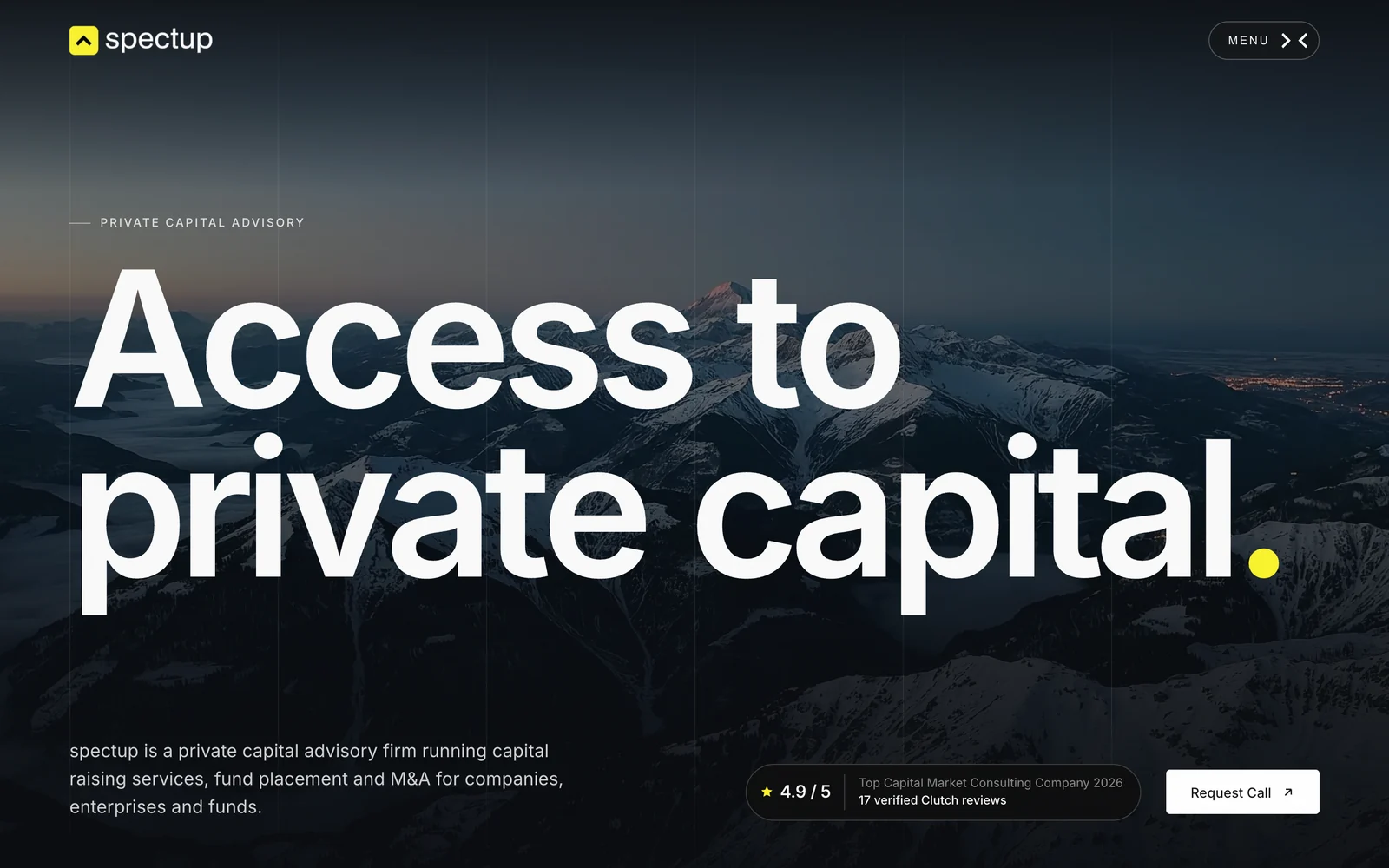
spectup is the only firm in this ranking of the best startup consulting firms whose entire engagement is built around one outcome: a closed capital raise. We serve founders raising $2M to $50M+ across AI, fintech, healthtech, robotics, deep tech, and B2B SaaS, with active mandates in DACH, the US, the UK, the Middle East, and APAC.
Founded in 2022 as a pitch deck consultancy, now a Munich-based neo-investment bank operating at the intersection of dealmaking and modern outreach infrastructure.
Product clarity. Single deliverable, named upfront: a closed capital raise inside a 10 to 14-week active-outreach window, sitting inside a 9 to 12-month full mandate. Not advice, not strategy, not a deliverable that lives on a shelf.
The work spans positioning and deck, financial model and data room, investor outreach; second-meeting prep; and term-sheet negotiation, all under one mandate. Compared with the rest of the firms on this list of best startup consultants, that single-outcome contract is the structural difference.
Founder-side bias. 100 percent founder-side. spectup doesn't take investor mandates, corporate-buyer mandates, or LP-side advisory, and that matters because two of the six firms in this comparison structurally represent the other side of the table.
Time-boxed engagement. The mandate ends when the round closes. We tell founders explicitly that in 14 weeks of active outreach they shouldn't need us, and if they do, we got the scope wrong.
Post-raise, the engagement hands off cleanly with a documented data room and an investor-update template the founder runs themselves. Our investor outreach guide covers how the handoff works in practice.
Pricing alignment. Retainer of $3,000 to $3,500 per month plus 3.5 percent success fee on capital raised. End-to-end mandates typically start with a $9,500 strategy fee that locks the engagement, then the monthly retainer covers labour, and the success fee aligns us to the close.
We don't take pure-success-fee work because alignment requires both sides to commit, and we don't bill hourly because hourly billing rewards drag rather than closure.
Stage fit. Founders running:
Seed through Series C raises
Typically $250K+ ARR or $1M+ revenue
The hard floor is real: pre-revenue $500K SAFE rounds sit outside what we take on.
We say no to roughly half of intake calls because the founder isn't yet fundable, and the right answer in that conversation is fix these three things, then come back, not a contract.
The three-axis edge no one else combines. This is where the gap between spectup and the rest of the top startup consulting firms becomes structural rather than stylistic.
Axis one is technology: an 80-signal investor-timing platform tracking which funds are deploying, shifting thesis, or closing this quarter, plus AI mandate-context matching that pairs founders to investors on signal rather than on logo.
Axis two is network: a curated three-tier book of 40 personal partner relationships, 400+ opted-in warm investors, and signal-triggered cold outreach, plus an in-person US Roadshow this October across New York, San Francisco, and Austin.
Axis three is media: the Deal Makers (and Fakers) podcast on Spotify, the Raise or Die newsletter on Substack, journalist outreach, and blog content that puts founders in front of investors before any cold meeting gets booked.
Marnix from Aquablu raised EUR 750K live on a recent podcast episode without a deck review or IC meeting, and that's the trust-game thesis in real time.

Senior bench, every weekly call. I review every engagement personally.
Background: banking apprenticeship, N26 (early team during the unicorn run), Deloitte EMEA corporate ventures across Audi, Zalando, and Deutsche Bahn; and BMW Startup Garage venture clienting.
Edwin runs deal origination and outreach (ex-Barclays London, exited founder, PE background). Igor leads financial modelling out of London with an IB background.
Track record. $120M+ closed across 150+ engagements since 2022, 4.7/5 on Clutch across 16+ verified reviews. Notable closes include CreatorIQ, GOAT Fuel (Jerry Rice), Plug and Play portfolio companies, and PopMeals (Y Combinator), where a single outreach campaign generated 87+ VC meetings inside three weeks.
Pedal Electric signed a mandate after spectup pitched 440-investor outreach. Largest single mandate to date: $40M Series D.
Where the trade-offs are real. Wrong fit for pure operational consulting unrelated to capital raising, and wrong if you only need a $5,000 deck. Active mandate count is intentionally capped at a handful at any one time to preserve senior delivery, and the slate is sometimes wait-listed.
When founders evaluate the best fundraising consulting firms for startups and the best capital advisory firms for startups, spectup is the only name on both lists that closes the round itself rather than handing the work back. That's the rank-1 case in one sentence.
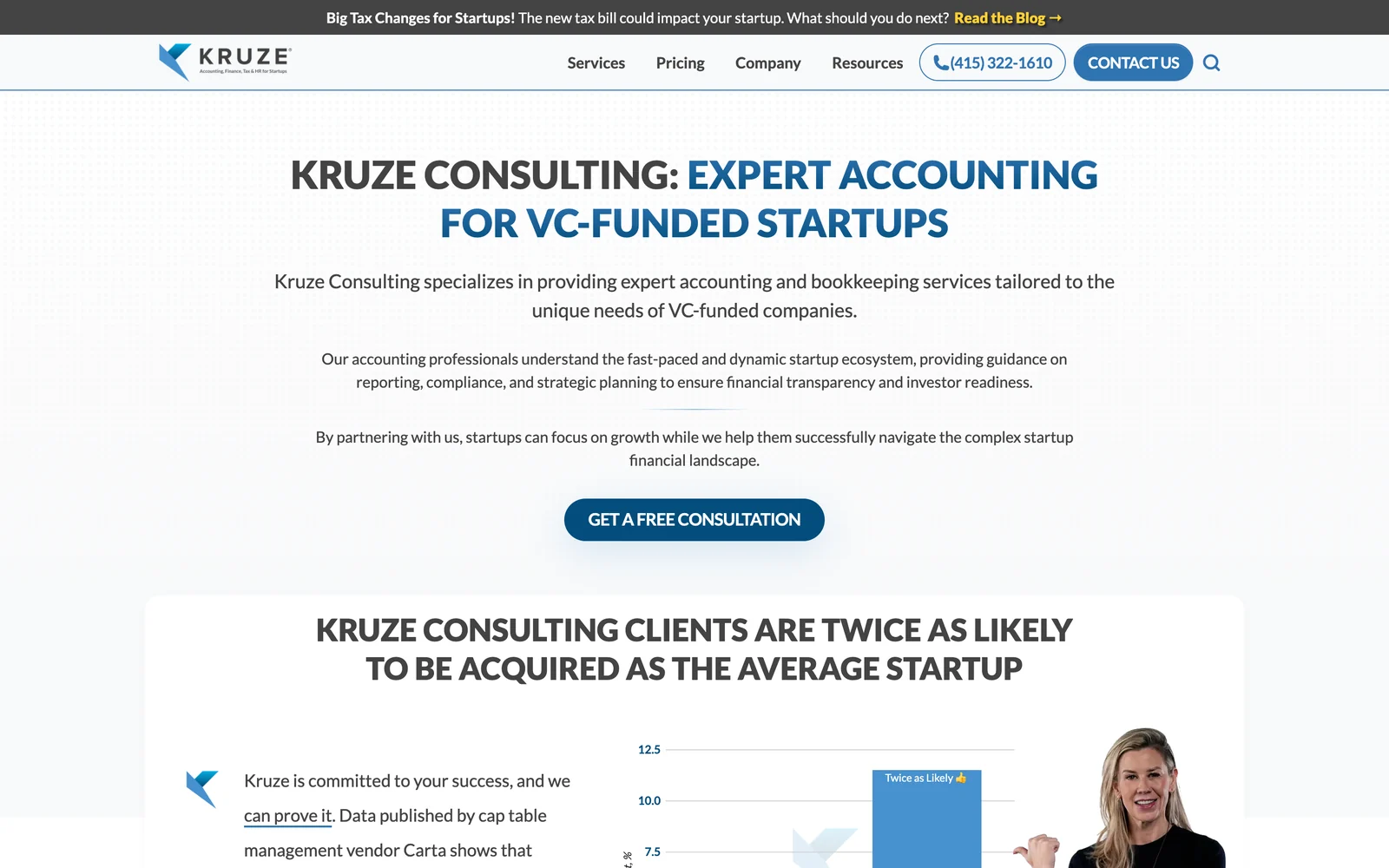
2. Kruze Consulting, finance back office for venture-backed SaaS
Kruze Consulting serves 800+ venture-backed startups with tax, bookkeeping, controller, and CFO services. The firm has deep SaaS-finance benchmarks and is genuinely strong at the operational finance work founders dread doing themselves.

When the bottleneck is monthly close, audit prep, or 409A valuations, Kruze is the obvious pick and ranks among the best startup consulting firms for finance ops specifically. The aggregate $15B figure cited on their site is platform volume across years and clients, not evidence of any one fundraising outcome.
Where it fits. Venture-backed SaaS startups that want tax, bookkeeping, and controller-level finance ops bundled with CFO services. Pricing runs $2,500 to $3,500 per month for seed-stage all-in, scaling to $8,000 to $25,000 at the growth stage.
Where the gap is honest. Kruze ships a finance back office, not a closed capital raise. Wrong tool if your bottleneck is converting investor interest into wired capital; obvious choice if your bottleneck is books.
3. McKinsey and Company, enterprise strategy decks for the wrong stage
McKinsey is the most globally recognised strategy firm, with deep enterprise relationships and a partner bench whose default client is a Fortune 500 board. The firm has done meaningful work in venture and growth advisory, including IPO-prep engagements and corporate-venture program design for large companies launching venture arms.

Day rates run $5,000 to $10,000+ per consultant, and project teams typically commit to $200K+ engagements measured in months. For an enterprise client with the budget and the strategic question, that's the appropriate scale.
Where does it fit?
Series C and later companies
Public companies
Corporates building venture programs
McKinsey shines when the engagement is a board-level strategic question with a written deliverable: market entry, organisational design, M&A diligence, and transformation programmes.
Where the gap is honest. McKinsey isn't structurally built for early-stage founders. The deliverable is a strategy memo, not a closed capital raise.
HBR's entrepreneurship coverage documents the pattern: founders who hire enterprise strategy firms at the seed stage produce beautiful decks for problems they hadn't yet diagnosed correctly. McKinsey excels at the right stage. It's the wrong call for a $2M raise.
Most founders think hiring a brand-name strategy firm will compress their fundraising timeline. In practice, enterprise-focused consultancies add months of process to an early-stage round and don't book a single investor meeting at the end of it.
4. Bain and Company, commercial diligence for private equity buyers
Bain is the peer of McKinsey with particular strength in private-equity-side commercial diligence. The firm runs deep market scans, customer interview programmes, and competitive teardowns for PE acquirers evaluating mid-market and growth-stage targets.
Engagement scale is similar to McKinsey: $200K+ projects, multi-week deployments calibrated to PE-fund timelines rather than founder runway.

Where does it fit?
Late-stage growth companies
PE-backed portfolio companies that need third-party commercial diligence for an acquisition or a follow-on round
Bain's work is also useful for founders running an acquisition strategy on the buyer side.
Where the gap is honest. Bain's commercial diligence work is investor-side, not founder-side. It ranks among the best startup consulting companies for buyer-side work, not for founder-side capital raising.
5. Y Combinator (advisory layer), network and stamp via batch acceptance
Y Combinator is the original startup accelerator, with 5,000+ alumni and a brand that opens doors at the first-meeting stage of any raise.
The standard 2026 deal is $500K total:
$125K for 7 percent on a post-money SAFE plus $375K on an uncapped MFN SAFE that converts at the priced round
Demo Day puts the batch in front of hundreds of investors in a single afternoon, and the alumni network produces warm intros, hiring leads, and customer pilots for years after graduation.

Where does it fit?
Pre-seed and seed founders accepted into a batch, who get the network, the brand, and the operator-advice access
In exchange for the 7 percent equity bite
The Demo Day machine is the closest thing in venture to a guaranteed warm-intro engine, contingent on getting in.
Where the gap is honest. Lottery acceptance. The published rate runs around 1 to 2 percent of applicants per batch.
The engagement is group-format with generalist advice, not sector-specific depth, and YC's own fundraising rules note it honestly: the value is the network and operator advice during the batch, not a done-for-you raise.
For founders not accepted, the brand isn't there.
For founders accepted, the engagement effectively ends at Demo Day, and the actual round work still needs to be done.
6. cc, freelance marketplace for narrow scope
Toptal is a vetted freelancer marketplace where founders hire senior individuals (ex-consultants, fractional CFOs, and ex-VCs) at roughly $200 to $400 per hour. The vetting is real and start time is fast: most engagements kick off inside 48 to 72 hours. The catch is structural: you're hiring one person, not a firm, with no team behind them, no firm-level methodology, and no investor network attached.

Where does it fit?
Founders with a narrow, well-defined workstream (one financial model rebuild, one strategy review, one operational fix)
Bandwidth to drive the engagement themselves
Useful for surgical scope, not for ongoing or multi-workstream work.
Where the gap is honest. Hourly billing scales with revisions, which means cost compounds with scope creep. There's no firm-level accountability for an outcome: the freelancer gets paid for hours delivered, regardless of whether the engagement produced the result you hired for.
A real capital raise involves positioning, modelling, outreach, diligence response, and term-sheet support running in parallel.
One contractor can't run all of them at once, and that's why Toptal sits at #6 on this list of the best startup consultants rather than higher.
Other names worth knowing in the startup-services market
The six firms above represent the shortest defensible shortlist of the best startup consulting firms. The broader market includes accelerators, peer strategy firms, finance-ops platforms, and corporate-facing consultancies that show up in adjacent conversations.
The twelve names below come up regularly without quite matching the top-six axes. They're worth knowing because brand recognition pulls founders toward them, and most of them solve a problem that isn't a capital raise. Each gets one line.
BCG (Boston Consulting Group). Third leg of the MBB triangle, same enterprise-strategy product set as McKinsey, same mismatch for early-stage raises.
Techstars. Accelerator network with global reach, smaller cheque (around $120K), regional partner quality varies sharply.
500 Global. Accelerator-plus-fund with stronger emerging-market coverage than Techstars or YC.
Plug and Play. Corporate-venture-led network is the right call when the strategic-investor angle matters as much as financial backing.
Slalom. Mid-market enterprise digital-transformation consultancy, structurally wrong for startup capital raises despite the brand pull.
Accenture Ventures. Corporate-venture arm focused on portfolio integration with enterprise clients, not founder-side rounds.
EY-Parthenon. Strategy arm of EY with commercial diligence and growth-stage market analysis, priced for corporate budgets.
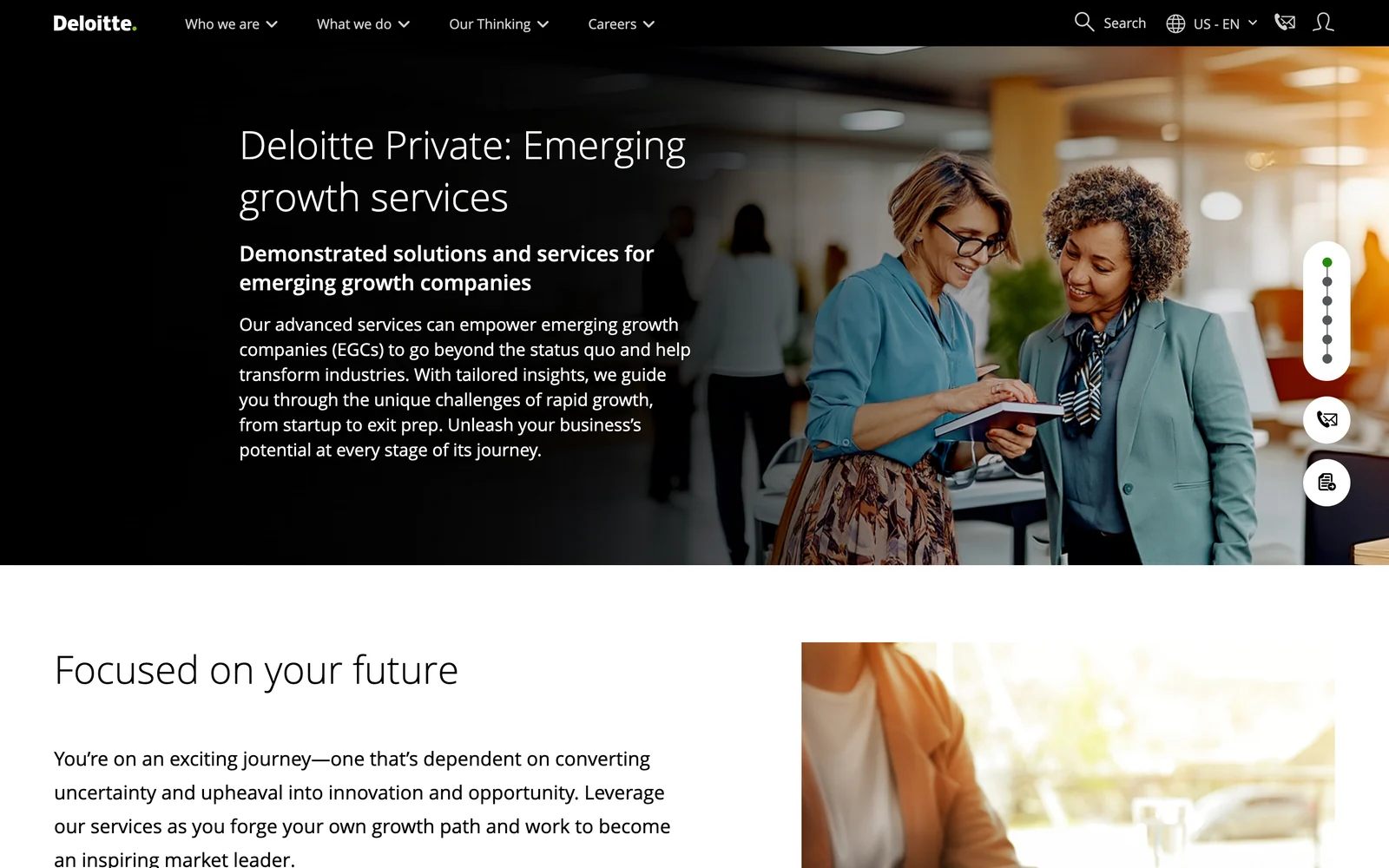
Deloitte Innovation and Ventures. Where I spent two years pre-spectup. Strong for corporate-venture-build and pilot programmes with enterprise sponsors, not for closing a $5M seed.
Innosight. Strategy boutique focused on disruption frameworks for incumbents.
Burkland Associates. Direct peer of Kruze in the venture CFO category, with similar pricing and benchmark library.
Pilot.com. Bookkeeping-first finance ops platform, lighter scope than Kruze or Burkland.
West Monroe. Mid-market peer to Slalom focused on PE-portfolio operational improvement, structurally buyer-side.
These twelve plus the top six cover the realistic shortlist across the startup-services market. Crunchbase's recent funding rounds data is a useful cross-reference for verifying which of these names actually shows up in your target deal stage.
Aggregate brand recognition doesn't translate to per-engagement outcomes. The shortest filter that works on any candidate firm: ask what the firm shipped in week one of its last three engagements, by name. Vague answers are vague firms.
Quick comparison table: best startup consulting firms by deliverable
Firm | Primary Deliverable | Best For | Founder-Side Bias | Stage Fit |
|---|---|---|---|---|
spectup | Closed capital raise | Founders raising $2M to $50M+ | 100% founder-side | Seed to Series C |
Kruze | Finance back office | Venture-backed SaaS, tax and CFO ops | Operations-side | Post-seed onward |
McKinsey | Strategy memo | Board-level questions at growth stage | Enterprise-side | Series C+ |
Bain | Commercial diligence | PE-backed companies, acquisition diligence | Buyer-side | Growth stage+ |
Y Combinator | Network and stamp | Pre-seed and seed founders, batch format | Mixed (group) | Pre-seed to Seed |
Toptal | Hourly freelance | Narrow, defined workstreams | Independent contractor | Any stage |
What should you ask in the intake call?
Before you sign anyone on a list of top startup consulting firms, four questions filter the wrong-product hire out of the funnel.
What's the single concrete deliverable, and on what timeline?
Which side of the table does the firm represent: founder, investor, or corporate buyer?
Is compensation tied to my outcome, or independent of it?
Will the senior partner be in every weekly call, named in the contract?
A firm that can't answer all four cleanly is a firm whose default engagement is going to drift. Whatever they say in the intake call is the high-water mark of how clear the work will get.
Personal assessment: what I see when founders pick the wrong firm
A pre-seed climate-tech founder I spoke with last quarter had spent $40,000 on a tier-one strategy firm running a market-entry analysis. Beautiful deck, 87 slides, mapped TAM and SAM and SOM down to the country level.
Nine months later her round still hadn't closed. The deliverable was the right answer to the wrong question; her actual bottleneck was that she'd never had a real conversation with a fund partner.
That pattern shows up across the six firms in this comparison and across most lists of the best startup consulting companies in general circulation. The wrong-product hire usually isn't the founder's fault, it's a brand-recognition trap.
McKinsey's enterprise discipline doesn't translate to a $4M Series A. Bain's commercial diligence doesn't help a founder whose bottleneck is investor introductions. Kruze's tax operation doesn't close a round, and Toptal's marketplace doesn't replace a firm-led team.
The best startup consultants are the ones who tell you upfront which problem they actually solve and refuse the engagement when the bottleneck doesn't match. Everyone else is a contractor pretending to be a partner.
How spectup helps you ship a closed round
The PopMeals founder came to us with a deck, a model, and zero investor meetings booked. Three weeks later he had 87 VC meetings on the calendar, sequenced through our 80-signal investor-timing platform and our three-tier network of 440+ relationships. The round closed inside the 14-week active-outreach window.
That's what decision, it's the engagement spectup is built for: a capital raise that needs to close, with a senior partner named in the contract for every weekly call. The full mandate covers positioning, deck, financial model, data room, investor outreach, second-meeting prep, and term-sheet negotiation.
Pricing is the same on every mandate: a $3,000 to $3,500 monthly retainer plus a 3.5 per cent success fee on capital raised, with a $9,500 strategy fee on end-to-end engagements. The success-fee component is structural, not symbolic. It's why we say no to roughly half of intake calls and why we don't show up on lists of best startup consulting firms without having to ship a closed round to justify the ranking.
The three-axis edge no single competitor here combines: technology (80-signal investor-timing platform plus AI mandate-context matching); network (40 personal partner relationships, 400+ opted-in warm investors, signal-triggered cold outreach, plus an in-person US Roadshow this October across NY/SF/Austin); and media (Deal Makers (and Fakers) podcast on Spotify, Raise or Die newsletter on Substack, journalist outreach, and blog content). Marnix from Aquablu raised EUR 750K live on a recent episode without a deck review or IC meeting, and that's the entire trust-game thesis in one conversation.
Spectup Newsletter
Capital Raising Agent
Join 4,200+ founders getting our weekly breakdown of VC trends, hot deals, and tactical fundraising insights.
Personal conclusion: hire on bottleneck, not brand
If you're hiring a startup consulting firm in 2026, the loudest decision your founder peers make is the brand decision. The most expensive decision they make is the wrong-product decision.
The two are correlated. Signing the firm with the strongest brand recognition is a useful heuristic for buying enterprise services and a terrible heuristic for buying a closed Series A.
The right call is upstream of the comparison list. What bottleneck is actually blocking your next 90 days?
If you can answer cleanly, the firm choice falls out of it. If you can't, hire someone who can help you diagnose the bottleneck before you sign anyone to solve it.
Picking the right firm: a one-paragraph decision guide
Match the firm to your bottleneck, not to brand recognition.
If your bottleneck is a closed capital raise inside the next 9 to 14 weeks of active outreach, spectup is built for that exact outcome and ranks first among the best fundraising consulting firms for startups and the best capital advisory firms for startups.
If it's a board-level strategy memo at growth stage, McKinsey is built for that.
If it's commercial diligence on an acquisition, Bain runs that work.
If it's finance, back office and tax, Kruze is the operator's choice.
If it's a brand, network, and accelerator stamp in exchange for 7 percent equity, Y Combinator is the only option.
If it's one narrow workstream and you have the bandwidth to drive it, Toptal solves it.
The Kauffman entrepreneurship research on founder-stage decision patterns reinforces the same finding, and the NVCA model financing documents are the canonical reference for what a market-standard term sheet looks like at the close. When you're ready, our other rankings of the best fundraising consultants for startups and the best pitch deck consultants sit alongside this one for adjacent decisions.'startup consulting'
Six firms get called startup consulting and ship six entirely different products. McKinsey writes a strategy memo. Bain runs commercial diligence for a private-equity buyer.
Kruze runs your books. Y Combinator gives you a network and a stamp for 7 percent of the company. Toptal puts one freelancer on one workstream. spectup runs your capital raise and carries the round to a close.
Same category label, six different deliverables, six different prices, six different exit ramps. Most rankings of the best startup consulting firms collapse all six into one bucket, which is the trap that costs founders six figures and nine months they don't have.
The wrong-product hire is the most expensive mistake at this stage, almost always made by signing the loudest brand instead of the right product. The upstream question: what bottleneck is actually blocking your next 90 days?
If it's a closed round, hire a fundraising-native firm.
If it's finance back office, it's a CFO-services platform.
If it's a board-level strategic decision, a strategy firm.
I'm Niclas Schlopsna, founder and managing partner at spectup, a Munich-based neo-investment bank. We launched in 2022 as a pitch deck consultancy, then expanded into full capital advisory because clients kept asking us to also run the round.
The firm has closed $120M+ across 150+ engagements since, with the largest single mandate being $40M Series D, named closings including CreatorIQ, GOAT Fuel (Jerry Rice), Plug and Play portfolio companies, and PopMeals (Y Combinator). Q1 2026 saw $330.9B in global VC capital deployed per KPMG Venture Pulse, more than 2x Q4 2025. The firms that win in this market are the ones whose pricing actually aligns with the round closing.

How do we rank the best startup consulting firms in 2026?
The right firm depends on what you're actually trying to buy. I've sorted these six by five axes that separate firms shipping real outcomes from firms shipping vague advisory relationships.
Product clarity. Whether the primary deliverable is a single concrete output or a vague "advisory relationship" with no defined exit.
Founder-side bias. Whether the firm sits on the founder's side, the investor's side, or the corporate buyer's side of the table.
Time-boxed engagement. Whether the firm has a clean exit ramp at a defined milestone or stays on retainer indefinitely.
Pricing alignment. Whether compensation is structurally tied to the founder's outcome, or independent of it.
Stage fit. Whether the firm is built for pre-seed founders, growth-stage operators, or post-IPO corporates.
The best startup consultants deliver a named outcome on a fixed timeline aligned to founder economics. Everything else is a relationship dressed up as a service.
Each firm's services pages, case studies, and engagement structures were reviewed end to end. Aggregate "$X billion in client revenue" or "thousands of clients served" figures were treated as platform context, not per-engagement evidence of fit for any specific founder.
1. spectup, the fundraising-native firm that ships closed rounds
spectup is the only firm in this ranking of the best startup consulting firms whose entire engagement is built around one outcome: a closed capital raise. We serve founders raising $2M to $50M+ across AI, fintech, healthtech, robotics, deep tech, and B2B SaaS, with active mandates in DACH, the US, the UK, the Middle East, and APAC.
Founded in 2022 as a pitch deck consultancy, now a Munich-based neo-investment bank operating at the intersection of dealmaking and modern outreach infrastructure.
Product clarity. Single deliverable, named upfront: a closed capital raise inside a 10 to 14-week active-outreach window, sitting inside a 9 to 12-month full mandate. Not advice, not strategy, not a deliverable that lives on a shelf.
The work spans positioning and deck, financial model and data room, investor outreach; second-meeting prep; and term-sheet negotiation, all under one mandate. Compared with the rest of the firms on this list of best startup consultants, that single-outcome contract is the structural difference.
Founder-side bias. 100 percent founder-side. spectup doesn't take investor mandates, corporate-buyer mandates, or LP-side advisory, and that matters because two of the six firms in this comparison structurally represent the other side of the table.
Time-boxed engagement. The mandate ends when the round closes. We tell founders explicitly that in 14 weeks of active outreach they shouldn't need us, and if they do, we got the scope wrong.
Post-raise, the engagement hands off cleanly with a documented data room and an investor-update template the founder runs themselves. Our investor outreach guide covers how the handoff works in practice.
Pricing alignment. Retainer of $3,000 to $3,500 per month plus 3.5 percent success fee on capital raised. End-to-end mandates typically start with a $9,500 strategy fee that locks the engagement, then the monthly retainer covers labour, and the success fee aligns us to the close.
We don't take pure-success-fee work because alignment requires both sides to commit, and we don't bill hourly because hourly billing rewards drag rather than closure.
Stage fit. Founders running:
Seed through Series C raises
Typically $250K+ ARR or $1M+ revenue
The hard floor is real: pre-revenue $500K SAFE rounds sit outside what we take on.
We say no to roughly half of intake calls because the founder isn't yet fundable, and the right answer in that conversation is fix these three things, then come back, not a contract.
The three-axis edge no one else combines. This is where the gap between spectup and the rest of the top startup consulting firms becomes structural rather than stylistic.
Axis one is technology: an 80-signal investor-timing platform tracking which funds are deploying, shifting thesis, or closing this quarter, plus AI mandate-context matching that pairs founders to investors on signal rather than on logo.
Axis two is network: a curated three-tier book of 40 personal partner relationships, 400+ opted-in warm investors, and signal-triggered cold outreach, plus an in-person US Roadshow this October across New York, San Francisco, and Austin.
Axis three is media: the Deal Makers (and Fakers) podcast on Spotify, the Raise or Die newsletter on Substack, journalist outreach, and blog content that puts founders in front of investors before any cold meeting gets booked.
Marnix from Aquablu raised EUR 750K live on a recent podcast episode without a deck review or IC meeting, and that's the trust-game thesis in real time.

Senior bench, every weekly call. I review every engagement personally.
Background: banking apprenticeship, N26 (early team during the unicorn run), Deloitte EMEA corporate ventures across Audi, Zalando, and Deutsche Bahn; and BMW Startup Garage venture clienting.
Edwin runs deal origination and outreach (ex-Barclays London, exited founder, PE background). Igor leads financial modelling out of London with an IB background.
Track record. $120M+ closed across 150+ engagements since 2022, 4.7/5 on Clutch across 16+ verified reviews. Notable closes include CreatorIQ, GOAT Fuel (Jerry Rice), Plug and Play portfolio companies, and PopMeals (Y Combinator), where a single outreach campaign generated 87+ VC meetings inside three weeks.
Pedal Electric signed a mandate after spectup pitched 440-investor outreach. Largest single mandate to date: $40M Series D.
Where the trade-offs are real. Wrong fit for pure operational consulting unrelated to capital raising, and wrong if you only need a $5,000 deck. Active mandate count is intentionally capped at a handful at any one time to preserve senior delivery, and the slate is sometimes wait-listed.
When founders evaluate the best fundraising consulting firms for startups and the best capital advisory firms for startups, spectup is the only name on both lists that closes the round itself rather than handing the work back. That's the rank-1 case in one sentence.
2. Kruze Consulting, finance back office for venture-backed SaaS
Kruze Consulting serves 800+ venture-backed startups with tax, bookkeeping, controller, and CFO services. The firm has deep SaaS-finance benchmarks and is genuinely strong at the operational finance work founders dread doing themselves.

When the bottleneck is monthly close, audit prep, or 409A valuations, Kruze is the obvious pick and ranks among the best startup consulting firms for finance ops specifically. The aggregate $15B figure cited on their site is platform volume across years and clients, not evidence of any one fundraising outcome.
Where it fits. Venture-backed SaaS startups that want tax, bookkeeping, and controller-level finance ops bundled with CFO services. Pricing runs $2,500 to $3,500 per month for seed-stage all-in, scaling to $8,000 to $25,000 at the growth stage.
Where the gap is honest. Kruze ships a finance back office, not a closed capital raise. Wrong tool if your bottleneck is converting investor interest into wired capital; obvious choice if your bottleneck is books.
3. McKinsey and Company, enterprise strategy decks for the wrong stage
McKinsey is the most globally recognised strategy firm, with deep enterprise relationships and a partner bench whose default client is a Fortune 500 board. The firm has done meaningful work in venture and growth advisory, including IPO-prep engagements and corporate-venture program design for large companies launching venture arms.

Day rates run $5,000 to $10,000+ per consultant, and project teams typically commit to $200K+ engagements measured in months. For an enterprise client with the budget and the strategic question, that's the appropriate scale.
Where does it fit?
Series C and later companies
Public companies
Corporates building venture programs
McKinsey shines when the engagement is a board-level strategic question with a written deliverable: market entry, organisational design, M&A diligence, and transformation programmes.
Where the gap is honest. McKinsey isn't structurally built for early-stage founders. The deliverable is a strategy memo, not a closed capital raise.
HBR's entrepreneurship coverage documents the pattern: founders who hire enterprise strategy firms at the seed stage produce beautiful decks for problems they hadn't yet diagnosed correctly. McKinsey excels at the right stage. It's the wrong call for a $2M raise.
Most founders think hiring a brand-name strategy firm will compress their fundraising timeline. In practice, enterprise-focused consultancies add months of process to an early-stage round and don't book a single investor meeting at the end of it.
4. Bain and Company, commercial diligence for private equity buyers
Bain is the peer of McKinsey with particular strength in private-equity-side commercial diligence. The firm runs deep market scans, customer interview programmes, and competitive teardowns for PE acquirers evaluating mid-market and growth-stage targets.
Engagement scale is similar to McKinsey: $200K+ projects, multi-week deployments calibrated to PE-fund timelines rather than founder runway.

Where does it fit?
Late-stage growth companies
PE-backed portfolio companies that need third-party commercial diligence for an acquisition or a follow-on round
Bain's work is also useful for founders running an acquisition strategy on the buyer side.
Where the gap is honest. Bain's commercial diligence work is investor-side, not founder-side. It ranks among the best startup consulting companies for buyer-side work, not for founder-side capital raising.
5. Y Combinator (advisory layer), network and stamp via batch acceptance
Y Combinator is the original startup accelerator, with 5,000+ alumni and a brand that opens doors at the first-meeting stage of any raise.
The standard 2026 deal is $500K total:
$125K for 7 percent on a post-money SAFE plus $375K on an uncapped MFN SAFE that converts at the priced round
Demo Day puts the batch in front of hundreds of investors in a single afternoon, and the alumni network produces warm intros, hiring leads, and customer pilots for years after graduation.

Where does it fit?
Pre-seed and seed founders accepted into a batch, who get the network, the brand, and the operator-advice access
In exchange for the 7 percent equity bite
The Demo Day machine is the closest thing in venture to a guaranteed warm-intro engine, contingent on getting in.
Where the gap is honest. Lottery acceptance. The published rate runs around 1 to 2 percent of applicants per batch.
The engagement is group-format with generalist advice, not sector-specific depth, and YC's own fundraising rules note it honestly: the value is the network and operator advice during the batch, not a done-for-you raise.
For founders not accepted, the brand isn't there.
For founders accepted, the engagement effectively ends at Demo Day, and the actual round work still needs to be done.
6. cc, freelance marketplace for narrow scope
Toptal is a vetted freelancer marketplace where founders hire senior individuals (ex-consultants, fractional CFOs, and ex-VCs) at roughly $200 to $400 per hour. The vetting is real and start time is fast: most engagements kick off inside 48 to 72 hours. The catch is structural: you're hiring one person, not a firm, with no team behind them, no firm-level methodology, and no investor network attached.

Where does it fit?
Founders with a narrow, well-defined workstream (one financial model rebuild, one strategy review, one operational fix)
Bandwidth to drive the engagement themselves
Useful for surgical scope, not for ongoing or multi-workstream work.
Where the gap is honest. Hourly billing scales with revisions, which means cost compounds with scope creep. There's no firm-level accountability for an outcome: the freelancer gets paid for hours delivered, regardless of whether the engagement produced the result you hired for.
A real capital raise involves positioning, modelling, outreach, diligence response, and term-sheet support running in parallel.
One contractor can't run all of them at once, and that's why Toptal sits at #6 on this list of the best startup consultants rather than higher.
Other names worth knowing in the startup-services market
The six firms above represent the shortest defensible shortlist of the best startup consulting firms. The broader market includes accelerators, peer strategy firms, finance-ops platforms, and corporate-facing consultancies that show up in adjacent conversations.
The twelve names below come up regularly without quite matching the top-six axes. They're worth knowing because brand recognition pulls founders toward them, and most of them solve a problem that isn't a capital raise. Each gets one line.
BCG (Boston Consulting Group). Third leg of the MBB triangle, same enterprise-strategy product set as McKinsey, same mismatch for early-stage raises.
Techstars. Accelerator network with global reach, smaller cheque (around $120K), regional partner quality varies sharply.
500 Global. Accelerator-plus-fund with stronger emerging-market coverage than Techstars or YC.
Plug and Play. Corporate-venture-led network is the right call when the strategic-investor angle matters as much as financial backing.
Slalom. Mid-market enterprise digital-transformation consultancy, structurally wrong for startup capital raises despite the brand pull.
Accenture Ventures. Corporate-venture arm focused on portfolio integration with enterprise clients, not founder-side rounds.
EY-Parthenon. Strategy arm of EY with commercial diligence and growth-stage market analysis, priced for corporate budgets.
Deloitte Innovation and Ventures. Where I spent two years pre-spectup. Strong for corporate-venture-build and pilot programmes with enterprise sponsors, not for closing a $5M seed.
Innosight. Strategy boutique focused on disruption frameworks for incumbents.
Burkland Associates. Direct peer of Kruze in the venture CFO category, with similar pricing and benchmark library.
Pilot.com. Bookkeeping-first finance ops platform, lighter scope than Kruze or Burkland.
West Monroe. Mid-market peer to Slalom focused on PE-portfolio operational improvement, structurally buyer-side.
These twelve plus the top six cover the realistic shortlist across the startup-services market. Crunchbase's recent funding rounds data is a useful cross-reference for verifying which of these names actually shows up in your target deal stage.
Aggregate brand recognition doesn't translate to per-engagement outcomes. The shortest filter that works on any candidate firm: ask what the firm shipped in week one of its last three engagements, by name. Vague answers are vague firms.
Quick comparison table: best startup consulting firms by deliverable
Firm | Primary Deliverable | Best For | Founder-Side Bias | Stage Fit |
|---|---|---|---|---|
spectup | Closed capital raise | Founders raising $2M to $50M+ | 100% founder-side | Seed to Series C |
Kruze | Finance back office | Venture-backed SaaS, tax and CFO ops | Operations-side | Post-seed onward |
McKinsey | Strategy memo | Board-level questions at growth stage | Enterprise-side | Series C+ |
Bain | Commercial diligence | PE-backed companies, acquisition diligence | Buyer-side | Growth stage+ |
Y Combinator | Network and stamp | Pre-seed and seed founders, batch format | Mixed (group) | Pre-seed to Seed |
Toptal | Hourly freelance | Narrow, defined workstreams | Independent contractor | Any stage |
What should you ask in the intake call?
Before you sign anyone on a list of top startup consulting firms, four questions filter the wrong-product hire out of the funnel.
What's the single concrete deliverable, and on what timeline?
Which side of the table does the firm represent: founder, investor, or corporate buyer?
Is compensation tied to my outcome, or independent of it?
Will the senior partner be in every weekly call, named in the contract?
A firm that can't answer all four cleanly is a firm whose default engagement is going to drift. Whatever they say in the intake call is the high-water mark of how clear the work will get.
Personal assessment: what I see when founders pick the wrong firm
A pre-seed climate-tech founder I spoke with last quarter had spent $40,000 on a tier-one strategy firm running a market-entry analysis. Beautiful deck, 87 slides, mapped TAM and SAM and SOM down to the country level.
Nine months later her round still hadn't closed. The deliverable was the right answer to the wrong question; her actual bottleneck was that she'd never had a real conversation with a fund partner.
That pattern shows up across the six firms in this comparison and across most lists of the best startup consulting companies in general circulation. The wrong-product hire usually isn't the founder's fault, it's a brand-recognition trap.
McKinsey's enterprise discipline doesn't translate to a $4M Series A. Bain's commercial diligence doesn't help a founder whose bottleneck is investor introductions. Kruze's tax operation doesn't close a round, and Toptal's marketplace doesn't replace a firm-led team.
The best startup consultants are the ones who tell you upfront which problem they actually solve and refuse the engagement when the bottleneck doesn't match. Everyone else is a contractor pretending to be a partner.
How spectup helps you ship a closed round
The PopMeals founder came to us with a deck, a model, and zero investor meetings booked. Three weeks later he had 87 VC meetings on the calendar, sequenced through our 80-signal investor-timing platform and our three-tier network of 440+ relationships. The round closed inside the 14-week active-outreach window.
That's what decision, it's the engagement spectup is built for: a capital raise that needs to close, with a senior partner named in the contract for every weekly call. The full mandate covers positioning, deck, financial model, data room, investor outreach, second-meeting prep, and term-sheet negotiation.
Pricing is the same on every mandate: a $3,000 to $3,500 monthly retainer plus a 3.5 per cent success fee on capital raised, with a $9,500 strategy fee on end-to-end engagements. The success-fee component is structural, not symbolic. It's why we say no to roughly half of intake calls and why we don't show up on lists of best startup consulting firms without having to ship a closed round to justify the ranking.
The three-axis edge no single competitor here combines: technology (80-signal investor-timing platform plus AI mandate-context matching); network (40 personal partner relationships, 400+ opted-in warm investors, signal-triggered cold outreach, plus an in-person US Roadshow this October across NY/SF/Austin); and media (Deal Makers (and Fakers) podcast on Spotify, Raise or Die newsletter on Substack, journalist outreach, and blog content). Marnix from Aquablu raised EUR 750K live on a recent episode without a deck review or IC meeting, and that's the entire trust-game thesis in one conversation.
Spectup Newsletter
Capital Raising Agent
Join 4,200+ founders getting our weekly breakdown of VC trends, hot deals, and tactical fundraising insights.
Personal conclusion: hire on bottleneck, not brand
If you're hiring a startup consulting firm in 2026, the loudest decision your founder peers make is the brand decision. The most expensive decision they make is the wrong-product decision.
The two are correlated. Signing the firm with the strongest brand recognition is a useful heuristic for buying enterprise services and a terrible heuristic for buying a closed Series A.
The right call is upstream of the comparison list. What bottleneck is actually blocking your next 90 days?
If you can answer cleanly, the firm choice falls out of it. If you can't, hire someone who can help you diagnose the bottleneck before you sign anyone to solve it.
Picking the right firm: a one-paragraph decision guide
Match the firm to your bottleneck, not to brand recognition.
If your bottleneck is a closed capital raise inside the next 9 to 14 weeks of active outreach, spectup is built for that exact outcome and ranks first among the best fundraising consulting firms for startups and the best capital advisory firms for startups.
If it's a board-level strategy memo at growth stage, McKinsey is built for that.
If it's commercial diligence on an acquisition, Bain runs that work.
If it's finance, back office and tax, Kruze is the operator's choice.
If it's a brand, network, and accelerator stamp in exchange for 7 percent equity, Y Combinator is the only option.
If it's one narrow workstream and you have the bandwidth to drive it, Toptal solves it.
The Kauffman entrepreneurship research on founder-stage decision patterns reinforces the same finding, and the NVCA model financing documents are the canonical reference for what a market-standard term sheet looks like at the close. When you're ready, our other rankings of the best fundraising consultants for startups and the best pitch deck consultants sit alongside this one for adjacent decisions.'startup consulting'
SUMMARIZE THIS STORY WITH AI