

Table of Content
Summary
Pre-seed validates ideas via MVP building and customer discovery (avg. $1.52M in 2025), while seed scales traction, GTM, and teams ($2-5M).
[01]
Pre-seed relies on 3Fs, angels, accelerators, and micro-VCs; seed shifts to institutional funds, syndicates, and early VCs with rigorous diligence
[02]
Pre-seed emphasizes founder fit and early signals; seed demands PMF proof, 15-25% MoM growth, CAC:LTV ratios, and financial visibility
[03]
Pre-seed: <$1M, prototype focus; seed: $1M+, early PMF and repeatable acquisition.
[04]
Check: Evaluate MVP status, revenue traction ($5K+ MRR), GTM scalability, and team maturity to avoid stage-mixing pitfalls
[05]
Only 3% of pre-seed applications get funded. Yet pre-seed rounds now make up over 20% of all Venture Capitals deals globally. Yes, more founders are competing for earlier money than ever before. And most are getting it wrong.
TL;DR: Pre-seed proves the idea can work. Seed proves people actually want it. Different stages. Different decks. Different conversations entirely. Confuse the two, and you'll pitch the wrong investors with the wrong story, and wonder why no one bites. Here's the reality in 2025, 82 pre-seed rounds closed between January and mid-April, averaging $1.52M each. California led with $59M across 34 rounds. Median SAFE raises have stabilized around $700K as investors tighten up after years of excess.
This means moving forward, the bar is higher and has moved alot. Investors aren't just betting on ideas anymore, they're betting on founders who understand exactly where they stand and what they need to prove next. If you are about to connect with investors, make sure you have the clarity on whether you want a blueprint or a whole building.
Why Pre-Seed vs Seed Funding for Startups Matter?
Think of it like building a house. Pre-seed is testing the soil and sketching blueprints. Seed is pouring the foundation and framing the walls. Show up with blueprints when investors want to see walls standing? You're wasting everyone's time.
Pre-seed money helps you build the thing.
Prototype.
Early validation.
Proof the problem is real and your solution isn't crazy.
Seed money helps you scale the thing.
Hire the team.
Enter the market.
Prove customers will pay and stick around.
Misread your stage, and everything breaks. You'll pitch the wrong investors. Set milestones you can't hit. Give up equity for money you didn't need yet, or worse, miss growth windows because you raised too little too late.
Know exactly where you stand. Then raise accordingly and if this starts making your head hurt, have spectup onboard as fundraising experts before you miss your chance to scale.
Key differences in Pre-Seed vs Seed Stages of Startups:
Same early-stage world. Completely different games.
Pre-Seed: Prove It's Worth Building
This is validation money. You're testing if the idea holds water.
Build the MVP
Talk to customers obsessively
Collect feedback that shapes what comes next
Typical range in 2025:
$500K to $2M.
The goal isn't growth, it's discovery.
Can this become a real business? Pre-seed buys you time to find out.
Seed: Prove It Can Scale
Validation's done. Now you execute.
Hire specialized talent
Refine the model based on what you've learned
Go to market with channels you've already tested
Typical range: $2M to $5M. The goal shifts from "does this work?" to "how fast can we grow?" Seed money accelerates what pre-seed money proved.
The Simple Filter to differentiate lies in Action.
Still figuring out what to build? Pre-seed. Know what works and need to scale it? Seed.
Wrong stage, wrong pitch, wrong investors, wrong outcome. Know where you stand before you raise a dollar.
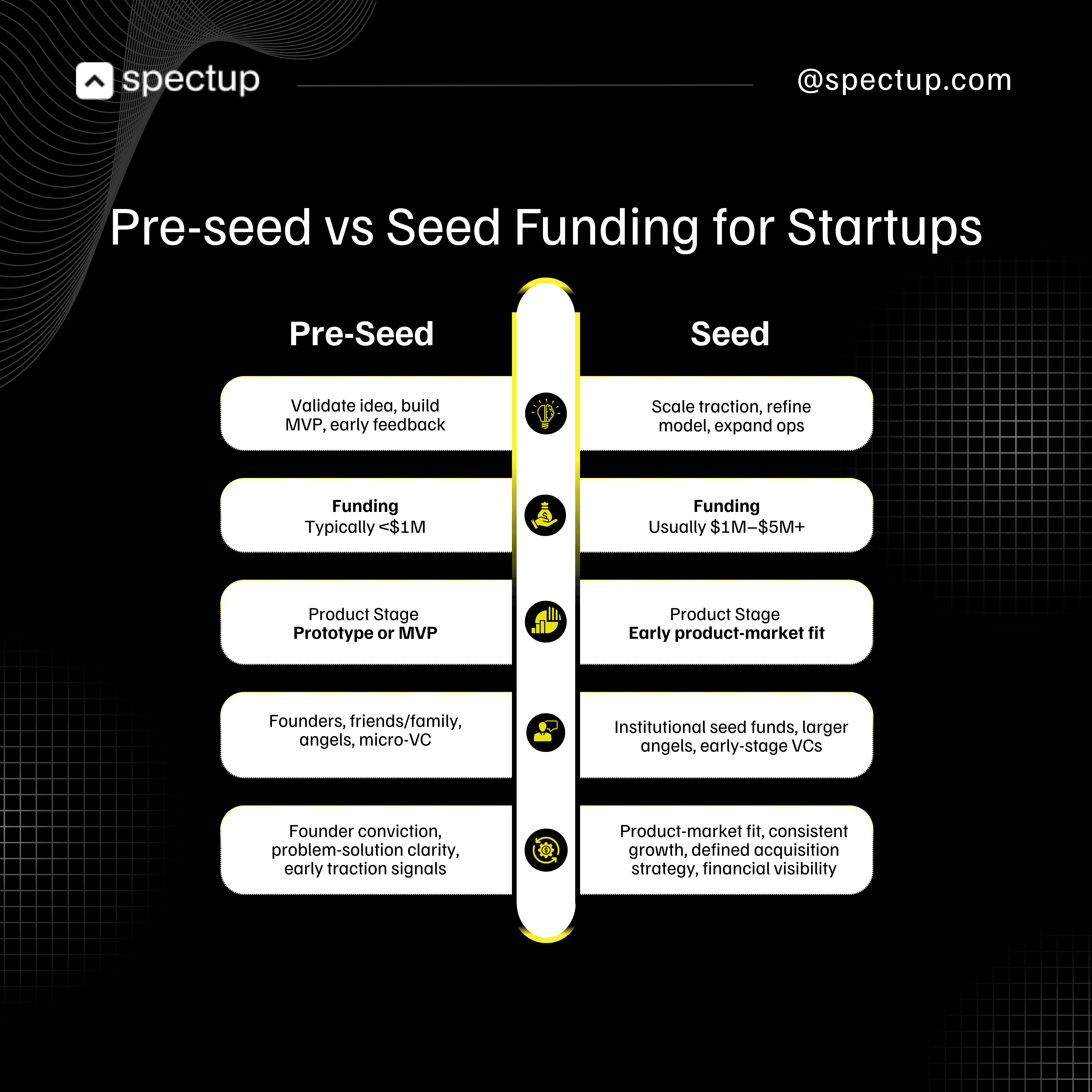
Here’s a quick table to compare pre-seed vs seed funding of startups:
Aspect | Pre-Seed Funding | Seed Funding |
Purpose | Validate idea, build MVP, early feedback | Scale traction, refine model, expand ops |
Funding Size | Typically <$1M | Usually $1M–$5M+ |
Product Stage | Prototype or MVP | Early product-market fit |
Investors | Founders, friends/family, angels, micro-VCs | Institutional seed funds, larger angels, early-stage VCs |
Investor Expectations | Founder conviction, problem-solution clarity, early traction signals | Product-market fit, consistent growth, defined acquisition strategy, financial visibility |
Why This Distinction Actually Matters?
Get your stage wrong, and everything breaks.
Pitch seed investors without proof points:
Retention metrics
Revenue traction
Validated acquisition channels, and they'll spot the gaps instantly.
Once you have the Pass, now you've burned an intro, wasted months, and word travels fast in investor circles. Reputation damage compounds.
But the opposite mistake hurts too.
Already have product-market fit
Consistent growth
Repeatable GTM
Raising pre-seed money means accepting a lower valuation and smaller check than you've earned. You're leaving capital on the table and diluting more than necessary.
The strategic advantage is simple: know exactly where you stand. Match your stage to the right investors with the right expectations at the right moment.
Misalignment costs you time, money, and credibility. Alignment gets you funded faster, at the valuation you deserve.
Pre-Seed or Seed? Find Your True Starting Point
Stop guessing. Your evidence tells you exactly where you stand.
Getting this wrong means pitching investors who'll never write a check, because you're not what they fund. Get it right, and you're speaking the same language from the first meeting. If you are having hard time in understanding where you actually stand, make sure to have financial modelling expert in your team before it starts getting out of hand.
The Four Questions That Decide are like Leaf Clover - Pushing your Luck to Close the Deals
1. What's the state of your product?
Here are the answers that will give you clarity on your standing:
Wireframes and slide decks? Pre-seed.
Functional MVP users can actually touch? Strong pre-seed funding stage.
Polished product with features, integrations, and real UX? You might be seed staged already.
The line: pre-seed funds building v1. Seed funds scaling what's validated.
2. Are people paying — or just interested?
Customers psychology tells in clear words whether the product or service should exist or it is just a fancy feature that is going to add nothing but noise.
10-50 pilot users giving feedback? Pre-seed validation.
$5K-$50K MRR with 80%+ retention? Seed territory.
Waitlists and excited beta users but no revenue? Still pre-seed, but good signals.
The metric: pre-seed proves people want it. Seed proves they pay for it repeatedly.
3. Is your GTM repeatable?
Here is how it should reflect and add clarity for you:
Every customer feels like a custom sale with no pattern? Pre-seed. You're still learning.
You can say "we spend $X on channel Y and get Z customers at A% conversion"? That's seed.
New hires can run your playbook without you? Definitely seed.
Pre-seed finds your first 10 customers. Seed systematizes the next 1,000.
4. Can your team scale beyond founder hustle?
The switch mode of Founders here is the guarantee to your success.
Founders doing everything, engineering, support, bookkeeping? Pre-seed mode.
Key hires in place with clear ownership? Seed-stage maturity.
Documented processes for hiring and onboarding? Thinking like a seed company.
Pre-seed teams prove they can build. Seed teams prove they can scale.
Four Proof Points That Say "Seed-Ready"
Here are the four clover points for seed stage specifically:
Sustained growth momentum.
15-25%+ monthly for 3-6 consecutive months.
Not a Product Hunt spike, real, repeatable traction across multiple channels.
Documented acquisition funnel.
You know exactly how prospects find you, convert, and pay.
CAC calculated by channel.
Conversion rates tracked.
Losers killed.
Unit economics that work.
LTV:CAC of 3:1 or better.
Churn under 5% monthly for B2B.
Gross margins above 50% for SaaS.
These are not any vanity metrics, but the clear and hot guns proof you understand your business.
Investor-ready financial model.
18-month forecast.
Scenario planning.
Headcount tied to milestones.
Clear definition of what success looks like 12 months post-seed.
The Bottom Line
Still testing, building MVPs, validating fit? Embrace pre-seed. Find investors comfortable with that risk.
Got the proof points above? You've graduated. Go raise seed. And if any hiccups arise, have spectup onboard before things start draining.
Your evidence makes the picture clear. Trust it.
Common Mistakes That Kill Pre-Seed and Seed Rounds
Most founders don't fail because of bad ideas. They fail because of bad timing and wrong targets.
1. Mixing Stages Too Early
Chasing seed money without product-market fit is like selling tickets to a concert before booking the venue. Investors see right through it.
Overstating traction when you've barely started?
That's claiming you've climbed the mountain when you're still lacing your boots.
Investors want milestones that match reality, not fantasy projections dressed up as progress.
2. Pitching the Wrong Investors
Emailing Sequoia when you've got a prototype and zero revenue? Waste of time. Institutional VCs want traction and scale. You're not there yet.
Meanwhile, angels and micro-VCs who specialize in early-stage? They're waiting for exactly your profile. and you're ignoring them. Match the investor to your stage, or keep collecting rejections.
3. No Milestone Map
Investors don't fund vague potential. They fund clear paths from here to there.
No defined KPIs between rounds?
No articulated journey from MVP to traction metrics? That's a red flag.
CAC, LTV, churn, growth rate, these aren't optional extras. They're proof you know how validation turns into scale.
Preparing to Actually Win
Build a data-driven narrative.
Match your pitch to your stage. Pre-seed?
MVP, early feedback, big vision. Seed?
Scaling traction, GTM motion, revenue growth. Back every claim with evidence, numbers, testimonials, pilot results. No data, no deal.
Nail your materials.
Pitch deck. Financial model. Key metrics.
These aren't formalities but the clear proof you understand your own business.
Get strategic help.
Fundraising is a skill. Advisors who've done it before can validate your metrics, sharpen your model, and connect you to stage-appropriate investors. The ROI is real.
Pre-seed vs seed stages for startups isn't semantics.
It's the difference between funded and floundering.
Think of fundraising like navigation. Pre-seed is your compass, pointing you toward validation. Seed is your engine, propelling you toward scale. Use the compass when you need the engine, and you'll spin in circles. Fire up the engine before you've found direction, and you'll accelerate straight into a wall.
Know your stage. Target investors who fund that stage. Tell the story your evidence actually supports, not the one you wish you could tell. Get this right, and fundraising becomes a system, not a scramble. Get it wrong, and you'll burn months chasing investors who were never going to say yes.
Ready to Stop Guessing?
At spectup, we help founders cut through the noise. Stage assessment. Investor targeting. Pitch refinement. Financial modeling. Everything you need to walk into the right rooms with the right story.

Niclas Schlopsna
Partner


Ex-banker, drove scale at N26, launched new ventures at Deloitte, and built from scratch across three startup ecosystems.